
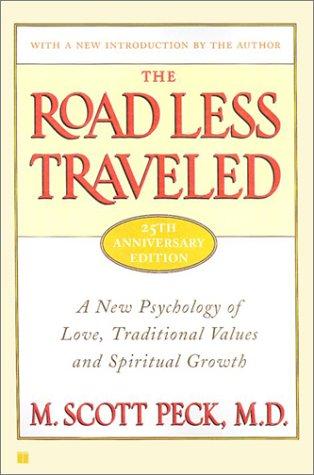
The Road Less Traveled
Simon & Schuster · 1978 · 320 pages
ISBN: 9780743243155
Review Editor
Sofia Reyes
M. Scott Peck opens his 1978 book with three words: “Life is difficult.” Not as complaint or lament, but as a statement he intends to clear the air with before saying anything else. That opening has kept readers coming back for nearly fifty years. The Road Less Traveled sold slowly at first, built through word of mouth, and eventually spent more than thirteen years on the New York Times bestseller list. It has sold over ten million copies in the United States alone. Its staying power comes not from easy answers but from something rarer in self-help writing: a willingness to sit with difficulty and argue that difficulty is, in fact, the point.
Peck was a psychiatrist working in the United States in the 1970s, and the book draws on his clinical practice throughout. Its full title, The Road Less Traveled: A New Psychology of Love, Traditional Values and Spiritual Growth, signals its ambition. Peck treats mental health and spiritual health as connected rather than separate, and his central argument, stated plainly and returned to across all four sections of the book, is that both require the same thing: the willingness to confront reality honestly, including the reality of one’s own limitations, failures, and obligations. This is not a comfortable book. It asks more of the reader than most self-help writing does, and it refuses to offer shortcuts.
The book divides into four parts. The first, Discipline, examines the tools necessary for confronting problems: delaying gratification, accepting responsibility, honesty, and balance. The second, Love, proposes a definition of love so demanding it startled many readers when the book first appeared. The third, Growth and Religion, addresses the spiritual dimension of mental health and asks why organized religion so often functions as a defense against growth rather than a support for it. The fourth, Grace, ventures into territory some readers find transcendent and others find puzzling, exploring what Peck calls the “miraculous” assistance that sometimes appears when people engage seriously with their own development. Together, the four sections build a framework that is more coherent than it initially appears, though it requires patience to see the architecture.
Character Arcs and Development
The central figures in this book are the patients from Peck’s practice, anonymized and compressed into case studies, and the reader themselves. Peck works in a tradition that treats human development as an ongoing project, and the vignettes he includes are not illustrations so much as arguments in narrative form. He shows us people who refuse to delay gratification, who assign responsibility for their circumstances to everyone but themselves, who cling to dependency and call it love. He shows us people who do the harder work. The contrast is deliberately unflattering, because Peck’s assumption is that the reader is probably somewhere in the first category more often than they would like to admit.
Among the most memorable figures is a woman he calls Mrs. A, who presents with what looks like depression and turns out to be a profound unwillingness to take responsibility for her own life. Peck does not present her as a failure so much as a person who has found it more comfortable to suffer than to change. She has organized her suffering into something manageable. This is a pattern Peck returns to repeatedly: the way people mistake familiar pain for safety and unfamiliar growth for danger. His other case studies are similarly specific and similarly uncomfortable, including a young man whose excessive dependency he diagnoses not as love but as emotional parasitism, and a successful executive whose surface competence conceals a complete unwillingness to examine his own assumptions.
Secondary figures include Peck himself, who appears as a character in some of the clinical narratives, sometimes struggling, sometimes wrong, occasionally humbled by a patient who sees something he missed. These moments of authorial honesty give the book a dimension that purely prescriptive self-help writing lacks. Peck is not describing a path he has already perfected. He is describing one he is also on.
Pacing
The book’s pacing is genuinely uneven, and that unevenness shapes the reading experience significantly depending on which sections resonate with you. The first part, Discipline, is the tightest. Peck makes his arguments in short, well-constructed sequences, and the clinical case studies anchor the abstractions in recognizable behavior. It reads like a good therapist working through a session: purposeful, attentive, moving forward with intention.
The second section, Love, is slower and more contentious. Peck’s definition of love requires patient exposition because it runs against so many received ideas about what love is and how it works. Some readers find this the most revelatory section of the book; others find it laborious. The third and fourth sections move into increasingly spiritual territory, and by the final chapters Peck is discussing grace, serendipity, and the “collective unconscious” in ways that sit at an angle to his earlier clinical precision. The book does not build to a tidy conclusion so much as it opens outward into larger questions. Whether that reads as a strength or a weakness depends considerably on what you hoped to find at the end.
Deeper Thematic Exploration
Peck’s central thesis is that most human suffering results not from circumstance but from avoidance. Problems are not the enemy. They are the mechanism by which growth happens. The discipline to confront them, sit with the discomfort they produce, and respond honestly rather than defensively is what mental health consists of. This is not an original idea, but Peck states it with particular clarity and backs it with enough clinical evidence that it resists the easy dismissal that attaches to softer self-help writing. His opening claim, “Life is difficult,” is not pessimism. It is a premise: if you accept that difficulty is the condition of human life rather than an aberration from it, you stop spending energy fighting that reality and can redirect it toward something more useful.
The section on love is the most philosophically ambitious part of the book and possibly the most controversial. Peck argues that what most people call love, the intense emotional state of being in love, is not love at all. It is a temporary dissolution of ego boundaries, a biological phenomenon that enables bonding but fades in nearly all cases within a few years. Genuine love, for Peck, is a decision and a practice: “the will to extend one’s self for the purpose of nurturing one’s own or another’s spiritual growth.” This definition is demanding to the point of being almost impossible by conventional standards, and Peck knows it. His argument is not that most people don’t care about each other but that they misunderstand what love actually requires. Falling in love is something that happens to you. Loving is something you do, repeatedly, against the grain of self-interest, because you have decided that another person’s growth matters as much as your own comfort.
The book also takes religion seriously in a way that neither dismisses it nor accepts it uncritically. Peck argues that everyone operates from a worldview that functions like a religion, whether or not they describe it that way, and that psychological maturity often requires challenging that worldview rather than defending it. He describes four stages of spiritual development, ranging from the chaotic and unprincipled through the rigidly institutional to the genuinely questioning and finally the mystical, and he argues that most people and most institutions prefer the second stage because it offers rules and certainty that the later stages refuse to provide. This framework is thought-provoking, though it has aged unevenly: the cultural landscape Peck wrote about in 1978 has shifted considerably, and some of his generalizations about organized religion reflect assumptions that no longer hold universally.
Style and Voice
Peck writes like a thoughtful, serious man who has spent years listening carefully to people in pain and has arrived at some conclusions he believes are true. The prose is not polished in a literary sense. It is clear, direct, and occasionally blunt in the way that genuine conviction can be blunt. He says what he means without softening it, and sometimes what he means is harder to read than easy reassurance would be. There are passages of real warmth, particularly in the sections on grace, where the clinical voice opens into something more personal and less certain. When Peck writes about moments of unexpected help appearing precisely when it was needed, he sounds less like a psychiatrist presenting data and more like a person who has been genuinely surprised by the world.
The book’s authority comes from its specificity. Peck does not deal in the generalities that fill most popular psychology writing. When he makes a claim about human behavior, he grounds it in someone he has sat with in a consulting room. The details he includes, the patient who cannot get out of bed, the executive who bullies subordinates while telling himself he is managing them, the person who talks about God every Sunday and uses religious language to avoid genuine self-examination, are precise enough to function as argument rather than decoration. This grounding separates The Road Less Traveled from the many books it helped inspire, many of which traded his clinical rigor for something more accessible and considerably less honest about how hard the work actually is.
Verdict
The Road Less Traveled is not a comfortable book, and that is inseparable from its value. Readers who want encouragement without challenge will find it difficult. Readers who want simple answers to hard questions will find it insufficient. But readers willing to sit with the possibility that much of their suffering is at least partly chosen, and that the path toward something better requires engaging that suffering directly rather than avoiding it, will find here one of the most genuinely useful books written in their genre. It is not the most graceful book on its shelf. It is one of the most honest.
Its limitations are real: the spiritual sections will lose some readers, certain psychological frameworks have not aged well, and Peck’s confidence in his own conclusions occasionally tips into a certainty that sits uneasily beside the openness he advocates for in others. But the core argument holds across five decades because it describes something fundamental about how people avoid growth and what it costs them. You don’t need to share Peck’s religious convictions to find the framework useful, and you don’t need to agree with everything he says about love to recognize that he has identified something real about the difference between dependency and genuine care. Start with the first section. See where it takes you.
Frequently Asked Questions about The Road Less Traveled
What is The Road Less Traveled by M. Scott Peck about?
The Road Less Traveled is a 1978 book by psychiatrist M. Scott Peck arguing that mental and spiritual health both require the willingness to confront problems honestly rather than avoid them. Divided into four sections (Discipline, Love, Growth and Religion, and Grace), it draws on Peck’s clinical practice to examine how people organize their lives around avoidance, why that strategy fails, and what it looks like to take responsibility for one’s own development instead. The book opens with one of the most quoted sentences in self-help literature: “Life is difficult.”
Who was M. Scott Peck and what made him qualified to write this book?
Morgan Scott Peck (1936-2005) was an American psychiatrist who trained at Harvard and Case Western Reserve University and worked extensively as a therapist before writing this book. He later served as a consultant to the U.S. Army Surgeon General. The Road Less Traveled draws directly on his clinical experience, and the case studies throughout reflect years of sitting with patients across a wide range of psychological difficulties. He wrote several subsequent books, including People of the Lie (1983) and Further Along the Road Less Traveled (1993).
What are the main themes in The Road Less Traveled?
Four themes run through the book. First: problems and suffering are not obstacles to life but the material life is made of; growth requires engaging them rather than avoiding them. Second: love is a decision and a practice, not a feeling; genuine love means consistently choosing another person’s growth over your own comfort. Third: spiritual development and psychological development are not separate tracks but the same track; genuine maturity eventually requires questioning the worldview you inherited. Fourth: unexpected help appears to people who are genuinely doing the work, and recognizing it requires a kind of openness Peck calls attention to grace.
How long is The Road Less Traveled and how difficult is it to read?
The book runs approximately 320 pages across its four sections. The prose is clear and direct rather than academic, though Peck does not write in the breezy style of contemporary self-help books. The clinical sections read quickly; the philosophical and spiritual sections in the second half require more patience. Most readers can finish it in a week of casual reading, though many report needing to stop and think after certain passages. It is not a difficult read in the technical sense, but it is a demanding one in the sense that it asks you to apply its arguments to your own life while you are reading it.
Is The Road Less Traveled still relevant in 2024?
The core argument has aged well precisely because it does not depend on specific cultural conditions. The observation that people avoid growth by avoiding difficulty describes something constant in human psychology, and Peck’s clinical examples remain recognizable. Some of the religious and cultural assumptions from 1978 have dated, and a few of the psychological frameworks he employs have been revised or challenged since publication. Read it as a serious argument rather than a manual, and the ideas that hold up are still worth the encounter. Time magazine included it in its list of 100 Best Nonfiction Books, and its readership has not declined significantly in decades.
What does M. Scott Peck mean when he says “Life is difficult”?
Peck intends this as a liberating observation rather than a depressing one. His argument is that most human suffering comes not from difficulty itself but from the expectation that life should not be difficult. Once a person genuinely accepts that problems are a normal and permanent feature of human existence rather than aberrations to be eliminated, they stop spending energy on resistance and can redirect it toward actually solving or engaging with those problems. The statement is the foundation of his entire framework: you cannot learn to confront problems honestly until you stop treating their existence as an injustice.
How does The Road Less Traveled define love, and do most people agree with it?
Peck defines love as “the will to extend one’s self for the purpose of nurturing one’s own or another’s spiritual growth.” He distinguishes this from falling in love (which he treats as a biological phenomenon, not an act of will), dependency (which he argues is often mistaken for love), and self-sacrifice that does not actually serve growth. His definition is demanding enough that he essentially argues most people experience love far less often than they think they do. It has drawn both admiration and criticism: admirers find it clarifying, critics find it so demanding as to be unrealistic. The debate it provokes is itself a reasonable test of how seriously the reader wants to engage with his argument.
Should I read The Road Less Traveled, and who is it not right for?
Read it if you are willing to be challenged rather than comforted, and if you are open to the idea that psychological and spiritual questions are connected. The book rewards readers who are at a genuine crossroads or who sense that something in their life is not working and want a framework for understanding why. It is not right for readers who want quick practical techniques, who are not interested in the spiritual dimensions of human development, or who find Peck’s clinical confidence off-putting. It is also not a crisis resource; it is a book for relatively stable readers willing to do extended reflective work. At its best, it is one of the most serious conversations self-help literature has ever offered.
Book Details
- Title
- The Road Less Traveled
- Author
- M. Scott Peck
- Genre
- Self-Help
- Publisher
- Simon & Schuster
- Year Published
- 1978
- Pages
- 320
- ISBN
- 9780743243155
- WritersReview Rating
- 4.1 / 5