
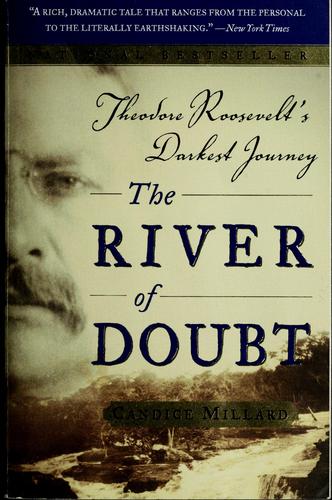
The River of Doubt
Broadway Books · 2005 · 416 pages
ISBN: 9780767913737
Review Editor
Thomas Calloway
Candice Millard’s debut book arrived in 2005 with a premise that sounds almost too dramatic to be true: former President Theodore Roosevelt, after losing his 1912 bid to return to the White House, decided to do the next logical thing. He plunged into the unmapped Brazilian Amazon with a team of Brazilian soldiers, American naturalists, and his own son Kermit, to chart a thousand-mile river nobody outside its indigenous inhabitants had ever navigated. He nearly died doing it.
The River of Doubt: Theodore Roosevelt’s Darkest Journey follows the Roosevelt-Rondon Scientific Expedition from its launch in late 1913 through months of brutal jungle travel in 1914. The River of Doubt (Rio da Dúvida) was a genuine blank on the map, and Roosevelt wanted to be the one to fill it in. His partner was Cândido Rondon, a revered Brazilian army officer and veteran Amazon explorer who had spent years mapping territory that no cartographer had reached. Together, with a team of about twenty men and a flotilla of dugout canoes, they set out to follow the river to wherever it ended.
What followed was one of the most dangerous expeditions of the twentieth century. The party faced piranhas, rapids that destroyed their canoes, malaria and other tropical diseases that felled men one by one, an indigenous tribe they could hear but never see, and near starvation. Then one member of the expedition killed a comrade and fled into the jungle, leaving the rest to make decisions that had no good answers. Roosevelt himself suffered a serious leg wound that became infected and consumed him with fever. At one point he told his son Kermit to leave him behind and go on without him. He was fifty-five years old, and the Amazon nearly finished what an assassin’s bullet had failed to do two years earlier.
Character Arcs and Development
Roosevelt himself is the most compelling figure here, partly because Millard resists turning him into pure legend. The man who arrives in Brazil is already past his physical peak. The presidency and the years of campaigning had taken a toll, and the jungle had a way of exposing what a more forgiving environment could conceal. His determination never wavers, even as his body betrays him. The scene where he tells Kermit to leave him to die is genuinely affecting precisely because you understand how fiercely he would have resisted that thought. Roosevelt comes across as someone who chose this journey partly to prove he could still do it, and who found out what proving yourself costs when the jungle does not care about your credentials.
Kermit Roosevelt is the book’s quiet hero. He was twenty-three, recently engaged, and had every reason to be somewhere safer. He stayed, and more than once his presence kept his father from giving up entirely. Millard shows the bond between them rather than explaining it, which is the right choice. The scenes where Kermit watches his father with the combination of love and barely concealed alarm are some of the most human moments in the narrative.
Cândido Rondon is the figure who deserves more attention than he usually gets in accounts of this expedition. He had spent years in the Amazon and developed a policy unusual for the time: his teams never fired on indigenous tribes, even in self-defense. The reasoning was long-term. Punitive expeditions bred cycles of violence; peaceful contact, maintained at personal cost, was the only path toward eventual trust. That policy required discipline from every man under his command and genuine moral conviction from Rondon himself. He comes across as steady and purposeful in a situation that would unmoor most people, and his influence on the expedition’s outcome was at least as significant as Roosevelt’s will to survive.
Pacing
Millard builds tension by intercutting the main expedition narrative with chapters on Amazonian natural history: the behavior of piranhas, the biology of tropical disease vectors, the physics of the rapids the men had to portage around. These sections slow the pace intentionally. When the story returns to the men in their canoes, the contrast between the indifferent natural world churning around them and their increasingly desperate situation lands harder. The book’s middle third is its most effective: the canoes are being destroyed, men are getting sick, food is running out, and the river is showing no sign of ending. Millard knows when to pull back and when to close in, and she does not rush the resolution.
The early chapters, which spend considerable time on Roosevelt’s political career and his loss to Woodrow Wilson, are useful context but occasionally feel like a long on-ramp. The expedition itself is urgent enough to have carried its own weight from the first page.
Deeper Thematic Exploration
The book’s deepest question is what compels certain people to attempt things that could kill them when they have nothing left to prove. Roosevelt had been president. He had explored Africa. He had written dozens of books and become one of the most famous men in the world. No one would have thought less of him for spending his post-political years comfortably. He chose not to. The Amazon expedition was not practical or strategic or well-organized. It was something closer to a compulsion: a refusal to let the chapter of physical adventure close, and a test of whether the self-image he had built over decades still held.
Millard lets the irony sit quietly. The man who built his reputation on vigor and toughness spent weeks of the expedition either delirious with fever in the bottom of a dugout canoe or unable to walk without help. The jungle does not grant exceptions for former presidents. What Roosevelt discovers is that the thing that drove him toward risk his whole life was real, but it no longer came with the physical capacity to absorb the consequences. That tension, between will and body, gives the book a dimension that a straightforward adventure narrative would not have.
There is also a thread about colonialism and contact that Millard handles with more care than most adventure histories from this period would require. Rondon’s approach toward indigenous peoples represents one possible alternative to the extractive and often violent model that characterized most Western contact with Amazonian tribes. The expedition passed through territory where tribal observers watched from the riverbanks without making sustained contact. The fact that Rondon’s discipline kept his men from firing first meant that something other than the usual pattern could at least exist. It is a small strand in the narrative, but it gives the book a moral texture that earns its place alongside the survival story.
Style and Voice
Millard writes with the pacing of thriller fiction and the precision of careful scholarship. Her sentences are clean and direct, consistently in the active voice, which keeps the narrative moving through sections that could easily have turned heavy. Her gift is making natural history readable: the chapters on piranhas and tropical fever do not feel like detours because she writes the Amazon itself as an antagonist with its own logic and behavior. The river is not backdrop. It has agency.
Her prose works best when it grounds itself in physical specificity: the weight of the waterlogged canoes, the sound of rapids the men can hear before they can see them, the particular misery of a leg wound advancing in a body with no reserves left. She resists the impulse to overdescribe, which in one of the world’s most visually overwhelming environments requires real discipline. The result is a narrative that trusts its reader to fill in the sensory details from what the text provides.
Verdict
The River of Doubt succeeds as adventure narrative, as biography, and as natural history, holding all three together without compromising any of them. Readers who enjoy narrative nonfiction that moves with purpose and treats its subject with genuine intellectual seriousness will find this exactly what they are looking for. The early chapters require some patience, and the natural history sections occasionally interrupt momentum at inopportune moments. Those are modest complaints about a book that delivers on its central promise: it puts you on that river, in those canoes, watching the provisions run low, and makes you feel the weight of every remaining mile.
If you have any interest in Roosevelt, in exploration narratives, or in popular history that respects both its subject and its audience, this belongs on your reading list. Readers who finish it and want more will find Millard’s later books, Destiny of the Republic and Hero of the Empire, in the same tradition and just as satisfying.
Frequently Asked Questions about The River of Doubt
What is The River of Doubt by Candice Millard about?
The River of Doubt tells the true story of Theodore Roosevelt’s 1914 expedition down an uncharted Amazon tributary called the Rio da Dúvida (River of Doubt). After losing the 1912 presidential election, Roosevelt partnered with Brazilian explorer Cândido Rondon for a thousand-mile journey through unmapped jungle. The team faced disease, starvation, treacherous rapids, and an internal murder before completing the expedition. The river was eventually renamed the Roosevelt River in honor of the former president.
Is The River of Doubt based on a true story?
Yes, entirely. Millard researched the book using expedition journals, newspaper accounts, letters, and historical records. Every major event she describes, including the killing of one soldier by another, Roosevelt’s near-fatal leg infection, and the repeated destruction of their canoes on the rapids, is documented in the historical record. Her bibliography and notes section provides detailed sourcing for readers who want to investigate further.
What are the main themes in The River of Doubt?
The book explores at least four interlocking themes: the human compulsion toward risk and exploration even after external pressure to pursue it has disappeared; the limits of willpower when the body cannot match it; the relationship between Western expeditions and indigenous Amazonian peoples, particularly through the lens of Rondon’s policy of non-violence; and the nature of loyalty under extreme conditions, especially between Roosevelt and his son Kermit. The natural world itself functions as a fifth presence, indifferent and overwhelming.
How long is The River of Doubt and is it a difficult read?
The main narrative runs about 320 pages, with extensive notes and bibliography bringing the total closer to 416 pages. It reads quickly; Millard writes accessible prose aimed at general readers rather than specialists. The natural history sections require no scientific background. Most readers comfortable with popular nonfiction will finish the book in three or four sittings without difficulty.
Is there a movie or TV adaptation of The River of Doubt?
No film or television adaptation was in release as of early 2026. The book’s cinematic qualities, a former president, a deadly river, murder, disease, and survival against the odds, have attracted Hollywood interest, and adaptation rights have been explored over the years. Check current entertainment sources for the latest status on any announced production.
Who was Cândido Rondon and why does he matter in this story?
Cândido Rondon was a Brazilian army officer and one of the great Amazon explorers of the early twentieth century. He had spent years mapping uncharted territories and enforced a firm policy: his teams would never fire on indigenous tribes, even in self-defense. This made him an unusual and principled figure in the history of Amazonian contact. In the expedition, his experience and steady leadership were essential to the group’s survival, and Millard gives him the attention he deserves in a story often told primarily through Roosevelt.
How does The River of Doubt compare to Candice Millard’s other books?
Millard’s other major works are Destiny of the Republic (2011), about President James Garfield’s assassination and the doctors who may have done more damage than the gunshot wound, and Hero of the Empire (2016), about Winston Churchill’s capture and escape during the Boer War. All three books share a structure: a famous historical figure in mortal danger, surrounded by a vivid cast, in a narrative that reads like fiction while remaining scrupulously documented. The River of Doubt has the energy of a debut, with the freshest sense of discovery. Readers who enjoy any one of the three will find the others equally absorbing.
Should I read The River of Doubt and is it worth the time?
If you enjoy narrative history that moves with real purpose and takes both its subject and its reader seriously, yes. Readers who appreciated Erik Larson’s The Devil in the White City or Jon Krakauer’s Into Thin Air will find Millard working in the same tradition: serious research delivered with genuine narrative tension. If you come primarily for Roosevelt the politician, be aware the book focuses on one expedition and spends relatively little time on his presidency. As a portrait of what Roosevelt was at his core, though, it turns out to be more revealing than most political biographies.
Book Details
- Title
- The River of Doubt
- Author
- Candice Millard
- Genre
- History
- Publisher
- Broadway Books
- Year Published
- 2005
- Pages
- 416
- ISBN
- 9780767913737
- WritersReview Rating
- 4.4 / 5