
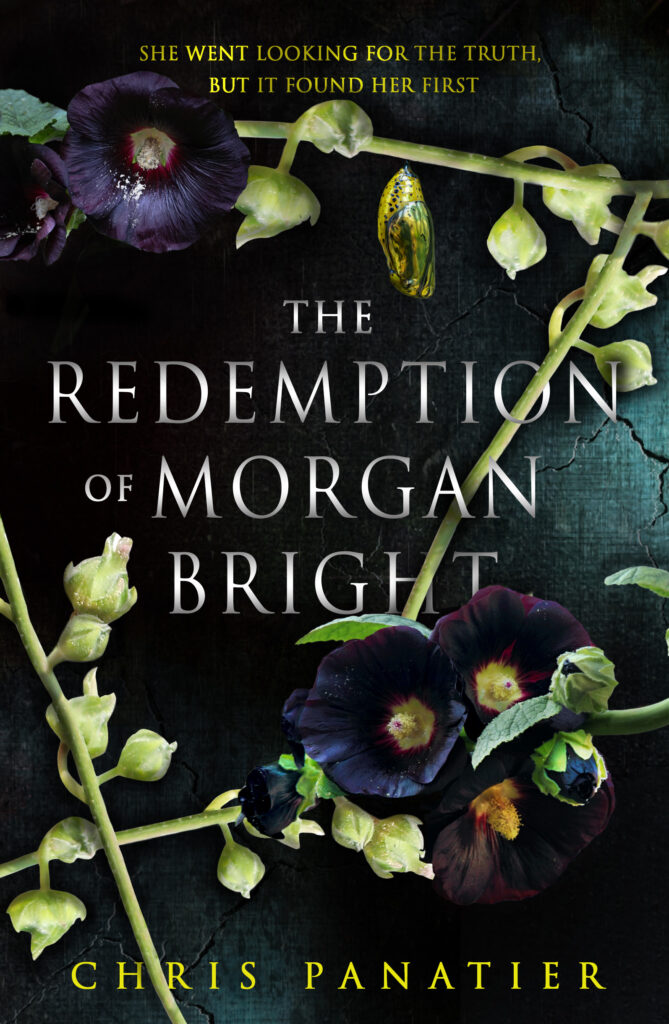
The Redemption of Morgan Bright
Angry Robot · 2024 · 400 pages
ISBN: 9781915202895
Review Editor
Marcus Webb
An Asylum of Mirrors
Chris Panatier’s The Redemption of Morgan Bright is the kind of novel that earns its horrors honestly. Published in 2024 by Angry Robot, it follows Morgan Bright, a woman who checks herself into Hollyhock Asylum under a false identity in order to uncover the truth behind her sister Hadleigh’s death. What begins as a controlled investigation into an institution’s secrets becomes something far more destabilising, as Morgan finds the boundary between patient and investigator, between Charlotte Turner and herself, dissolving under the asylum’s peculiar pressures. Panatier constructs a book of genuine psychological menace, working the epistolary form into a vehicle for mounting uncertainty, and delivering a story where the atmosphere of wrongness seeps through every document, letter, and clinical note.
The novel sits comfortably alongside recent works that treat mental health institutions as sites of social horror rather than mere gothic backdrop. Panatier is not interested in easy vilification of psychiatry, but in how systems of care can be weaponised, and how the label of instability can be deployed to erase inconvenient people. Morgan’s mission to find out what happened to Hadleigh is grounded in love and grief, but the reader quickly understands that Hollyhock is not an ordinary asylum, and that Morgan’s false identity may not be her most dangerous vulnerability going in.
Plot and Structure
The plot of The Redemption of Morgan Bright unfolds through a layered epistolary architecture: case files, journal entries, inter-departmental memos, and fragments of correspondence stack up to create a picture that is at once official and deeply unreliable. Morgan enters Hollyhock as Charlotte Turner, presenting a rehearsed history, and the novel charts both her investigation into the institution’s practices and her gradual psychological unmooring. As she digs deeper into what happened to Hadleigh, she finds evidence of something that cannot be explained by negligence or ordinary cruelty alone.
Panatier is skilled at withholding and revealing in equal measure. The epistolary structure means the reader is never in possession of the full picture at any given moment; instead, each new document recontextualises what came before, creating a reading experience that mirrors Morgan’s own fractured understanding of her situation. The novel’s three-act movement builds toward a conclusion that is genuinely disturbing, one that feels earned rather than manufactured. The pacing is deliberate and assured, and the decision to embed genre horror within the administrative language of institutional care gives The Redemption of Morgan Bright a distinctive voice among recent horror and dark speculative fiction.
Character and Atmosphere
Morgan Bright is a compelling protagonist precisely because her competence is not a guarantee of safety. She has prepared, she has a plan, and she has genuine purpose in finding out what the asylum did to her sister. Yet Panatier is careful to show how even the most prepared person can be worn down by an environment designed to question their perceptions. Charlotte Turner, Morgan’s cover identity, becomes increasingly difficult to maintain as Hollyhock’s routines, its staff, and its other patients begin to reshape her responses and reactions.
The supporting cast is drawn with care. The staff of Hollyhock range from the merely complicit to the actively sinister, and Panatier resists the temptation to make them into cardboard villains. The fellow patients Morgan encounters are rendered as full human beings with histories and vulnerabilities of their own, which gives the novel’s horror an ethical weight: the violence being done at Hollyhock is not abstract. The institution itself functions as a character, the building and its rhythms carrying menace in the way the best horror locations do, a place where ordinary things have been made wrong.
Themes and Ideas
At its core, The Redemption of Morgan Bright is a novel about the politics of credibility. Who gets to decide what is real? Whose account of events is treated as reliable? The asylum, as a setting, makes these questions immediate and urgent: the very act of being institutionalised can strip a person of their claim to accurate perception, and Panatier explores this dynamic with rigour. Morgan’s false identity creates a particular kind of double bind, one in which she cannot easily assert her sanity without drawing attention to the lie at her centre.
The novel also grapples with grief and the limits of loyalty. Morgan’s mission is motivated by love for Hadleigh, but the book does not romanticise this. The quest for truth in the face of institutional denial is shown as costly, psychologically and otherwise. Panatier is interested in what people destroy in themselves in the pursuit of justice, and in whether the truth, once discovered, can actually redeem anything. The title’s promised redemption is not straightforwardly delivered, which is to the novel’s considerable credit. This is a book that trusts its readers to sit with ambiguity.
Narrative Craft
The epistolary form in The Redemption of Morgan Bright is not ornamental. Panatier uses it to create a reading experience where authority and authenticity are always in question: every document has an author with a perspective, and the gaps between documents are as telling as what is written. Clinical language coexists with raw personal testimony, and the friction between these registers generates much of the novel’s unease. Panatier writes the bureaucratic voice with dark fluency, producing intake forms and clinical assessments that are chilling in their calm certainty.
There is also a formal wit at work here: the novel is aware of itself as a collection of documents, and plays with the reader’s instinct to trust or distrust particular sources. By the time the shape of what happened to Hadleigh becomes clear, the reader has been put through a version of the same epistemological confusion that Morgan experiences. This is technically demanding to pull off, and Panatier manages it with confidence. The result is a novel that feels genuinely unnerving rather than conventionally scary, the kind of horror that stays with you because it has lodged something true about vulnerability and institutional power.
Final Verdict
The Redemption of Morgan Bright is a strong, distinctive piece of dark speculative fiction. Chris Panatier uses the epistolary form not as a stylistic flourish but as a structural necessity, one that puts the reader inside Morgan’s escalating uncertainty in a way that straight narration could not achieve. The novel is intelligent about power, grief, and the way institutions can rewrite reality for those inside them. It is also, at the level of plot, a gripping read with genuine menace and a payoff that feels hard-won. Recommended for readers who like their horror cerebral, their structures ambitious, and their endings willing to resist easy comfort.
Who is Morgan Bright?
Morgan Bright is the novel’s protagonist, a woman who goes undercover at Hollyhock Asylum using the false identity of Charlotte Turner. Her goal is to discover the truth behind her sister Hadleigh’s death, which she believes the institution is concealing.
What is Hollyhock Asylum?
Hollyhock Asylum is the central setting of the novel, a psychiatric institution that presents a respectable face to the outside world while concealing deeply disturbing practices within. It functions as both a physical location and a symbolic space where the powerful define reality for the vulnerable.
What does “epistolary” mean and how does it work in this novel?
An epistolary novel is one told through documents: letters, diary entries, records, reports. In The Redemption of Morgan Bright, the story unfolds through case files, clinical notes, journal entries, and correspondence, which means the reader assembles the truth from partial and unreliable sources, mirroring the disorientation Morgan herself experiences.
Is this primarily a horror novel or a thriller?
The Redemption of Morgan Bright blends both genres. It carries the investigative momentum of a thriller and the escalating dread of psychological horror, with elements of speculative and dark science fiction woven through the institutional premise. Readers who enjoy work at the intersection of these genres will find it rewarding.
What happened to Hadleigh?
The question of what happened to Hadleigh drives the entire novel. Morgan’s investigation gradually uncovers the layers of what the institution was doing to patients, and the full picture is revealed through the accumulation of documents and testimony across the book. Hadleigh’s fate is central to the story’s emotional and thematic core.
How does identity function as a theme?
Morgan’s undercover identity as Charlotte Turner becomes increasingly difficult to maintain as the asylum works on her perceptions and responses. The novel explores how identity is not a fixed possession but something that can be destabilised by external systems, particularly institutions that have the authority to define who a person is.
Is The Redemption of Morgan Bright part of a series?
The Redemption of Morgan Bright stands alone as a complete narrative. It is Chris Panatier’s second novel following his debut Stringers, published by Angry Robot in 2021, and it can be read without prior knowledge of his other work.
Who will enjoy The Redemption of Morgan Bright?
This novel is ideal for readers who enjoy psychologically complex horror, unreliable narrators, and formally inventive structures. Fans of dark institutional fiction, epistolary novels, and speculative work that takes social power seriously will find it particularly compelling.
Book Details
- Title
- The Redemption of Morgan Bright
- Author
- Chris Panatier
- Genre
- Science Fiction
- Publisher
- Angry Robot
- Year Published
- 2024
- Pages
- 400
- ISBN
- 9781915202895
- WritersReview Rating
- 4.0 / 5