
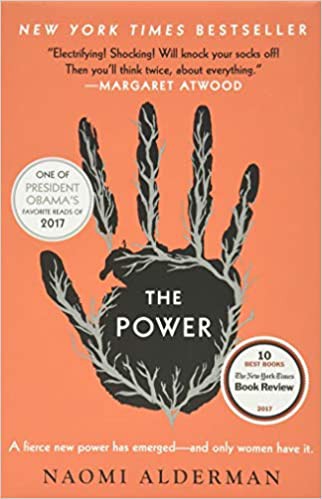
The Power
Little, Brown and Company · 2017 · 352 pages
ISBN: 9780316547611
Review Editor
Marcus Webb
Summary
The Power begins with a premise that sounds like wish-fulfillment and delivers something considerably more complex. Women and girls around the world discover they have developed a biological ability: they can conduct electricity through their bodies and release it at will, ranging from a mild shock to a lethal charge. The ability can be awakened in older women by the young. Within a few years, the physical dominance that has structured human society for millennia has inverted, and the world is remaking itself in the image of the newly powerful.
Naomi Alderman tells this story through four primary viewpoints: Roxy, the daughter of a London crime boss who discovers her power is unusually strong; Allie, an American teenager in an abusive foster home who becomes the founder of a new religion; Tunde, a Nigerian-British young man who travels the world documenting the change as a journalist; and Margot, an American politician whose pragmatic response to the new power structure shapes her career and her family. Around them, the world reshapes itself in ways that are sometimes liberatory, sometimes terrifying, and consistently illuminating about the relationship between physical power and the structures of civilization.
The novel is framed as a work of historical fiction written by a man named Neil, who has discovered these events in the distant past and is writing about them for an academic audience. The frame functions as a mirror held up to every historical narrative written by members of dominant groups about the societies they dominated, and the questions it raises about whose account we trust and why are part of the novel’s essential argument.
Character Arcs and Development
Roxy’s arc is the novel’s most visceral. She begins witnessing her mother’s murder and discovering her power in the same moment of trauma. Her trajectory through the criminal underworld, into political alliance with Allie, and eventually toward something like wisdom is violent, specific, and refuses sentimentality. Roxy is not a good person in any comfortable sense, but she is a fully realized person whose choices are comprehensible even when they are appalling, and whose final choices are among the most unexpected and moving in the novel.
Allie, who renames herself Mother Eve, is the novel’s most complex and disturbing creation. She begins as a victim of abuse who discovers both power and a divine voice in her head that may be God or may be her own survival intelligence speaking in theological language. Her construction of a new religion around the power is presented with genuine moral ambiguity; readers will disagree about whether she is a visionary, a manipulator, or simply someone doing what humans always do when they find themselves with power greater than they expected.
Tunde’s perspective is crucial. As a man documenting the change, he experiences the world’s inversion from the outside, and his trajectory, from excited documentarian to something considerably more frightened, tracks the novel’s darkening emotional register. His chapters function as a kind of emotional thermometer for the reader, tracking how it feels to occupy the newly subordinate position.
Margot is the politician’s politician: pragmatic, effective, and increasingly willing to compromise. Her arc is perhaps the most recognizable to contemporary readers, the progressive figure making deals with power while telling herself the deals serve larger goods. Alderman is not entirely unkind to her, but she is honest about the costs of that mode of navigation.
Pacing
The novel spans roughly ten years, covering the initial discovery of the power through its gradual normalization and finally the collapse of the old order and the construction of something new and not obviously better. Alderman manages this span with considerable skill, accelerating and decelerating as the narrative requires and using the four perspectives to create counterpoint rather than redundancy.
The pacing becomes more urgent as the implications of the power’s existence become more extreme. The middle sections have a documentary quality that makes them feel comprehensive rather than selective. The final sections are grimmer and faster, as consequences that were always implicit become explicit and unavoidable. The novel does not flinch from those consequences, which is one of the things that makes it essential rather than merely interesting.
Deeper Thematic Exploration
The novel’s central argument is that power corrupts regardless of who holds it, and that a world controlled by women is not automatically a better world. It is a world with different people in control and the same basic dynamics of dominance and submission, violence and coercion. This is not pessimism about human nature; it is a precise argument about the difference between changing who has power and changing the structures through which power is exercised.
The comparison with Margaret Atwood’s The Handmaid’s Tale is inevitable and instructive. Where Atwood depicts a society that has doubled down on existing patriarchal logic, Alderman depicts what happens when that logic is inverted. The conclusion is that the logic itself is the problem. What Alderman constructs is not an argument that women should not have power, but that anyone should not have unchecked power, and that any structure making systematic domination possible will be used for systematic domination by whoever controls it.
The religious thread of the novel is particularly rich. Allie’s new religion is constructed with the same mechanisms as every historically successful religion: charismatic founder, revelation experience, theology that maps the divine onto the social arrangements of the moment. The fact that those arrangements are now different from historical norms does not make the resulting theology any less a rationalization of power. Alderman, who has written extensively about Judaism and religious structures, brings genuine depth to this material.
Style and Voice
Alderman writes with precision and intelligence, and her prose serves the novel’s intellectual ambitions without becoming academic. The four voices are distinct without being exaggerated, and the shift between them creates a sense of the story being larger than any single perspective can contain, which is precisely the effect she is after. The structural work in this novel is as impressive as the prose: managing four viewpoints over a decade of accelerating change is a significant technical achievement.
The epistolary frame, the letters between “Neil” and “Naomi” that open and close the novel, is where the book’s wit is most concentrated. The conversation between these two fictional writers enacts the novel’s argument at a remove, demonstrating how completely the frame of who-is-speaking determines what we see as normal and what we see as extraordinary. It is the kind of structural cleverness that earns its own weight.
Verdict
The Power is one of the most important works of speculative fiction published in the twenty-first century, and its importance has only increased as the specific political and social concerns it addresses have become more acute. It is not a comfortable book, and it is not designed to be. It uses the tools of science fiction to make an argument about power and its consequences that history has repeatedly made and that we have repeatedly failed to absorb.
It is also a gripping narrative with fully realized characters, a constructed world that is horrifying precisely because of how recognizable it is, and a structural ingenuity that rewards close reading. Its Baileys Women’s Prize was entirely deserved, and its ongoing relevance is either a tribute to Alderman’s prescience or a reflection of the slowness with which the real world moves. It is worth reading for both reasons, and for the quality of the fiction itself.
Five stars: essential, challenging, and essential precisely because it is challenging.
Is The Power feminist fiction?
Yes, though its specific feminist argument is more complex than the premise might suggest. The novel is not a celebration of female power; it is an examination of what happens when the mechanisms of patriarchal domination are run by different people. Its conclusion, that those mechanisms produce the same results regardless of who operates them, is a feminist argument in the tradition of structuralist critique: the problem is not who is in charge, it is the structure of the system.
Is this related to The Handmaid’s Tale?
Not directly in terms of narrative, but very much so in terms of tradition and dialogue. Margaret Atwood was Alderman’s mentor during the writing of the book, and the novels are in explicit conversation. Where Atwood depicts the intensification of patriarchal logic, Alderman depicts its inversion. Reading them together is particularly illuminating, though each stands independently.
How violent is The Power?
Significantly, and with purpose. The violence in the novel is not gratuitous but is used to make the argument about power and domination in the most direct possible way. Some readers will find certain passages difficult. The novel is not exploitative, but it does not look away from the consequences of what it depicts. Readers who prefer speculative fiction that keeps physical violence in the background should be aware that this book does not.
What is the framing device in The Power?
The novel is presented as a work of historical fiction written by a man named Neil in a society in which women are dominant, sent to “Naomi” for comment. The letters between them at the opening and close of the novel raise questions about whose account of history we trust and why, and the correspondence is quietly very funny in ways that become more apparent on rereading after finishing the main narrative.
Does the novel have a hopeful ending?
The novel’s ending is ambiguous in a carefully constructed way. The main narrative does not end happily for most of its characters, and the world it leaves behind is not obviously better than the one it began with. The frame narrative offers a different and more complex kind of hope, but only if the reader engages with what the frame is actually arguing. This is not a feel-good book, but it is a book that takes seriously the possibility that understanding is the beginning of change.
Is The Power based on real science?
The biological mechanism Alderman invents, a new organ called the skein that generates and channels electricity, is speculative rather than scientifically grounded. Electric fish and eels do have biological electricity-generating organs, so the premise is not entirely without scientific basis. The novel is not interested in justifying the premise scientifically; it is interested in what the premise reveals about social structures when taken seriously as an imaginative experiment.
What is the significance of religion in The Power?
Religion functions in the novel as both a social mechanism and a thematic mirror. Allie’s construction of a new religion around the power demonstrates how theology is always partly a rationalization of existing power arrangements: God resembles whatever the powerful need God to resemble. The critique extends to historical religions through the inversion, suggesting that the gendered theologies of actual human history are similarly constructed. This is a serious religious-studies argument wrapped in speculative fiction.
Who should read The Power?
Anyone interested in feminist theory, political philosophy, or speculative fiction should read it. It is also an ideal choice for readers who found The Handmaid’s Tale compelling and want to see the same territory approached from a different angle, and for readers interested in how religious movements form and consolidate power. It is not appropriate for readers who want comfortable resolutions or who are averse to depictions of violence used as argument.
Book Details
- Title
- The Power
- Author
- Naomi Alderman
- Genre
- Science Fiction
- Publisher
- Little, Brown and Company
- Year Published
- 2017
- Pages
- 352
- ISBN
- 9780316547611
- WritersReview Rating
- 5.0 / 5