
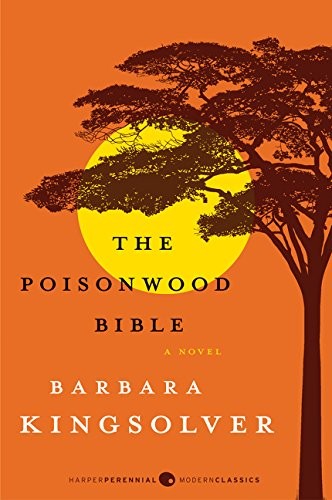
Barbara Kingsolver spent years researching the Congo before writing The Poisonwood Bible, and every page reflects that rigor. Published in 1998, this novel follows an American missionary family into the heart of Africa in 1959 and watches their certainties dissolve one by one. It is a book about the damage that self-righteous conviction inflicts on everything it touches, and it achieves its indictment not through argument but through five voices, each one irreplaceable.
What Happens in The Poisonwood Bible
Nathan Price, a Southern Baptist preacher haunted by his survival at Bataan, moves his wife and four daughters from Bethlehem, Georgia, to the village of Kilanga in the Belgian Congo. He intends to baptize the locals and plant a Christian community. He brings Betty Crocker cake mixes and vegetable seeds that will not survive the equatorial soil. He refuses to listen to anyone who warns him that his methods will not work here.
The five narrators – Orleanna Price and daughters Rachel, Leah, Adah, and Ruth May – take turns telling the story across more than three decades. Orleanna speaks from a vantage of grief and hindsight. Rachel, the eldest, monitors her own appearance with the ferocity of the truly shallow. Leah, a tomboy who initially worships her father, gradually shifts her allegiance to Africa itself. Adah, born with hemiplegia and rendered selectively mute, reads everything backward and forward and says very little aloud. Ruth May, the youngest, sees the world with a child’s terrifying clarity.
The Congo gains independence from Belgium in 1960. Patrice Lumumba’s government collapses. Mobutu Sese Seko rises. The Price family watches these events from Kilanga, where Nathan grows more rigid as his plans fail.
The Chorus of Voices
Kingsolver’s structural decision to filter everything through five female perspectives is the novel’s greatest achievement. Each voice carries its own grammar, its own rhythm, its own relationship to truth. Adah speaks in palindromes and split meanings. Ruth May uses the shorthand of a seven-year-old who understands more than she lets on. Rachel’s malapropisms reveal a mind that has absorbed American consumer culture so completely that she cannot see beyond it.
Leah’s voice carries the novel’s moral weight. She starts as a child who wants only her father’s approval, and she ends as a woman who has married into the Congo, raised children there, and stayed long after every other American has left. Her transformation is the book’s spine.
Nathan Price almost never speaks in the novel. He is refracted entirely through the women around him. This choice makes him more frightening, not less. He exists as damage done and wounds received.
Africa as Character and Indictment
The Congolese landscape, the community of Kilanga, the political upheaval that begins with independence and accelerates into decades of violence – Kingsolver treats all of this as a fully inhabited world, not a backdrop for a white family’s crisis. The novel’s indictment of American and European imperialism is not subtle, but it earns its anger. Kingsolver traces the line from Nathan Price’s personal arrogance to the CIA’s role in Lumumba’s assassination to the decades of Mobutu’s rule.
Kingsolver’s Language and Craft
The title comes from a recurring joke and horror. Nathan, struggling with the Kikongo language, keeps mispronouncing “Jesus is precious” so that it becomes “Jesus is poisonwood” – a deadly tree. The village laughs. Nathan does not understand why. Kingsolver uses this moment to crystallize the entire novel’s concern: the damage that comes not from malice but from the refusal to acknowledge that one does not know where one is.
Who This Book Is For
Readers who want a novel that operates at both the intimate and the epic scale will find The Poisonwood Bible absorbing. It demands patience – the opening section in Georgia moves slowly – but the investment pays off in the Congo, where the novel finds its full force. Anyone interested in African history, colonial literature, or the mechanics of how a family breaks will find material here that stays with them long after the last page.
Frequently Asked Questions
- Is The Poisonwood Bible based on a true story?
- No, but Kingsolver researched the Congo extensively, and the political events – independence, Lumumba’s assassination, Mobutu’s rise – are historical. The Price family and their specific experiences are fictional.
- Is the book anti-Christian?
- The novel critiques a specific type of religious certainty that refuses to adapt or listen. It does not argue against Christianity broadly. Brother Fowles, a genuinely faithful man who learned to love Africa on its own terms, serves as a counterpoint to Nathan’s rigidity.
- Why does Adah speak in palindromes?
- Adah, born with hemiplegia and partly nonverbal, has developed an interior life built around language games and reversals. Her palindromes reflect her habit of seeing everything from multiple directions simultaneously – a form of intelligence that the novel treats with great respect.
- What happens to Ruth May?
- Ruth May dies from a snake bite during a village panic. Her death marks the novel’s point of no return. Orleanna’s subsequent guilt and grief drive the book’s second half.
- Is this book appropriate for high school students?
- It appears frequently on AP Literature syllabi and is appropriate for mature high school readers. It contains violence, death, and adult themes, but nothing gratuitous.
- How does the book handle the Congolese characters?
- Kingsolver gives the Congolese characters, particularly Anatole, full interiority and moral complexity. They are not props in the Price family’s story. Leah’s eventual life as a Congolese resident gives the novel a long view of how the relationship between an outsider and a country can evolve.
- Should I read The Poisonwood Bible before or after Demon Copperhead?
- Either order works. The two novels are very different in setting and approach. The Poisonwood Bible is more overtly political; Demon Copperhead is more narrowly intimate. Reading them together gives a fuller picture of Kingsolver’s range.
Book Details
- Title
- The Poisonwood Bible
- Author
- Barbara Kingsolver
- Genre
- Literary Fiction
- Publisher
- Harper
- ISBN
- 9780062213709
- WritersReview Rating
- 5.0 / 5