
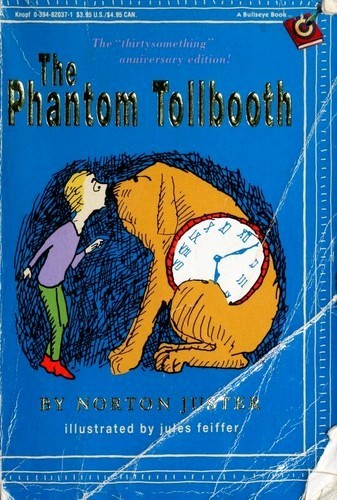
The Phantom Tollbooth
Random House · 1961 · 255 pages
ISBN: 9780394820378
Review Editor
Hannah Bright
The Phantom Tollbooth arrived in 1961 with almost no expectation behind it. Its author, Norton Juster, was an architect who had received a Ford Foundation grant to write a book about cities, then quietly abandoned that project in favor of something stranger and, as it turned out, far more lasting. His housemate, cartoonist Jules Feiffer, started sketching characters to go along with what Juster was writing. An editor at Random House bought the manuscript, and what followed was a children’s book that has sold nearly five million copies and spent more than six decades in print.
The story follows Milo, a boy so thoroughly bored that even boredom bores him. He goes to school without learning anything, comes home without doing anything, and spends his evenings wondering what to do with his time while not really wanting to find out. Then a mysterious tollbooth appears in his bedroom. He drives through it in his small toy car mostly because he has nothing better to do, and arrives in the Lands Beyond: a kingdom that is falling apart because its two ruling princesses, Rhyme and Reason, have been banished by the rival kings who govern it. Milo picks up two traveling companions along the way: Tock, a watchdog with a ticking clock embedded in his side, and the Humbug, a pompous insect who bluffs constantly but means well. Together they set out to rescue the princesses and restore some order to the kingdom.
The Lands Beyond function as a kind of philosophical theme park built from the inside of a child’s education. Dictionopolis runs on words; Digitopolis runs on numbers. Between them lie the Doldrums, where thinking is prohibited and the residents spend their days doing nothing in particular; the Island of Conclusions, reachable only by jumping to one; and the Mountains of Ignorance, populated by demons with names like the Terrible Trivium and the Gelatinous Giant. Each location is a concept given physical form, and the result is a world that rewards attention at every turn.
Character Arcs and Development
Milo begins the book as a hollow vessel, and Juster makes no attempt to disguise this. He is bored with everything because he has never learned to pay attention to anything. His arc is not dramatic in the traditional sense: he does not overcome a traumatic past or face a deeply held fear in a climactic moment. He simply wakes up. By the final pages, he returns home wanting to examine every word he hears and every number he sees, curious about everything that once seemed pointless. Juster earns this transformation by making you feel the contrast rather than announcing it. The Milo at the end of the book is recognizably the same person as the one at the beginning, only alive in a way he was not before.
Tock is a better character than he has any right to be. He exists partly as a practical device (a watchdog who literally ticks helps Milo escape the Doldrums, where no one is allowed to think) but Feiffer’s illustrations give him a mournful dignity, and Juster writes him with real warmth. The Humbug is funnier: a pompous braggart who insists on his own bravery and expertise while demonstrating neither, but who turns out to be useful anyway. The secondary characters are more like extremely good jokes than fully developed people, but that suits the book’s logic. Faintly Macabre the Which, who was once in charge of choosing which words could be used and banned all of them out of spite, gets enough backstory to feel like more than a cameo. The Mathemagician, ruler of Digitopolis, is a genuine counterpart to King Azaz of Dictionopolis, and their rivalry gives the story its structural tension without requiring either of them to function as a villain.
Pacing
The structure is episodic, which fits the material most of the time and works against it occasionally. Each stop on Milo’s journey delivers a new puzzle, a new character, and a new idea. Most of these land with real force: the chapter where Chroma the Great conducts the colors of the sunrise using a full orchestra is quietly astonishing, and the marketplace in Dictionopolis, where words are sold by the bagful, is one of the most inventive sequences in children’s literature. But the episodic format means some chapters feel like diversions from the story rather than steps forward in it. The extended banquet scene in Dictionopolis and a few of the interstitial encounters in the second half slow the momentum noticeably. At 255 pages the book never becomes tedious, but readers who prefer tight plotting will feel the looseness around the midpoint. The book is trying to be both a quest narrative and a kind of encyclopedia of ideas, and sometimes the encyclopedia takes priority.
Deeper Thematic Exploration
The surface argument is clear enough: pay attention, stay curious, learning matters. But underneath that is something more interesting. The central conflict in the Lands Beyond is not between good and evil. It is between two incomplete halves of a whole. Dictionopolis and Digitopolis have been at war for years because King Azaz believes words are more important than numbers and the Mathemagician believes the opposite. The princesses Rhyme and Reason were banished because they refused to declare a winner, insisting both sides were right and wrong in equal measure. The kingdom did not collapse because evil triumphed. It collapsed because a false opposition drove out the only people willing to hold two things in mind at once.
This is a book about the culture wars embedded in education, written in 1961, and it has not aged out of relevance. The idea that you are either a word person or a numbers person, that the humanities and sciences are natural competitors, that learning is fundamentally a burden: these are the demons Milo meets in the Mountains of Ignorance, and defeating them requires not special gifts but simply the willingness to go through the difficulty. The Island of Conclusions is one of the sharpest pieces of satirical thinking in the book. The only way to reach it is to jump to one, and the only way to leave is to swim back through the Sea of Knowledge, which is cold and long. Juster understood that sloppy thinking carries a cost, and he found a way to show that cost to eight-year-olds without being preachy about it.
The Terrible Trivium is the book’s most quietly unsettling creation: a polished, pleasant demon whose sole occupation is keeping you busy with tasks that accomplish nothing, so that you never get around to doing anything real. The name feels almost prescient now. And Faintly Macabre, who banned all words because she had the authority and feared someone might misuse them, is a precise description of the censor’s logic that requires no commentary. What lifts the book above allegory is that Juster treats boredom not as a character flaw but as a condition, and treats curiosity not as a talent but as a practice. Milo does not discover that he was interesting all along. He discovers that the world is.
Style and Voice
Juster writes like someone who genuinely loves language and trusts children to love it too. The prose is clear without being flat, witty without announcing its own wit. Every idiom he literalizes, and there are many, is chosen because it illuminates something rather than just delivering a joke. When time turns out to be a living entity with strong opinions about how it is spent, the conceit works because Juster follows it to its logical conclusions instead of dropping it after one scene. The jokes land because the world is internally consistent. Feiffer’s illustrations are not decoration but texture, as integral to the experience as Tenniel’s drawings are to Alice. His Humbug and Tock look exactly like they should: slightly absurd, just believable enough.
The narration sits in a warm, slightly dry third person, like someone reading aloud to a child who is old enough to catch the double meanings. Juster never condescends and never reaches for an emotional gravity the book does not need. The tone stays consistent across all 255 pages, which is harder than it sounds in a novel structured around satirical set pieces. The voice is the glue that holds the whole elaborate construction together.
Verdict
The Phantom Tollbooth reads differently at different ages. At eight it is an adventure story full of interesting wordplay. At twelve you start catching the satire. At thirty you realize you are reading a fairly sophisticated argument about education, attention, and what we lose when we stop finding things worth noticing. That range is not common in children’s literature, and it is why the book has stayed in print for more than sixty years and why it keeps finding new readers who feel, as so many have reported, that it turned a light on in their heads.
Read it if you have any patience for wordplay, any interest in how metaphors work as structures for thought, or any memory of going through school without understanding why any of it mattered. It will work on you differently now than it did at ten. Readers who prefer plot-driven adventure may find the episodic middle section a little loose, and a few of the teaching moments are heavy-handed in the way that allegory sometimes is. But the ideas in this book are real ideas, the humor is genuinely funny, and the ending earns the feeling Juster builds toward it. Few books written primarily for children have this much to say to adults who pick them up again.
Frequently Asked Questions about The Phantom Tollbooth
What is The Phantom Tollbooth by Norton Juster about?
The Phantom Tollbooth follows Milo, a bored young boy who receives a mysterious toy tollbooth in his bedroom. When he drives through it, he arrives in the Lands Beyond, a kingdom in trouble because its two princesses, Rhyme and Reason, have been exiled. Milo, traveling with a watchdog named Tock and an insect called the Humbug, sets out to rescue them. Along the way, he visits places like Dictionopolis, where words are sold at market, and Digitopolis, where numbers rule everything, and slowly discovers that the world is far more interesting than he had assumed.
What age is The Phantom Tollbooth appropriate for?
The book is typically marketed to readers aged 8 to 12, and that range works well for a first read. The wordplay and adventure are immediately accessible around age 8 or 9, while the satire and philosophical undercurrent become more apparent in the tween years. Many adults who read it for the first time or revisit it find the book just as rewarding as they did as children, sometimes more so. It is one of those rare children’s books that does not lose anything as you get older.
What are the main themes in The Phantom Tollbooth?
The central themes are curiosity, the value of education, and the dangers of boredom and lazy thinking. The book also takes on the false rivalry between words and numbers, arguing through its plot that both are essential and that banishing either (or anyone who tries to reconcile them) leads to chaos. A quieter theme runs through the whole book: attention itself, the act of actually looking and listening to the world, is presented as a kind of superpower that Milo has to learn deliberately rather than receive as a gift.
Is The Phantom Tollbooth based on a true story?
No, The Phantom Tollbooth is a work of fiction. Norton Juster wrote it while he was supposed to be working on a nonfiction book about cities for the Ford Foundation. The tollbooth itself and the Lands Beyond are entirely invented, though Juster has said in interviews that the book grew out of his own experiences of boredom and his sense that school had not taught him to find the world interesting. The emotional truth of Milo’s predicament is real; the plot is fantasy.
Is there a movie adaptation of The Phantom Tollbooth?
Yes. A film adaptation was released in 1970, directed by Chuck Jones (known for Looney Tunes) and David Monahan. It used a combination of live action for a brief framing sequence and animation for the Lands Beyond sequences. The film is generally considered a respectful adaptation, though it compresses the book significantly. It is available for streaming and rental through various platforms. There have been stage adaptations as well, including at least one opera version, but no major new film as of 2026.
How long is The Phantom Tollbooth and is it hard to read?
The book runs 255 pages and reads quickly. The prose is clear and the chapters are short, making it easy to read in manageable sessions. The wordplay requires some attention: puns and literalized idioms are central to the humor, and readers who rush through dialogue will miss some of the jokes. A motivated young reader can finish it in a few days. For adults reading it aloud to a child, the shared experience of catching the jokes together is part of the pleasure.
Why is The Phantom Tollbooth considered a children’s classic?
The book earned its reputation through a combination of originality, longevity, and the fact that it takes its readers seriously. When it was published in 1961, reviews compared it to Alice in Wonderland and The Wizard of Oz, and those comparisons have held up. The book treats intellectual curiosity as something genuinely exciting rather than something children need to be tricked into caring about. It won the Lewis Carroll Shelf Award in 1965 and has remained in print continuously since publication, with nearly five million copies sold as of 2021.
What books are similar to The Phantom Tollbooth?
Readers who love The Phantom Tollbooth often connect with Lewis Carroll’s Alice’s Adventures in Wonderland, which shares the device of a child transported into a world built from language and logic puzzles. The Wizard of Oz has a similar structure (a journey through a strange land, a companion assembled along the way, a return home that means something). For more contemporary options, Terry Pratchett’s Discworld novels for younger readers carry some of the same satirical warmth, and Roald Dahl’s work shares the trust in children to handle dark humor and real ideas.
Book Details
- Title
- The Phantom Tollbooth
- Author
- Norton Juster
- Genre
- Children's
- Publisher
- Random House
- Year Published
- 1961
- Pages
- 255
- ISBN
- 9780394820378
- WritersReview Rating
- 4.6 / 5