
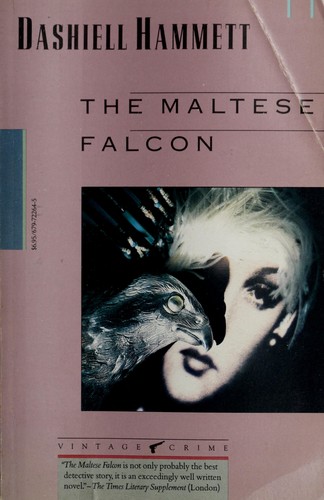
The Maltese Falcon
Vintage Books · 1930 · 217 pages
ISBN: 9780679722649
Review Editor
James Voss
When Dashiell Hammett published The Maltese Falcon in 1930, the dominant model of mystery fiction was English, drawing-room, and cerebral. Hercule Poirot observed. Miss Marple intuited. The detective stood above the fray, gathered the suspects, and delivered a solution in clear light. Hammett looked at that tradition and wrote something entirely different: a novel set in the fog and graft of San Francisco, about a private detective who lies to nearly everyone around him and tells the truth with his hands. The result created a genre that most crime fiction still works inside today.
The story begins when a woman who calls herself Miss Wonderly walks into Sam Spade’s office and hires him and his partner Miles Archer to follow a man named Floyd Thursby. Before morning, Archer is found shot dead in a dark alley, and Thursby is dead too. The police look at Spade first. The woman, whose real name is Brigid O’Shaughnessy, has been lying from the beginning. What she has drawn Spade into is a three-way competition for a jeweled statuette of a falcon, created by the Knights of Malta in the sixteenth century, coated in black enamel to hide its value, and passed through so many hands over the centuries that its location has become legend. Several people want it badly enough to kill for it. Spade has a murdered partner, a lying client, hostile police, and no particular desire to become anyone’s victim.
Hammett drew directly on his experience as a Pinkerton Agency detective in San Francisco, and that background shows in every scene. This is not a novel by someone imagining what crime looks like; it is a novel by someone who has sat in the rooms where deals are made and broken. The texture of the city, the rhythms of interrogation and evasion, the way professional criminals speak to each other when they are being careful: all of it carries the weight of actual observation rather than literary construction.
Character Arcs and Development
Sam Spade is one of the enduring creations in American fiction, and the key to understanding him is that Hammett refuses to let you inside his head. The novel operates in strict third-person objective mode, with no access to thought, only to gesture, expression, and dialogue. You watch Spade the way you watch a stranger across a room: you read his face, track what his hands do, listen for what he says and what he stops short of saying. Raymond Chandler would later write that Hammett gave murder back to the kind of people who commit it for reasons, and Spade is the vessel for that philosophy.
What you piece together, over two hundred pages of careful watching, is a man who works through calculation rather than impulse. He allows himself to be attracted to Brigid while refusing to trust her for a moment. He plays Gutman against Cairo against the police with the patience of someone who has done this work before and knows that most people are terrible liars when under pressure. He is not a hero in any conventional sense: he was sleeping with Archer’s wife, he is entirely comfortable with physical intimidation, and he can be charming and threatening within the same exchange. The arc Hammett gives Spade is not one of growth or self-discovery but of revelation. By the novel’s end, you understand what this man is made of, what his code actually says, and why he follows it even when following it costs him something he wanted.
Brigid O’Shaughnessy is Spade’s mirror and his test. She is beautiful, desperate, extraordinarily skilled at performance, and genuinely dangerous. Hammett does not let her be merely villainous; her fear, at points, reads as real, and her feeling for Spade may not be entirely calculated. Casper Gutman, the corpulent, genial villain obsessed with recovering the falcon, works as a genuinely interesting antagonist: intelligent, almost likeable, and completely amoral. Joel Cairo and the young gunman Wilmer fill out the criminal constellation with efficient economy. Effie Perine, Spade’s secretary, is the one person who consistently reads situations correctly and the one person Spade cannot quite fool, which tells you something important about both of them.
Pacing
At 217 pages, The Maltese Falcon moves fast without feeling rushed. Hammett builds momentum through scene rather than summary: almost everything important happens in real time, in dialogue, in rooms where people are doing things to each other. Chapters are short. The section where Spade circles Gutman, waiting for information and trying not to surrender any, could easily drag, but Hammett sustains tension through behavioral precision. The way Gutman pours drinks, the way Wilmer holds himself near the door, the way Spade sits with his elbows on his knees: these details do the work that interior monologue might have done in a different kind of novel.
One extended passage does slow the forward drive: Gutman’s account of the falcon’s history, the story of its creation by the Knights of Malta and its centuries of violent transit from owner to owner. That section works as history and as character study (it reveals how thoroughly Gutman has organized his entire adult life around a single obsession), but it does interrupt the novel’s kinetic rhythm. Most readers find it earns its place. The rest of the book is as tightly paced as the genre has produced.
Deeper Thematic Exploration
The Maltese Falcon is, at its core, a novel about what loyalty looks like when nothing around you is reliable. Spade’s professional code does not tell him to save the innocent or punish the guilty in any abstract sense. It tells him that when your partner is murdered, you have to do something about it. Not because you liked the man, but because if you do not, you become exactly as unreliable as everyone around you. The code is professional rather than moral, and that distinction is the one Hammett is most interested in pressing.
The statuette at the center of the story is one of the great MacGuffins in American fiction. It is worth everything and turns out to be worth nothing: a fake, a decoy, possibly a symbol of a thing that may never have existed as legend claimed. Hammett uses this not as a cruel punchline but as an argument about the nature of desire. People are willing to lie, betray, and kill in pursuit of a thing that may be purely imaginary. Gutman, confronted with the truth, decides to go back and keep searching; he cannot stop, not because the falcon definitely exists but because he has organized his life around believing it does. The novel is entirely without mercy about that kind of need.
Running beneath all of this is a portrait of San Francisco in the late 1920s that refuses nostalgia at every turn. The fog, the steep streets, the residential hotels, the police department that operates as one more competing interest: Hammett knew this city from working in it, and he writes it without sentiment. Everyone in this novel is running some kind of game. The question is not how to stay innocent but how to stay sharp enough not to become someone else’s loss.
Hammett also engages, through Spade’s choices, with questions of professional ethics that still feel current. What do you owe a client who has lied to you from the first sentence? What do you owe a dead partner you did not particularly respect? What does it cost to hold your line when holding it requires you to give up something you actually wanted? The novel works through these questions to a conclusion that feels right without feeling comfortable, and that ending is one of the most quietly devastating in the genre.
Style and Voice
Hammett’s prose in The Maltese Falcon is often called spare, but spare does not quite capture it. It is precise. Every sentence does exactly what it needs to do and then stops. He has an extraordinary ear for dialogue: his characters speak the way people speak when they are hiding things, which is to say in misdirection and implication, in quick pivots and deliberate non-answers. A ten-line exchange between Spade and a police detective contains more information about power, deception, and character than many novelists manage in a full chapter.
The third-person objective technique, which refuses access to any character’s thoughts, deserves particular attention. Hammett never tells you what Spade thinks. He tells you that Spade’s yellow-grey eyes go alert, that the corners of his mouth tighten, that he laughs suddenly when nothing seems to be funny. You do the interpretive work yourself. The effect is deeply cinematic: John Huston’s 1941 film adaptation works as well as it does partly because Hammett had already written in something close to film grammar. The effect is also genuinely unsettling. You cannot be entirely certain you understand Spade, which keeps you reading, and keeps you thinking after you put the book down.
Verdict
The Maltese Falcon belongs on a short list of American novels that changed what a genre was capable of doing. If you come to it expecting fair-play puzzle-solving in the Agatha Christie tradition, you will be disoriented: there is no elegant solution delivered in a parlor, no moment where all the pieces click into obvious place. What you get instead is a story about professional ethics conducted in a morally indifferent city, a study of how people behave when something valuable is at stake, and one of the most quietly devastating final scenes in crime fiction.
Read this if you want to understand where hardboiled fiction comes from, or if you want to spend time with a man whose code you will spend most of the novel trying to decode. Read it if you want prose that wastes nothing and buries nothing. If you prefer mystery novels that offer comfort and gentle resolution, Hammett is not your writer: he is cold, clear, and unsparing about what people do to each other when they think they can get away with it. That is exactly what keeps him worth reading nearly a century after this novel first appeared.
Frequently Asked Questions about The Maltese Falcon
What is The Maltese Falcon by Dashiell Hammett about?
The Maltese Falcon follows Sam Spade, a private detective in San Francisco, after his partner is murdered on what looked like a routine case. The job leads Spade into a web of competing criminals, all hunting a jeweled statuette of a falcon that may be worth a fortune. Published in 1930, the novel is the book that created hardboiled detective fiction as readers know it today.
Who plays Sam Spade in The Maltese Falcon movie?
The most famous film adaptation was released in 1941 and starred Humphrey Bogart as Sam Spade, with Mary Astor as Brigid O’Shaughnessy, Peter Lorre as Joel Cairo, and Sydney Greenstreet as Casper Gutman. Directed by John Huston, it is considered one of the defining works of film noir. There were also earlier adaptations in 1931 and 1936, neither of which carries the same reputation.
What are the main themes in The Maltese Falcon?
The novel works through several interlocking ideas: professional loyalty and what it demands when tested; the way desire corrupts judgment when people pursue something badly enough; the moral indifference of a city where everyone is running some kind of game; and the cost of maintaining a personal code in a world that does not share it. The falcon statuette itself functions as a symbol of how people destroy themselves chasing things that may not be worth what they believe.
How long is The Maltese Falcon and is it a difficult read?
The Vintage paperback edition runs 217 pages and reads quickly. The prose is precise, chapters are short, and dialogue moves fast. Some readers find Hammett’s third-person objective style unusual at first, since there is no access to any character’s thoughts, only to what they do and say. Most people adapt within the first chapter. The novel is not difficult in terms of vocabulary or structure, but it rewards close attention.
Is The Maltese Falcon based on a true story?
The Maltese Falcon is fiction, though Hammett drew on his years working as a Pinkerton detective in San Francisco. The city, the atmosphere, and many procedural details are grounded in real experience. Sam Spade himself is invented, though Hammett described him as a dream version of the kind of private detective he actually worked alongside: what those men would have liked to have been in their better moments.
What age group or reading level is The Maltese Falcon for?
The Maltese Falcon is an adult novel with some violence and sexual implication, and works best for readers comfortable with morally ambiguous characters and unresolved endings. Most adult readers will find it accessible. It is frequently taught in university literature and genre fiction courses. Readers who enjoy crime fiction, American literary history, or classic Hollywood film will find it particularly rewarding.
How does The Maltese Falcon compare to Dashiell Hammett’s other books?
The Maltese Falcon is generally considered Hammett’s best and most influential novel. His earlier Red Harvest (1929) is rougher and more violent, set in a corrupt mining town, and has fans who prefer its relentless energy. The Glass Key (1931) is often cited by critics as his most technically refined work. The Thin Man (1934), his last novel, is lighter and more comedic. All four are worth reading, but The Maltese Falcon is the one that changed the genre.
Should I read The Maltese Falcon even if I do not usually read classic crime novels?
Yes, if you have any interest in how genre fiction developed or simply want a compact, carefully written novel about a man under pressure. The Maltese Falcon does not feel dated in the way some 1930 novels do; its stripped-down prose and behavioral approach to character feel, if anything, contemporary. The book is short enough that the investment is modest, and its influence on everything that came after it makes it genuinely useful context for any crime fiction you read.
Book Details
- Title
- The Maltese Falcon
- Author
- Dashiell Hammett
- Genre
- Mystery & Thriller
- Publisher
- Vintage Books
- Year Published
- 1930
- Pages
- 217
- ISBN
- 9780679722649
- WritersReview Rating
- 4.7 / 5