
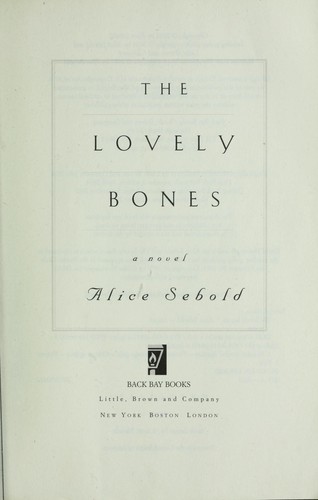
The Lovely Bones
Back Bay Books · 2004 · 328 pages
ISBN: 9780316044936
Review Editor
Eleanor Marsh
Susie Salmon is fourteen years old when her neighbor George Harvey rapes and murders her. From a personal heaven — a place shaped like a wishful version of high school, populated by others who share the things she loved — Susie watches her family fracture and slowly reconstruct in the years following her death. She watches Harvey go uncaught. She watches him continue his life, moving and working and killing again, while the people she loved try to grieve and eventually find ways to continue living. The novel spans roughly a decade as Susie narrates from this remove, observing but unable to intervene — except once, in a way that divided readers and critics.
Character Arcs
Sebold does her best work with Susie’s family. The father, Jack Salmon, channels his grief into obsession, becoming increasingly convinced that Harvey is responsible and pursuing that suspicion in ways that cost him. The mother, Abigail, handles trauma by shutting down emotionally and eventually leaving her family — a choice the novel neither endorses nor condemns but traces with uncomfortable accuracy. The sister Lindsey grows up fast and sharp, determined not to be defined by what happened to Susie, and her parallel investigation of Harvey is the novel’s most tightly plotted thread. Susie herself changes less than expected; her perspective shifts from longing to something closer to acceptance, but the emotional weight of the novel belongs to the survivors rather than the narrator.
Pacing
The novel’s non-linear structure, moving across years with Susie as guide, creates uneven pacing. Certain periods — the immediate aftermath, Lindsey’s adolescence, the eventual confrontation with Harvey — feel lived-in and specific. Other sections meander. The subplot involving a classmate named Ray and a girl called Ruth, who claims to sense Susie’s presence, takes up significant space without quite earning its length. These characters are clearly meaningful to Sebold, but the novel might have been tighter without them. The resolution of their thread, which involves a supernatural occurrence near the end, struck many readers as a violation of the novel’s established emotional logic.
Thematic Depth
The novel is fundamentally about the aftershocks of violence on the people who survive it. Sebold renders Harvey as human rather than monstrous — his normalcy is the book’s bravest and most uncomfortable choice, and far more disturbing than cartoonish evil would have been. Grief here is specific and often ugly: Jack’s tunnel vision, Abigail’s flight, the frozen way some characters stop developing for years. The heaven conceit allows Sebold to write about the dead watching the living, which is genuinely moving at its best. Susie wants to be remembered accurately, not as a symbol or a cautionary tale, and the novel treats that desire with seriousness.
Style and Voice
Susie’s narrative voice blends teenage immediacy with retrospective wisdom — she sounds like someone who died at fourteen and has had years in a liminal space to think about what she witnessed. Sebold handles this balance with variable success. Some passages feel too adult, too knowingly reflective, for a murdered fourteen-year-old. Others nail the specific sadness of watching life continue without you: the detail of watching her parents’ bedroom, the moment she sees her father’s hands shake. The prose is accessible and direct, rarely reaching for literary complexity, which suits the material but sometimes leaves the book feeling less substantial than its subject demands.
Verdict
The Lovely Bones is an emotionally effective novel with some genuine structural problems. The grief Sebold captures is real and specific, and the central conceit — a murdered girl watching the world move on without her — is genuinely affecting. But the pacing is loose in places, some subplots don’t justify their length, and the supernatural elements become erratic near the end in ways that undercut the more grounded emotional work the rest of the book does. It’s a novel that moves many readers despite its flaws, and that capacity for emotional reach is no small achievement.
Rating: 3.7 out of 5
Book Details
- Title
- The Lovely Bones
- Author
- Alice Sebold
- Genre
- Literary Fiction
- Publisher
- Back Bay Books
- Year Published
- 2004
- Pages
- 328
- ISBN
- 9780316044936
- WritersReview Rating
- 3.7 / 5