
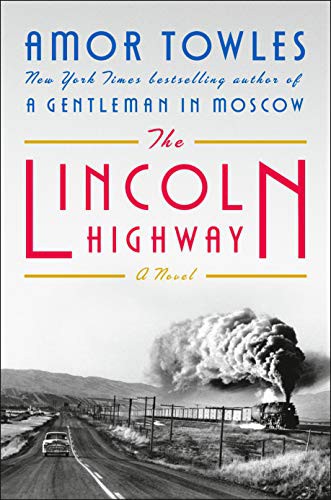
The Lincoln Highway
Penguin Publishing Group
ISBN: 9780735222373
Review Editor
admin
Amor Towles published The Lincoln Highway in 2021, eight years after Rules of Civility and five years after A Gentleman in Moscow. His third novel arrived with high expectations and met most of them: a genuine page-turner with literary ambitions, a novel that uses its period setting – America in June 1954 – to examine questions about adventure, responsibility, and the stories we tell ourselves about who we are.
Emmett Watson’s Plan
Emmett Watson, eighteen years old, returns to Morgen, Nebraska after fifteen months at a work farm in Kansas, having served his time for the accidental death of a boy during a fight. His father has died while he was away; the bank is about to foreclose on the farm. Emmett’s plan is clear and sensible: he will collect his eight-year-old brother Billy, sell the farm equipment, and drive west to California along the Lincoln Highway to start again.
The plan fails immediately. Hidden in the trunk of the warden’s car, two of Emmett’s friends from the work farm have hitched a ride to Nebraska: Duchess and Woolly, who have their own ideas about where they are going and what Emmett owes them. They steal Emmett’s car and head east – toward New York City. Emmett and Billy follow in a borrowed car, and the novel’s road trip runs counter to its own premise: not west toward new beginnings, but east, back toward the past.
The Four Travelers
Towles manages four central perspectives with great skill. Emmett is responsible, deliberate, and burdened by a sense of obligation. Duchess is the novel’s most entertaining creation – a con man and raconteur with a gift for justifying his own behavior through elaborate moral frameworks that serve his immediate interests. Woolly is a gentle, damaged young man from a wealthy family. Billy, the eight-year-old, carries a book about the heroes of history and applies its lessons with absolute seriousness to everything he encounters.
Billy is a particular achievement. He is a child who thinks in the particular way children think, who takes things literally and misses social subtleties and loves his brother with a completeness that the adult characters have learned to qualify.
Structure and the Ten Days
The novel takes place over exactly ten days in June 1954, divided into chapters that cycle through the four perspectives with discipline. The tight timeframe creates momentum; the multiple perspectives prevent any single character from dominating the moral landscape. The novel pays homage to the picaresque tradition – the episodic road narrative in which characters encounter a series of strangers and situations that test their resourcefulness and reveal their character.
A Novel About Stories
Billy’s book of heroes – a compendium of historical and mythological figures including Ulysses, Achilles, and Lincoln himself – functions as the novel’s explicit commentary on its own project. Towles uses this to make a gentle argument about the relationship between the stories cultures tell and the choices individuals make: the stories shape the choices, for better and worse, and the best we can do is choose our stories with care.
- What is the Lincoln Highway?
- The Lincoln Highway was the first transcontinental automobile road in the United States, running 3,389 miles from Times Square in New York City to Lincoln Park in San Francisco. It carried enormous symbolic freight as a monument to American mobility, westward movement, and the possibility of starting over – all themes that Towles uses and complicates in the novel.
- How does The Lincoln Highway compare to A Gentleman in Moscow?
- The two novels share Towles’s characteristic warmth and pleasure in formal structure. A Gentleman in Moscow is more intimate – one character, one location, decades of time. The Lincoln Highway is more kinetic – four characters, many locations, ten days. Readers who loved A Gentleman in Moscow for its warmth will find the same quality here.
- Why does the novel go east instead of west?
- The inversion of the expected direction is the novel’s central structural choice. Duchess’s decision to go to New York forces Emmett backward, into unfinished business rather than new starts. Towles is interested in what the American mythology of westward renewal costs – specifically what it allows people to leave unaddressed.
- Who is Duchess, and is he a villain?
- Duchess is the novel’s most fully realized character alongside Billy, and he is the furthest thing from a straightforward villain. He is a con man, a thief, and a manipulator, but he operates according to a genuine moral code – distorted, self-serving, and inconsistent, but real.
- Is the ending satisfying?
- Most readers find it so, though it is not a happy ending in the conventional sense. Towles brings the four trajectories to conclusions that feel earned given what each character is and what the novel has built. Towles’s instinct is always toward grace rather than tragedy, and the ending reflects this without sentimentality.
Book Details
- Title
- The Lincoln Highway
- Author
- Amor Towles
- Genre
- Literary Fiction
- Publisher
- Penguin Publishing Group
- ISBN
- 9780735222373
- WritersReview Rating
- 4.0 / 5