
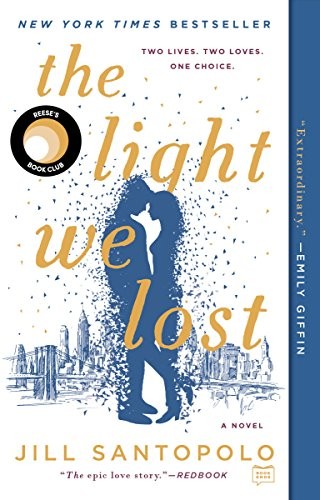
The Light We Lost
G.P. Putnam's Sons · 2017 · 328 pages
ISBN: 9780735212756
Review Editor
Priya Nair
Jill Santopolo’s debut novel for adult readers opens on September 11, 2001. Lucy Chen and Gabe Rivera are senior-year students at Columbia University, and they are watching lower Manhattan from a rooftop as the towers burn. They do not know each other yet. By the end of that day, they will. By the end of that semester, they will be inseparable. The Light We Lost, published in April 2017, takes that beginning and traces what follows across thirteen years of love, absence, career, marriage, and grief, told through one of the more structurally daring voices in recent commercial fiction.
Lucy narrates the entire novel in second person, speaking directly to Gabe. “You were standing at the edge of the roof,” the novel begins, and that “you” never wavers. Every memory is addressed to him. Every decision, every loss, every ordinary Tuesday is offered up to Gabe as though he is somewhere nearby, listening. The form signals something important before any plot does: Gabe is gone, and Lucy has never been able to stop talking to him in her head. The book becomes, in this sense, a long letter from someone who needed to write it.
Santopolo had spent years publishing children’s fiction before this novel, and The Light We Lost landed with real force. It climbed the New York Times bestseller list, was selected by Reese Witherspoon for her book club, and was translated into more than thirty-five languages. None of that commercial success would matter if the book didn’t earn it emotionally. On balance, it does, though not without reservations worth naming.
Character Arcs and Development
Lucy is the novel’s most fully realized character, which is appropriate given that we live entirely inside her perspective. She is a television producer: competent, self-aware, and acutely conscious of the gap between what she wants and what she allows herself to pursue. Santopolo gives her real intelligence about her own emotional life, which is rarer in romantic fiction than it should be. Lucy does not drift through her choices. She makes them with open eyes and then has to reckon with their costs. What she loves in Gabe is genuine. What she builds with Darren, her eventual husband, is also genuine. The novel is good enough to hold both things at once without collapsing them into a simple hierarchy.
Gabe is the book’s harder problem. We know him entirely through Lucy’s memory and longing, which means Santopolo has to make us feel his pull at one remove. He is a photojournalist drawn compulsively toward conflict, shaped by the belief that bearing witness to suffering is morally necessary, that images can change what people are willing to tolerate. His absences from Lucy’s life are not casual; they are the expression of who he is and what he thinks the world asks of him. That commitment is admirable and also, the novel quietly insists, a kind of wound. The difficulty is that Gabe can feel more like a gravitational force than a person. We see what Lucy sees in him. We are less sure, sometimes, that we see him. His presence in the novel is more felt than witnessed, and that asymmetry occasionally works against the story’s emotional logic.
Darren, Lucy’s husband, is one of the novel’s genuine achievements. Santopolo does not make him a villain or a consolation prize. He is patient, funny, present, and sincerely in love with Lucy. The book has the moral seriousness to mean this. When Lucy stays with Darren, she is not making a mistake or settling for safety. She is making a different, legitimate choice about what a life is for. That refusal to stack the deck is what separates The Light We Lost from softer versions of the same story.
Pacing
The novel moves in compressed scenes separated by significant time jumps, covering thirteen years in 328 pages. Santopolo handles the early sections with confidence. Each chapter feels loaded even when brief; the relationship between Lucy and Gabe develops with enough specificity that the reader understands what she is losing when it begins to fracture. The years pass quickly, but what she chooses to show matters.
The middle section, once Lucy has married Darren and is raising young children, settles into a slower rhythm. Gabe reappears in emails and texts rather than scenes. The novel becomes a portrait of domestic life shot through with recurrent longing, and this is where some readers lose patience. Santopolo is building toward something, but the build is long enough that the final chapters have to work hard to justify the wait. Whether they succeed will depend on the reader. The ending is designed to devastate, and for many people it does. For others, it will feel like a structural shortcut: a way of resolving ambivalence by removing one of its terms rather than by working through it.
Deeper Thematic Exploration
At its most serious, The Light We Lost asks what first love actually does to a person, not in the sentimental sense but in the neurological one. Santopolo is interested in the way one formative relationship can recalibrate everything that follows: who you compare people to, what you think desire is supposed to feel like, how you understand your own choices in retrospect. Lucy never stops loving Gabe, not because she has failed to move on but because the love itself became part of the structure of her self. The novel makes a case for this without romanticizing it. It does not argue that Lucy should have been with Gabe, or that she wasted her life. It argues that some connections are indelible, and that living alongside that fact is a form of work.
September 11 is not decorative backdrop. Santopolo positions the attacks as the hinge of her characters’ adult lives, the moment a certain kind of youthful immunity ended. For Lucy and Gabe, who meet on that day, every subsequent choice is in some way an answer to what 9/11 asked of them. Gabe becomes a photojournalist who documents the wars that followed, spending years in Iraq and Afghanistan and other places the news moves through. Lucy works in television, shaping how events reach an American audience. Both are defined by their relationship to public catastrophe, though at very different distances from it.
This is also a novel about the difference between passion that compels and love that sustains. Gabe and Lucy are electric together, and the novel makes you feel it. But Gabe cannot stop moving toward conflict, and Lucy cannot keep building a life around someone who is always leaving. Darren offers something else: continuity, attentiveness, the ordinary texture of being fully known by another person. Santopolo insists, more than most novels in this territory, that this second thing is not lesser. It is different, and it is real. The love that electrifies and the love that endures are not in competition; they are simply not the same thing, and a person may need both to understand what either one is worth.
The political dimension of the novel is both its ambition and its limitation. Gabe’s work in conflict zones gives his character moral weight and connects his personal story to something larger. But the wars themselves remain thin. We hear about what Gabe has witnessed without really experiencing it alongside him. This creates an occasional mismatch between the significance the novel assigns to his journalism and the emotional access it provides to that experience. The geopolitical gravity is borrowed rather than fully inhabited.
Style and Voice
The second-person narration is the novel’s central formal gamble, and it pays off. Addressing Gabe as “you” throughout gives every sentence the texture of spoken confession, as though Lucy has finally, years later, found the words she needed. The voice creates radical closeness: you are pulled into her perspective, made to see Gabe through her eyes, and that sustained intimacy is the book’s main emotional mechanism. It also does something structurally important: it establishes from the very first page that this is an account being rendered to someone who can no longer respond, and that knowledge charges every remembered scene with anticipatory grief.
Santopolo’s prose is clean and direct, not given to elaborate description or lyric excess. The sentences are short enough to pick up speed. Short chapters enforce momentum. The emotional register is high throughout, but the writing earns it by keeping close to specific detail, to concrete moment rather than abstracted feeling. There is a passage in the early chapters where Lucy describes sitting with Gabe while he looks at war photographs for the first time, his face going still as the images build up in him, and that kind of specificity is what keeps the book from becoming generic romantic tragedy. It knows how to show rather than announce.
Verdict
If you are drawn to novels that take the emotional life of love seriously, that are willing to follow feeling into difficult and ambivalent territory, The Light We Lost will hold you. The second-person narration is unusual and, once you settle into its logic, deeply effective. Lucy’s voice is intelligent, honest about its own contradictions, and finally very moving. Readers who connected with David Nicholls’s One Day or who want literary-adjacent fiction that earns its heartbreak rather than manufacturing it will find a lot to recommend here.
The book has real limitations. Gabe is more felt than fully seen. The middle section tests patience. The ending is a formal choice that will satisfy some readers and frustrate others. But the novel’s core is strong, and the core is Lucy: a woman who lived her life with full attention, who loved two very different men with genuine care, and who is still, years later, trying to make sense of how it all added up. Come with patience for its pace and tolerance for a sad ending, and this one will stay with you.
Frequently Asked Questions about The Light We Lost
What is The Light We Lost by Jill Santopolo about?
The Light We Lost follows Lucy Chen and Gabe Rivera, two Columbia University students who meet on September 11, 2001, as they watch lower Manhattan from a rooftop. The novel spans thirteen years, tracking their on-and-off love story as Gabe becomes a photojournalist drawn to conflict zones and Lucy builds a career and eventually a family in New York. Lucy narrates the entire story in second person, speaking directly to Gabe, in a voice that implies from the first page that something has happened to him.
Why is The Light We Lost written in second person?
Santopolo chose second-person narration to create the feeling that Lucy is composing a long letter or confession addressed to Gabe. The “you” throughout the novel pulls the reader into Lucy’s perspective and makes every remembered scene feel like an act of intimate accounting. The form also signals, before any plot development does, that Gabe is no longer present to respond, adding a layer of grief beneath every page from the opening lines.
What are the main themes in The Light We Lost?
The novel’s central themes are first love and the permanent mark it leaves, the tension between passionate and stable partnerships, and the psychological cost of bearing witness to trauma and conflict. September 11 and its aftermath serve as a generational turning point throughout: Gabe’s work as a photojournalist in Iraq and Afghanistan forces him to confront what sustained exposure to suffering does to a person, while the novel asks whether passion that compels and love that sustains are even the same thing at all.
Does The Light We Lost have a happy ending?
No. The novel ends with loss, and the structural revelation at the close confirms what the second-person narration has been quietly suggesting throughout: that Lucy is telling this story to Gabe because he is gone. Whether the ending feels earned or convenient will vary by reader. Many find it devastating and cathartic; others feel it shortcuts the novel’s emotional complexity by resolving the central ambivalence rather than working through it.
Is The Light We Lost based on a true story?
No, it is fiction. Santopolo has said she drew on the emotional landscape of her own generation, particularly the experience of coming of age during September 11 and watching the wars that followed reshape American life. The novel’s attention to photojournalism and conflict zones reflects research into that world rather than personal experience, though the emotional core of the story is drawn from her own thinking about love and loss.
How long is The Light We Lost and is it an easy read?
The novel is 328 pages, broken into short chapters that move quickly. The prose is direct and accessible, and most readers finish in two or three sittings. The emotional content is heavy, particularly in the second half, but the writing does not demand specialized knowledge or patience for dense prose. It is a fast-moving novel about difficult things.
How does The Light We Lost compare to One Day by David Nicholls?
Both novels track a formative love relationship across many years and ask what it costs to carry that connection through an adult life. One Day uses alternating third-person perspectives and a fixed annual structure; The Light We Lost uses second-person intimacy and looser time jumps. Nicholls is slightly more comic in register, Santopolo more solemnly romantic. The endings have comparable emotional ambitions. Readers who loved one will almost certainly want to read the other.
Should I read The Light We Lost?
If you want a novel that takes love seriously as a subject, that refuses to make the stable partner a villain, and that uses an unusual narrative voice to genuine emotional effect, yes. The book is worth the time it asks for. Come with patience for a slow middle section and a willingness to sit with an ending that does not resolve cleanly. Readers who prefer plotted thrillers or lighter romantic comedy may find it too heavy, but for readers who want to be moved and given something to think about, The Light We Lost delivers both.
Book Details
- Title
- The Light We Lost
- Author
- Jill Santopolo
- Genre
- Biography
- Publisher
- G.P. Putnam's Sons
- Year Published
- 2017
- Pages
- 328
- ISBN
- 9780735212756
- WritersReview Rating
- 3.9 / 5