
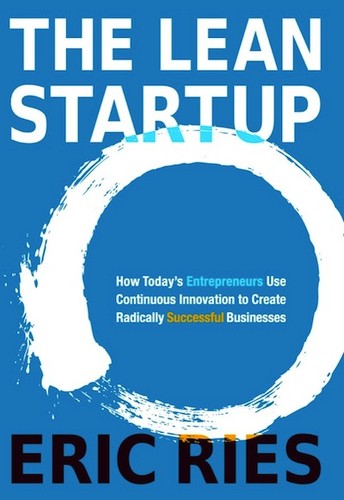
The Lean Startup
Crown Business · 2011 · 336 pages
ISBN: 9780307887894
Review Editor
Daniel Okafor
Eric Ries published The Lean Startup in 2011, drawing on his experience as a startup founder and his encounter with the manufacturing principles of lean production. His argument is that the traditional approach to building a company — write a business plan, raise money, spend years building a product, launch — is almost guaranteed to produce something nobody wants, because it defers learning about what customers actually need until after you’ve committed to a particular vision. The alternative he proposes — the minimum viable product, the build-measure-learn cycle, validated learning, and the “pivot or persevere” decision — is an approach to building companies as learning machines rather than execution machines. These ideas have become so embedded in startup culture that it’s easy to forget how counterintuitive they were when the book was published.
Character Arcs
Ries draws primarily on his own experience co-founding IMVU, a social network built on top of instant messaging clients, which nearly failed because his team spent months building features nobody used before learning to test assumptions rapidly. This autobiographical core gives the book specificity and credibility. He also draws on dozens of other company examples — Dropbox’s video MVP, Zappos’s initial experiment, Toyota’s production system — to illustrate that the principles generalize beyond Silicon Valley software startups. His tone is that of an evangelist who has seen the light through painful personal experience and wants to spare others the same mistakes.
Pacing
The book is organized around its core concepts — validated learning, the minimum viable product, innovation accounting, the pivot — and each is introduced, illustrated, and extended across consecutive chapters. The first half, establishing the core framework, is the strongest. The later chapters on organization and management are more speculative and sometimes feel like they’re extending the framework further than the evidence supports. The writing is clear and readable; some concepts are illustrated more thoroughly than necessary by the time you’ve read two or three examples. The book would be shorter and tighter at around two-thirds its current length.
Thematic Depth
The book’s most valuable contributions are conceptual: validated learning (the idea that the only meaningful measure of startup progress is learning what customers actually want, not products built or features shipped), the minimum viable product (the smallest experiment that can generate that learning), and the pivot (a structured course correction when a hypothesis is disproven, rather than abandoning a startup or persisting blindly). “Innovation accounting” — the idea that startups need different metrics than established companies, tracking learning milestones rather than traditional financial metrics — is less developed but points toward a real problem. The synthesis of agile software development with lean manufacturing principles is Ries’s genuine intellectual contribution.
Style and Voice
Ries writes with the energy and persuasion of a founder who believes deeply in what he’s describing, and with enough intellectual honesty to acknowledge cases where the framework has failed or been misapplied. The book is more thoughtful than most startup how-to books, and it’s written for people who want to understand the principles rather than just follow steps. It reads quickly. The main stylistic weakness is a tendency to conclude sections with inspirational summations that slightly overpromise on what the framework can deliver. The principles are genuinely useful; the missionary enthusiasm can obscure their limits.
Verdict
The Lean Startup has had more practical impact on how technology companies operate than almost any business book of the past two decades. Its core concepts — MVPs, build-measure-learn, pivots, validated learning — are now standard vocabulary in product development and venture capital. The book has aged reasonably well, though its principles are now so widely taught that they’ve become orthodoxy in ways that occasionally produce their own pathologies (the “MVP” concept has been badly misapplied to shipping barely functional products rather than testing specific hypotheses). Read it as the source material for ideas that are now taken for granted.
Rating: 3.8 out of 5