
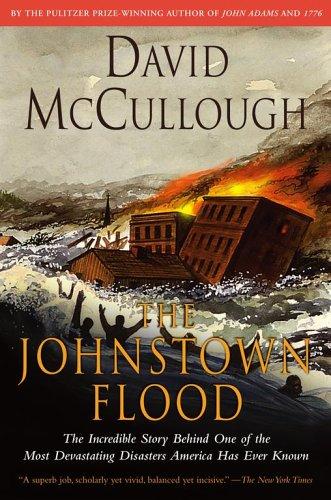
The Johnstown Flood
Simon & Schuster · 1968 · 302 pages
ISBN: 9780671207144
Review Editor
Thomas Calloway
On May 31, 1889, the South Fork Dam gave way after days of heavy rain, releasing twenty million tons of water in a single catastrophic surge down the Little Conemaugh River valley toward Johnstown, Pennsylvania. The wall of water, somewhere between forty and seventy-five feet high at its peak and moving at roughly forty miles per hour, collected trees, houses, freight cars, and the wreckage of every structure it met as it moved. By the time it reached Johnstown’s stone railroad bridge and everything piled and caught fire, more than 2,200 people were dead. The Johnstown Flood remains one of the deadliest peacetime disasters in American history.
David McCullough’s first book, published in 1968, reconstructs those events with precision and drive. McCullough, who would go on to win two Pulitzer Prizes for his biographies of Harry Truman and John Adams, spent years researching the disaster before he began writing, interviewing survivors who were still living and combing through archives, newspapers, and firsthand accounts. The result is history written with the propulsion of a novel, a book that rekindled national interest in an event that had largely slipped from collective memory over eight decades.
What the book places in full view is something that popular accounts of the flood had long softened: the dam belonged to the South Fork Fishing and Hunting Club, an exclusive summer retreat for Pittsburgh’s wealthiest industrialists. Among the members were Andrew Carnegie, Henry Clay Frick, and Andrew Mellon. The club had purchased a deteriorating dam, made structural modifications that weakened it further, ignored repeated warnings from engineers and downstream residents over a period of years, and ultimately bore no legal consequences whatsoever for the disaster. McCullough tells this story without editorializing heavily, trusting the facts themselves to do the work.
Character Arcs and Development
McCullough approaches his subject as a journalist and storyteller rather than as a biographer in the traditional sense, and so the figures in this book emerge less through interior development than through action under extreme pressure. The most compelling presence is not any single individual but an entire community confronting an impossible situation with almost no warning.
Among the individuals who stand out: Daniel J. Morrell, manager of the Cambria Iron Company, recognized the danger the South Fork Dam posed to the valley below and wrote formal letters to the club demanding repairs. He was politely ignored and died before the disaster he had foreseen. John Parke, a young engineer working for the club, rode toward Johnstown on the afternoon of May 31 to warn the town after watching the dam begin to fail; his warnings arrived too late and were not fully understood. Victor Heiser, sixteen years old on the day of the flood, survived by scrambling onto the family barn roof as it swept downstream and would later become a celebrated public health physician. These figures are vivid in McCullough’s telling even when glimpsed only briefly.
The most damning figures in the book may be the club members themselves, who appear as a collective rather than as individuals. McCullough resists the temptation to make cartoons of Carnegie or Frick. He presents them as men who genuinely believed they bore no responsibility, who lived within a legal and moral framework that placed private property rights above almost any other consideration. McCullough frames their escape from accountability not as conspiracy but as something more unsettling: the ordinary, predictable operation of a system designed, in that era, to protect wealth above all else.
Pacing
McCullough structures the book around the timeline of the disaster, and his pacing is one of the great pleasures of reading it. He builds the first third carefully, establishing the geography of the valley, the history of the dam, the sociology of the fishing club, and the slow accumulation of rainfall across the last days of May 1889. By the time the water starts rising in earnest, you understand exactly what is at stake and for whom. The actual break and the flood’s passage through the valley are described with real kinetic force. McCullough has a gift for physical description that is precise without being clinical: you can feel the scale of what is moving through the valley, the noise and the cold and the terrifying speed of it.
If the book has a soft spot, it is the aftermath. The final chapters, dealing with relief efforts and the failed legal proceedings, necessarily slow down. Clara Barton’s arrival with the Red Cross is genuinely moving, but the legal narrative is harder to sustain at the same pitch as the disaster itself. This is not a flaw so much as an honest consequence of what happened: the accountability portion of this story has no satisfying resolution, and McCullough does not pretend otherwise. The book earns its ending even if the ending offers little comfort.
Deeper Thematic Exploration
At its core, this is a book about power: who holds it, who is harmed by its careless exercise, and whether the legal and social structures of a given era have any interest in addressing that imbalance. The men of the South Fork Fishing and Hunting Club were not sadists. They were businessmen who had bought a recreational property, made engineering decisions driven by convenience and cost rather than public safety, been advised by club engineers that everything was probably fine, and genuinely felt that their obligations extended no further than their property line. The disaster, when it came, resulted not from malice but from accumulated indifference.
That indifference killed 2,200 people, most of them workers in the steel industry that generated the fortunes funding the lake above their heads. McCullough does not belabor the irony, but he does not let the reader miss it. The men and women who died in the valley below operated the furnaces and poured the steel that made the club members wealthy. The relationship between industrial capital and industrial labor was the defining tension of the Gilded Age, and the flood brought it into catastrophic, undeniable relief. When survivors and their families sued the club members in court, judges ruled that the flood was an act of God. An act of God, caused by a dam that engineers had warned for years was likely to fail.
A second theme runs through the book: the limits of American civic infrastructure for addressing collective risk. Warnings about the dam’s condition were not secret. Johnstown residents had joked darkly for years about the lake above them. Local engineers and businessmen had raised formal alarms. But there existed no regulatory body, no legal instrument, no enforceable standard that could compel a private property owner to maintain a structure that posed a danger to the surrounding public. The disaster contributed to the slow, contested development of dam safety regulations in Pennsylvania and eventually across the country. McCullough does not frame the book as an argument for regulation; he does not need to. The evidence assembles its own argument.
Beneath all of this runs a quieter thread: the American relationship with catastrophe and resilience. Johnstown rebuilt quickly, and the narrative of reconstruction became part of the town’s civic identity. McCullough honors that resilience without making it sentimental. Rebuilding was necessary and real. It did not erase what had been lost, and it did not deliver justice to anyone who had lost a family member or a home. Both things can be true at once, and the book holds them together.
Style and Voice
McCullough’s prose in this first book already shows the qualities that would make him one of the most widely read historians in America over the following five decades. He writes clean, declarative sentences that know how to accumulate toward something larger than themselves. His descriptions of the flood are spare and kinetic: the water does not simply rise, it moves, collects, batters, and sweeps. He gives the geography of the valley its full weight, so that you understand the physical logic of what happens as it happens.
His voice is warm without being soft, authoritative without being condescending. He quotes generously from contemporary newspaper accounts and survivor testimonies, weaving those voices into his own narrative without losing the thread. The book reads faster than its 302 pages suggest. You finish it with a clear sense of what happened and, more importantly, why it still matters. This is the hardest thing to achieve in popular history, and McCullough gets there on his first attempt.
Verdict
The Johnstown Flood belongs to a tradition of popular history that takes seriously both its obligation to the record and its obligation to the reader. McCullough assumes you can follow a complicated argument about class and negligence while also caring about the human beings caught in a flood. If you have never read McCullough, this is an excellent place to start: shorter and more focused than his later biographies, it demonstrates the essential gift, the ability to make you feel the weight of events that happened before you were born.
If you are already a McCullough reader and have somehow skipped this early work, correct that now. For anyone interested in American history of the Gilded Age, industrial disasters, or the development of American regulatory culture, this book is indispensable. The one reader who might find it unsatisfying is someone looking for sustained analytical engagement with the legal aftermath or the regulatory history; McCullough trusts the story to carry its argument, and for most readers, it does. Bring this one on a long weekend and plan to finish it.
Frequently Asked Questions about The Johnstown Flood
What is The Johnstown Flood by David McCullough about?
The Johnstown Flood is David McCullough’s first book, published in 1968, about the catastrophic dam failure on May 31, 1889, that destroyed Johnstown, Pennsylvania, and killed more than 2,200 people. McCullough traces the history of the South Fork Dam, the wealthy hunting and fishing club that owned it, the warnings that went unheeded, and the disaster itself, drawing on survivor testimony, newspaper accounts, and archival research to reconstruct one of the deadliest peacetime disasters in American history.
Who owned the dam that caused the Johnstown Flood?
The South Fork Dam was owned by the South Fork Fishing and Hunting Club, an exclusive private retreat whose members included some of the wealthiest industrialists in America: Andrew Carnegie, Henry Clay Frick, Andrew Mellon, and others. Club members had purchased the deteriorating dam years earlier, made structural changes that weakened it, and ignored repeated warnings that it posed a danger to the communities downstream. After the flood, lawsuits against club members were dismissed; courts ruled the disaster an act of God, and no member faced legal or financial consequences.
What are the main themes in The Johnstown Flood?
The book explores class and inequality in Gilded Age America, industrial negligence and the absence of public accountability for private property, the limits of American civic infrastructure for managing collective risk, and the tension between private wealth and public safety. Running beneath all of these is a thread about disaster, resilience, and the costs that communities bear when legal and regulatory systems fail to protect them. McCullough does not argue these themes explicitly but lets the documented events speak for themselves.
How long is The Johnstown Flood and is it a difficult read?
The book is 302 pages and reads considerably faster than that suggests. McCullough writes accessible, narrative-driven prose aimed at general readers rather than specialists; no prior knowledge of American history is required. Most readers finish it in two or three sittings. The early chapters establish context and geography before the disaster sequence begins, but the pacing picks up sharply once the flood itself gets underway. It is one of the easier entry points into American popular history writing.
Is there a film or documentary adaptation of The Johnstown Flood?
There is a 1989 PBS documentary film called The Johnstown Flood, made to mark the disaster’s centennial, though it is not a direct adaptation of McCullough’s book. McCullough himself contributed to flood-related documentary programming over the years. The book is not the basis of any major theatrical film. A much earlier silent film from 1926 dramatized the flood, but it predates McCullough’s account entirely and bears little relation to his research.
What age group or reading level is The Johnstown Flood for?
The book is written for adult general readers with an interest in American history. High school students with strong reading skills would handle it comfortably, and it appears on some advanced history curricula. The subject matter, a catastrophic flood and its human and political aftermath, is appropriate for readers in their mid-teens and up. It requires no background in engineering, law, or Gilded Age economics, though a general familiarity with the era makes the book richer.
How does The Johnstown Flood compare to McCullough’s other books?
As McCullough’s debut, The Johnstown Flood is shorter and more focused than the large-scale biographies he became famous for, including Truman, John Adams, and 1776. It is closer in form to his later narrative histories like The Great Bridge and The Path Between the Seas, which also center on a single dramatic event or engineering project. Readers who prefer McCullough’s character-driven biographical work may find this one more event-centered than they expect; readers who like his disaster and infrastructure narratives will feel immediately at home.
Should I read The Johnstown Flood by David McCullough?
Yes, without hesitation, if American history, narrative nonfiction, or Gilded Age social history interests you at all. McCullough makes a largely forgotten disaster feel immediate and morally urgent without resorting to sentimentality or heavy editorializing. The book is short, fast, and quietly devastating in its documentation of how wealth and legal structures protected the powerful and left victims without recourse. It is also, not incidentally, a superb piece of writing from a historian at the beginning of one of the most decorated careers in American letters.
Book Details
- Title
- The Johnstown Flood
- Author
- David McCullough
- Genre
- History
- Publisher
- Simon & Schuster
- Year Published
- 1968
- Pages
- 302
- ISBN
- 9780671207144
- WritersReview Rating
- 4.3 / 5