
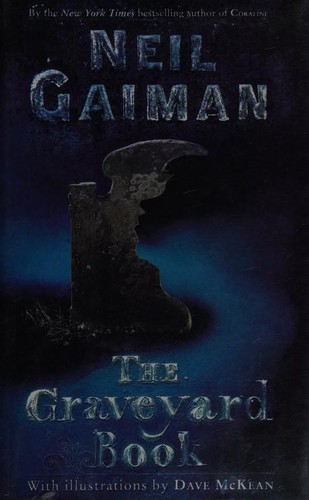
The Graveyard Book
HarperCollins · 2008 · 312 pages
ISBN: 9780060530921
Review Editor
Hannah Bright
Neil Gaiman published The Graveyard Book in 2008, and it won the Newbery Medal, the Hugo Award for Best Novel, and the Carnegie Medal in the two years that followed. No other book has won all three. That fact alone is worth sitting with for a moment, because what it tells you is that critics who judge children’s literature, genre fiction, and literary merit in general all looked at the same book and said: yes, this. It is an unusual achievement, and it is not an accident.
The story begins with a murder. A man named Jack has killed three members of a family in the night and is hunting the fourth, a toddler who has wandered away from the house. The toddler climbs a hill to the old graveyard at the top, where the resident ghosts decide to take him in. The Owens family adopts him and names him Nobody, Bod for short. His guardian, a shadowy figure named Silas who is neither living nor dead, provides for his material needs. The graveyard community raises him: teaching him to read from old epitaphs, helping him navigate the strange rules of his unusual home, protecting him from the world outside the gates.
What follows is a series of linked episodes, each covering a different period of Bod’s childhood, building toward a final confrontation with Jack and the organization behind him. Gaiman has acknowledged that the book began as an answer to a question: what would The Jungle Book look like if Mowgli were raised not by wolves but by the dead? The comparison holds up. This is a book about what happens when a child is raised by something utterly unlike a normal family, and what that child must eventually leave behind to become who he needs to be.
Character Arcs and Development
Bod is one of the more quietly accomplished child protagonists in recent children’s literature. He is curious, stubborn, earnest, and genuinely good in the way that only certain fictional children manage to be good without becoming saccharine. He grows across the book from a toddler exploring his graveyard home to a teenager who can hold his own in a fight, and Gaiman tracks that growth without ever losing the specific texture of who Bod is at each age. The chapter that takes place when Bod is about five feels different from the chapter where he is ten, not just because the plot requires it but because Gaiman seems to genuinely understand how children change.
Silas is the book’s most interesting adult figure. He is a vampire, though the book never quite says so, and his relationship with Bod is one of the most compelling mentor pairings in the genre. He is not warm, not in the way the ghost parents are. He is careful, controlled, and occasionally frightening. What he offers Bod is not comfort but competence, and a kind of steady love that expresses itself through action rather than words. When Silas leaves the graveyard on a mission he cannot explain, his absence feels significant precisely because his presence had felt so reliable.
The secondary characters are drawn with affection and wit. Mrs. Owens, Bod’s ghost mother, has genuine warmth and a proper maternal stubbornness. Miss Lupescu, who teaches Bod survival skills he does not initially appreciate, is formidable and eventually beloved. Scarlett, the living girl who befriends Bod as a child and returns as a teenager, is given real interiority, though the book’s final chapters push her slightly to the margins in ways that feel like a minor structural concession to the need to wrap up Bod’s story. The ghostly residents of the graveyard are rendered with humor and care, particularly the Victorian-era Sleer, ancient and bound, and the cheerfully pompous Mr. Pennyworth.
Pacing
The episodic structure of The Graveyard Book is its most distinctive formal quality and also its greatest potential liability. Each chapter is essentially a self-contained story, and Gaiman leans into this by giving several chapters their own internal story shapes. “The Witch’s Headstone” reads like a fairy tale with a proper moral. “Danse Macabre” is an extended set piece around a supernatural event that recurs once a century. A reader who picks this up expecting a conventional novel with rising action and increasing momentum may feel, around the third or fourth chapter, that the book is doing something other than building toward a climax.
It is. The payoff is the final two chapters, where everything the book has been accumulating, about Bod’s growing skill, the nature of his enemies, the cost of what Silas has been doing, and what it means to grow up in a place where everyone else stopped changing, lands with considerable force. The ending is bittersweet in a way that feels earned rather than imposed. Gaiman does not cheat the reader, does not smooth over the losses, but he does not wallow in them either. The book knows exactly what it is doing by the end, and the episodic chapters are revealed to be exactly as structural as they needed to be.
Deeper Thematic Exploration
The central tension in The Graveyard Book is one of belonging. Bod lives in a graveyard but is not dead. He can wander among the living but cannot safely stay with them. He has parents, a guardian, and an entire community that loves him, but none of them are like him. He is a creature of two worlds who fully belongs to neither. Gaiman treats this condition with genuine compassion rather than sentimentality. Bod’s outsiderness is not played as tragedy. It is simply the condition of his life, and he navigates it with the practical resourcefulness of someone who has never known anything different.
The book is also, and this is where it earns its depth, a meditation on what growing up actually costs. The ghosts in the graveyard stopped changing when they died. Bod, by contrast, cannot stop. He grows taller than his ghost parents. He outpaces what they can teach him. The graveyard that nurtured him becomes, by the book’s final pages, a place he can no longer entirely reach, because the living move through time in a direction the dead cannot follow. This is not a metaphor for something else. It is a metaphor for childhood itself, for the way that the people and places that form you eventually become places you can visit but no longer live in.
There is also something in the book about community as a form of safety. The graveyard is not merely spooky backdrop. It is a neighborhood, complete with gossip, hierarchies, old grievances, and genuine mutual care. The Owens family takes in Bod not because they are required to but because Mrs. Owens makes a choice. That act of chosen obligation runs through the whole book. Silas stays because he decides to stay. The graveyard protects Bod because it decides he is theirs. The living world, by contrast, offers no such shelter. Gaiman is not anti-social precisely, but the book is clear-eyed about the fact that belonging to something, even something unusual, is what allows a person to survive.
Jack and the Jacks of All Trades represent, in a fairly abstract way, those forces in the world that seek to eliminate the anomalous before it can grow into something threatening. Gaiman does not overload this into allegory, which is wise. They are primarily a plot mechanism, a source of real danger, but the idea that a child who falls outside expected categories becomes a target is not incidental to the book’s concerns.
Style and Voice
Gaiman’s prose in The Graveyard Book operates in the register of fairy tale without being coy about it. The sentences are clean and deliberate, the descriptions precise in the way that good fairy tale writing is precise: not lingering, but exact. When he describes the graveyard at night, you feel the cold air and the peculiar comfort of a place that has been at peace with its own strangeness for centuries. When he describes the Sleer, coiled under the barrow at the graveyard’s oldest edge, the menace is genuine, not decorative.
The book’s voice belongs to no particular era, which is part of its power. It feels old and new simultaneously. The chapter headings (“How Nobody Came to the Graveyard,” “The Witch’s Headstone”) echo old story collections. The concerns are contemporary, or rather timeless. The illustrator Dave McKean, whose chapter-opening drawings appear in the original edition, catches this quality exactly: the images are suggestive rather than literal, more atmosphere than documentation.
There are individual passages here of real loveliness, particularly in the scenes where Gaiman describes the relationship between Bod and the graveyard itself, the way it knows him and he knows it, the way certain spots hold certain feelings. He does not quote himself into sentimentality. The feeling is there in the structure of what he notices.
Verdict
If you are looking for a book to read with a child between the ages of nine and twelve, or a book you can give a teenager and expect them to keep, The Graveyard Book is one of the best options currently in print. It is genuinely scary in places without being traumatizing, genuinely funny in places without being silly, and the ending will sit with a young reader for years. Adults who come to it fresh will find it shorter and differently structured than they might expect from its reputation, but they will not be disappointed.
The book’s one genuine limitation is the slight thinness of its final antagonists. Jack is menacing for much of the book precisely because he is mostly offscreen, and the Jacks as a collective never quite solidify into something as interesting as the graveyard community they are set against. This is a real but minor weakness in a book whose strengths are so considerable. Whatever it gives up in conventional thriller mechanics, it more than recovers in the weight of what it says about growing up and leaving home. Some books you finish and feel vaguely satisfied. This one ends and leaves a particular silence that takes a moment to shake off. That is not nothing. That is most of what literature is for.
Frequently Asked Questions about The Graveyard Book
What is The Graveyard Book by Neil Gaiman about?
The Graveyard Book follows Nobody “Bod” Owens, a toddler whose family is murdered by a mysterious man named Jack. Bod escapes to a nearby graveyard, where the ghost residents adopt and raise him. The book follows Bod’s childhood through linked episodes, each covering a different stage of his life, until a final confrontation with Jack and the forces behind him. It is a story about belonging, growing up, and what it costs to leave behind the community that formed you.
Is The Graveyard Book appropriate for kids and what age is it for?
The Graveyard Book opens with a murder scene, and it contains genuine peril and one significant death of a character readers will care about. It is not a cozy read. Most booksellers and librarians recommend it for readers aged 9 to 12, though many children read it younger and many adults read it happily. If a child is comfortable with books like Harry Potter or the Narnia series, they will almost certainly handle The Graveyard Book without trouble.
What awards did The Graveyard Book by Neil Gaiman win?
The Graveyard Book won the Newbery Medal (2009), awarded by the American Library Association for the most distinguished contribution to American literature for children. It also won the Hugo Award for Best Novel (2009) and the Carnegie Medal (2010), the UK’s most prestigious prize for children’s literature. No other book has ever won all three of these awards, which together represent the highest recognition in children’s fiction, genre fiction, and literary fiction for young people.
How does The Graveyard Book compare to The Jungle Book?
Neil Gaiman has been open about the fact that The Graveyard Book was conceived as a graveyard version of Rudyard Kipling’s The Jungle Book. Both books follow a child raised outside human society by a community of non-human beings; both are structured as linked episodes covering different stages of childhood; and both end with the protagonist leaving behind the world that raised them. Gaiman’s version is darker and more emotionally complex, but the structural parallel is deliberate and worth knowing when you read it.
Is there a movie or TV adaptation of The Graveyard Book?
As of 2025, no film or television adaptation of The Graveyard Book has been released. A film adaptation has been in development at various studios for several years, with Ron Howard attached as director at one point. Nothing has yet reached production. The graphic novel adaptation, illustrated by P. Craig Russell and published in two volumes by HarperCollins, is an excellent alternative for visual readers and captures the tone of the original book very well.
What is Nobody “Bod” Owens like as a character?
Bod is one of children’s literature’s more quietly accomplished protagonists. He is curious, stubborn, and genuinely good without being saccharine. He grows across the book from a wandering toddler to a capable teenager, and Gaiman tracks that growth carefully, giving each age its own texture and set of concerns. Bod’s defining quality is probably his practical acceptance of his own strangeness: he lives in a graveyard, is raised by the dead, and takes this as simply the condition of his life rather than a tragedy requiring correction.
Who is Silas in The Graveyard Book and why does he matter?
Silas is Bod’s guardian: a figure who is neither living nor dead (the book strongly implies he is a vampire, without ever quite saying so) who provides for Bod’s material needs and teaches him to navigate the dangerous world outside the graveyard gates. He is the book’s most compelling adult character. Silas is not warm in the way Bod’s ghost parents are; he is controlled, careful, and occasionally frightening. His relationship with Bod is built on competence and quiet loyalty rather than expressed affection, and it is one of the most interesting mentor relationships in recent children’s fiction.
Should I read The Graveyard Book and is it worth it for adult readers?
For adults who enjoy fairy-tale register prose, complex emotional themes handled with precision, and stories that end on a bittersweet note that feels earned rather than imposed, yes, absolutely. The book is shorter than its reputation might suggest and reads in a single sitting. Adults coming to it for the first time should know it is episodic rather than conventionally plotted, which can wrong-foot readers expecting escalating thriller mechanics. If you can let it do what it does on its own terms, it is deeply rewarding, and the ending is the kind that takes a moment to shake off.
Book Details
- Title
- The Graveyard Book
- Author
- Neil Gaiman
- Genre
- Children's
- Publisher
- HarperCollins
- Year Published
- 2008
- Pages
- 312
- ISBN
- 9780060530921
- WritersReview Rating
- 4.7 / 5