
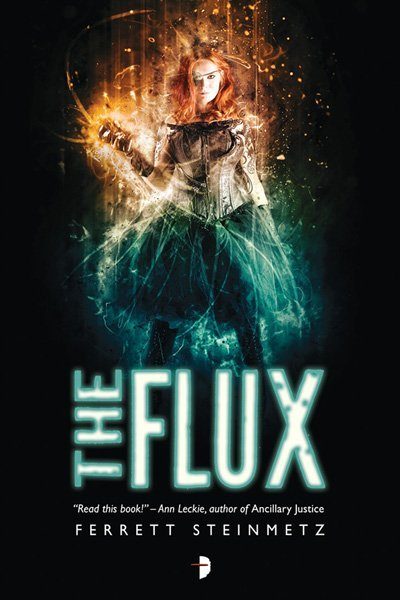
The Flux
Angry Robot · 2015 · 400 pages
ISBN: 9780857664631
Review Editor
Marcus Webb
Published in October 2015 by Angry Robot, The Flux is the second novel in Ferrett Steinmetz’s ‘Mancer trilogy, following Flex and preceding Fix. The series is built on a premise that sounds whimsical but plays out with real emotional weight: in this version of our world, obsession creates magic. Love something deeply enough, whether it’s paperwork, video games, or origami, and your devotion can bend the laws of physics. A bureaucromancer reshapes reality through forms and regulations. A videogamemancer pulls abilities straight from the games she’s played. But every act of magic carries a price called flux, a wave of bad luck that the universe throws back at you, proportional to how far you pushed it. The Flux picks up two years after the events of Flex, and it escalates every element of its predecessor while zeroing in on the messy, painful, beautiful question at its center: how do you protect the people you love when you are the danger?
Paul Tsabo is living at least three lives when the book opens. To the public, he’s the celebrated head of New York’s Task Force for ‘Mancer Control, the man who killed two ‘mancers and now hunts down others. In secret, he’s a bureaucromancer himself, wielding the power of paperwork with a quiet precision that makes him formidable in ways nobody expects. On the side, he’s brewing Flex, a magical drug, for a local crime syndicate to pay off old debts. His daughter Aliyah, just eight years old, is a videogamemancer who killed a terrorist with her powers in the previous book and is still trying to process that fact. If anyone discovers what either of them can do, the government will brainwash them both and conscript them into SMASH, the military’s anti-magic unit. Meanwhile, a new player called the King of New York has arrived with a private army of ‘mancers, and he wants Paul and Aliyah for reasons that unfold with genuinely surprising turns.
Character Arcs and Development
Paul Tsabo was already one of the more unusual protagonists in urban fantasy, and The Flux pushes him into territory that makes him genuinely uncomfortable to root for at times. He lies to everyone around him, including the people he’s supposed to be protecting, and Steinmetz never lets him off the hook for it. Paul’s desperation to keep Aliyah safe leads him into increasingly tangled moral compromises, and the book is smart enough to show that his protectiveness sometimes looks a lot like control. He means well. He almost always makes things worse. That tension is what makes him compelling rather than simply sympathetic.
Aliyah gets substantially more page time here, and she is a complicated kid to spend time with. She’s angry, traumatized, powerful beyond her understanding, and convinced that her father doesn’t trust her. She’s also eight, which means her judgment is terrible in exactly the ways an eight-year-old’s would be. Steinmetz walks a difficult line with her character, and mostly succeeds. There are moments where her dialogue feels slightly too articulate for her age, but her emotional logic, the way she processes fear as fury, the way she tests boundaries by blowing things up, feels grounded in how real children navigate overwhelming situations. The scenes where she and Paul clash over her use of magic carry real sting because both of them have a point.
Valentine DiGriz, the videogamemancer, comes fully into her own in this installment. She stole scenes in Flex, but here she’s a co-lead, and the book is better for it. Valentine is loud, confident, deeply loyal, and capable of channeling the mechanics of any video game she’s played into real-world combat. She also serves as a bridge between Paul and Aliyah, someone who understands both of them because she’s neither parent nor child but something like a wild older sister. Her friendship with a character called Tyler Durden (yes, that Tyler Durden, born from someone’s obsessive love of Fight Club) adds a welcome layer of humor and strangeness to the middle act.
Pacing
Steinmetz structures The Flux as a series of escalating crises, and the approach works. The opening chapters establish the new status quo efficiently: Paul’s double life, Aliyah’s growing powers, the conspicuous absence of new ‘mancers in a city where dozens were expected. Once the King of New York enters the picture, the book accelerates and rarely lets up. There’s a stretch in the second act where the family dynamics and the external threat weave together so tightly you can’t separate one from the other, and those are the book’s best pages.
If anything sags, it’s a handful of scenes in the middle where the pop culture references pile up faster than the plot needs them to. Steinmetz clearly loves gaming culture, and most of the references land, but there are moments where the sheer density of video game callbacks slows a scene that wants to be about character. It’s a minor issue. The final third of the book moves at a pace that will keep you reading past your planned bedtime, and the climax earns every bit of its emotional payoff.
Deeper Thematic Exploration
The ‘Mancer series has always been about obsession, but The Flux sharpens that idea into something more personal and more painful. Obsession is the source of magic here, and the book asks what happens when your obsession is another person. Paul is obsessed with protecting Aliyah. Aliyah is obsessed with proving she doesn’t need protection. These two drives feed on each other and create their own kind of flux, a relational blowback that damages both of them even as it comes from a place of love.
There’s a deeper current running through the story about the cost of secrecy. Paul lies to his ex-wife, his task force, his criminal associates, and eventually his own daughter. Every lie is justified by the need to keep Aliyah safe, but the accumulated weight of deception becomes its own kind of danger. Steinmetz draws a clear parallel between the magic system’s flux and the consequences of dishonesty: both are debts that compound, and both come due at the worst possible time.
The book also takes on the question of what it means to raise a child who is more powerful than you are. Paul can shape paperwork into miracles, but Aliyah can tear reality apart with a tantrum. The power imbalance between parent and child flips in this scenario, and Steinmetz explores the fear, pride, and helplessness that creates. Paul wants Aliyah to be safe, but safety for a ‘mancer means suppression, hiding, pretending to be ordinary. The book never pretends there’s an easy answer to that dilemma, and the story is richer for the honesty.
Style and Voice
Steinmetz writes with an energy that matches his characters. The prose is conversational and punchy, full of gaming slang and pop culture shorthand that could feel dated but mostly doesn’t because it’s so clearly rooted in character voice rather than authorial showing-off. When Valentine describes a fight in terms of combo chains and power-ups, it works because that’s how she genuinely sees the world. When Paul thinks in terms of bureaucratic loopholes, it works for the same reason. The two narrative voices complement each other in a way that keeps the reading experience varied and alive.
The action sequences are inventive and visually precise. Steinmetz has a gift for translating game mechanics into prose combat in ways that are both funny and visceral. A battle where Aliyah channels Pokemon abilities while Valentine pulls from God of War is exactly as chaotic and delightful as it sounds. The quieter scenes, particularly the arguments between Paul and Aliyah, are written with a different kind of precision: careful, emotionally exact, willing to let silence carry meaning. That range, from explosive set pieces to still, painful family moments, is what separates the ‘Mancer series from most of its urban fantasy peers.
Verdict
The Flux is that rare sequel that justifies its existence by going deeper rather than just bigger, though it manages to be bigger too. If you played video games growing up, if you’ve ever loved something so much it felt like it could change the world, if you’ve ever watched a parent and child hurt each other while trying to help, this book will find you where you live. Readers who bounced off Flex’s premise probably won’t be converted here, and anyone who needs their fantasy to take itself seriously at all times will find the pop culture density grating. But for everyone else, for the readers who want their urban fantasy weird and warm and willing to let its characters be wrong, The Flux delivers. Steinmetz built something special with this trilogy, and the second volume is where the foundation proves it can hold real weight.
Frequently Asked Questions about The Flux
What is The Flux by Ferrett Steinmetz about?
The Flux is the second book in the ‘Mancer trilogy, set in a world where obsession creates magic. It follows bureaucromancer Paul Tsabo, his eight-year-old videogamemancer daughter Aliyah, and their friend Valentine DiGriz as they hide their powers from the government while facing a mysterious new threat called the King of New York. The story blends urban fantasy action with a raw, honest exploration of a father trying to protect a daughter who may be too powerful to contain.
Do I need to read Flex before The Flux by Ferrett Steinmetz?
You can follow The Flux without having read Flex, but the experience is much richer with the first book’s context. Key character relationships, the magic system’s rules, and several major plot points carry over directly. Reading Flex first takes about eight hours and gives you the full emotional setup for everything The Flux pays off.
What are the main themes in The Flux by Ferrett Steinmetz?
The Flux explores the tension between protection and control in parent-child relationships, the compounding cost of secrecy and lies, what it means to raise a child more powerful than yourself, and how obsession can be both creative and destructive. The magic system, where every spell generates bad-luck blowback called flux, serves as a metaphor for how the consequences of our choices always catch up with us.
How long is The Flux and is it a difficult read?
The Flux is 400 pages (about 13 hours in audiobook format narrated by Peter Brooke) and reads quickly thanks to its conversational prose style and fast pacing. It’s accessible to anyone comfortable with urban fantasy, though you’ll get more out of the video game references if you have some gaming background. Most readers report finishing it in a few days.
Is there a movie or TV adaptation of The Flux?
As of 2026, there is no movie or TV adaptation of The Flux or any book in the ‘Mancer trilogy. The series’ blend of video game mechanics, creative magic battles, and emotional family drama would translate well to screen, but no adaptation has been announced by Angry Robot or any production studio.
What age group or reading level is The Flux appropriate for?
The Flux is written for adult readers. It contains violence, drug references (magical drug manufacturing is a plot element), and mature themes around trauma and family conflict. Paul’s daughter Aliyah is eight years old, but the story is told from adult perspectives. Older teens who read adult fantasy would likely enjoy it, but it is not a young adult novel.
How does The Flux compare to Flex and Fix in the ‘Mancer trilogy?
Most readers consider The Flux an improvement over Flex, with deeper character development, higher stakes, and a stronger role for Valentine DiGriz. It avoids the common “second book slump” by expanding the world and the emotional stakes simultaneously. Fix, the final book, carries a slightly higher Goodreads rating than The Flux, completing the trilogy’s upward trajectory in quality.
Should I read The Flux and is it worth it?
If you enjoy urban fantasy with creative magic systems and strong family dynamics, The Flux is well worth your time. Gamers will love the video game combat sequences, and readers who value emotional depth over pure action will find plenty to connect with. If you prefer traditional fantasy with a consistently serious tone, the pop culture density may not be for you. For most readers, though, this is one of the more original and emotionally satisfying entries in modern urban fantasy.
Book Details
- Title
- The Flux
- Author
- Ferrett Steinmetz
- Genre
- Science Fiction
- Publisher
- Angry Robot
- Year Published
- 2015
- Pages
- 400
- ISBN
- 9780857664631
- WritersReview Rating
- 4.1 / 5