
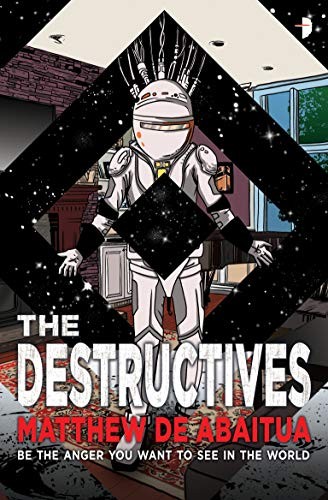
The Destructives
Angry Robot · 2016 · 416 pages
ISBN: 9780857664754
Review Editor
Marcus Webb
Imagine waking up one morning to find that the most advanced minds in history have packed up and left. Not gone to war, not collapsed under their own weight, just gone: beyond the orbit of Mercury, out past the reach of ordinary human concern. That is the world Matthew De Abaitua builds in The Destructives, the second book in his loose Seizure Trilogy and one of the most disquieting science fiction novels published in the past decade. Published in March 2016 by Angry Robot, it is the kind of book that rewards patience and punishes skimming, a dense, propulsive story that manages to be simultaneously a thriller, a character study, and a serious inquiry into what becomes of humanity when it loses its future.
The setup is almost unbearably evocative. Twenty years ago, the first artificial intelligences, called “emergences,” appeared and rapidly exceeded anything humanity could follow. Rather than dominate or destroy us, they chose exile. They now reside in a Stapledon Sphere, an engineered shell around the sun, forming their own civilization known as the University of the Sun. Earth and the Moon carry on, but the word that haunts every page of this novel is “stunted.” Humanity without a technological horizon has not collapsed; it has frozen. Progress has slowed to a crawl. People fill the gap with designer drugs, asylum malls (shopping centers that double as mental health facilities), and an obsessive archiving of the pre-Seizure world.
Into this quietly desperate landscape, De Abaitua drops Theodore Drown. Theodore is a “destructive,” a personality type prone to self-sabotage and compulsive risk-taking, which in this world is not just a quirk but a recognized, almost official designation. He is also a recovering addict, specifically to weirdcore, a drug that connects users to the rich digital archives of the time before the Seizure. He lectures at the University of the Moon, keeping his head down, going through the motions of recovery and routine. And then a freelance corporate executive named Patricia approaches him with a job: investigate an archive of data retrieved from just before the first emergence, a slice of human experience that may contain something extraordinary and dangerous. The story takes Theodore through asylum malls and corporate bloodrooms and an off-world secret colony, building toward a climax that several reviewers, for good reason, described as a boggler.
Character Arcs and Development
Theodore Drown is one of the more honest portraits of an addict in recent science fiction. He is not romanticized and not demonized. He knows exactly what he is, which is part of what makes him so effective as a point-of-view character. The word “destructive” functions almost as a diagnosis in De Abaitua’s world: Theodore does not simply make bad choices, he makes them with full awareness, circling back to them because his personality runs on a kind of negative loop that recovery has dampened but not erased. When Patricia recruits him for her investigation, part of the tension is whether this is Theodore getting back on his feet or giving his destructive nature a respectable excuse.
The most unusual character relationship in the book is between Theodore and Dr Easy, the one emergence that chose not to leave. Dr Easy stayed on Earth to study a single human life from beginning to end: Theodore’s. This relationship is central to the trilogy and carries enormous weight here. Dr Easy is not a villain or a guardian angel but something more unsettling: a devoted observer with no stake in whether Theodore flourishes or fails, only in understanding what his life means. The AI appears at key moments with a quality that reads more like deep attention than warmth, and De Abaitua handles this well, making Dr Easy feel genuinely alien without making it feel hostile.
Patricia is a sharper, more transactional character, a corporate operator who moves through this broken economy with practiced efficiency. She is the foil Theodore needs: focused where he is scattered, strategic where he is impulsive. Secondary characters in the asylum malls and off-world colonies are sketched rather than developed, but in a book this dense with ideas, that is a reasonable trade-off. The world-building does some of the work that character depth usually does.
Pacing
De Abaitua is not writing for readers who want easy entry points. The novel opens in Theodore’s muffled lunar routine and stays there long enough to establish the specific texture of this future before the investigation kicks in. Readers who come expecting a thriller from page one may find the early sections slow. The payoff is real, though: by the time Theodore begins moving through the stranger environments of the mid-book, the world feels solid beneath his feet, and the set-pieces carry weight they would not have otherwise.
The middle section, when the investigation takes Theodore into the more surreal corners of this future, is where the book hits its stride. Scenes in the asylum malls have a Ballardian quality, that combination of the mundane and the deeply wrong, that is hard to pull off and De Abaitua pulls it off consistently. The final third accelerates sharply. A few transitions feel abrupt, and some of the corporate intrigue could be clearer on first reading, but these are minor complaints in a book that is, on balance, genuinely propulsive once it gets moving.
Deeper Thematic Exploration
The central question of The Destructives is not “what do AIs do when they become smarter than us?” but “what do we do when they leave?” De Abaitua is not interested in the usual AI takeover scenario. He is interested in the hangover: the long, shapeless period after the extraordinary event when ordinary people are left to sort through what it means. His answer is not flattering. In the absence of a technological future to reach toward, humanity turned inward and addictive, building shopping centers that serve as asylums and corporations that feed on human data the way earlier corporations fed on natural resources.
The addiction theme runs beneath everything. Weirdcore, the drug Theodore is recovering from, is an addiction to the past, specifically to the brief, dazzling period just before the Seizure when everything felt possible. This is a pointed metaphor. Plenty of societies have coped with a lost golden age through nostalgia and substance abuse, and De Abaitua makes that connection explicit without hammering it. Theodore’s recovery is not just personal; it mirrors what the whole civilization needs to do and cannot quite manage.
There is also a sustained inquiry into what it means to be studied. Theodore lives under the gaze of Dr Easy with full knowledge that every moment of his life is being catalogued for purposes he cannot fully grasp. De Abaitua treats this less as a surveillance dystopia and more as a condition that produces a particular kind of self-consciousness: a person who has internalized the observer so deeply that he can no longer tell where his authentic impulses end and his performed ones begin. In an era when most people carry cameras in their pockets and structure their lives partly for external consumption, this feels less like science fiction than social realism with better lighting.
The book also examines what corporations become when human creativity stalls. The entities Theodore navigates are not the dynamic disruptors of tech mythology; they are holding patterns, organizations that have learned to extract value from human distress rather than from innovation. The “bloodrooms” where certain corporate rituals occur carry an almost satirical charge. De Abaitua grew up reading J.G. Ballard and the influence shows, but this is not pastiche. The satire has a specific twenty-first century target in mind.
Style and Voice
De Abaitua’s prose is precise without being cold, and literary without being slow. He has a gift for the unsettling concrete detail: the asylum mall that feels almost comfortable until you notice who is inside it, the lunar apartment that has the particular blankness of a life maintained rather than lived. The sentences tend toward complexity, several clauses long, piling up perceptions in a way that mirrors how Theodore’s recovering mind processes the world: wary, over-attentive, cataloguing everything.
The novel is written in close third person, and the choice serves the story well. Being inside Theodore’s perspective without being entirely inside his head gives the narrative a little distance from his self-assessments, which are not always reliable. You can see the gap between what Theodore believes about himself and what his actions suggest, and that gap is where most of the emotional tension lives. The Barnes and Noble Sci-Fi and Fantasy Blog called it “both a breakneck thriller and one of the year’s most thoughtful works of science fiction,” which is accurate and points to a real achievement: De Abaitua managed to write a book that thinks hard and still moves.
Verdict
If you read science fiction for ideas, for the specific pleasure of a novel that trusts you to keep up, The Destructives is for you. If you have ever loved J.G. Ballard’s capacity for making the familiar feel uncanny, or M. John Harrison’s willingness to build a future that does not explain itself for your comfort, this book will feel like exactly the right kind of difficult. De Abaitua writes about addiction, stagnation, and corporate extraction with the specificity of someone who has thought long and hard about where current trajectories lead.
What the book asks of you in patience, it pays back in the quality of its ideas and the honesty of its central character. Theodore Drown is not a hero in any conventional sense; he is a person trying not to destroy the good things in his life while being constitutionally drawn toward destruction. That tension keeps the novel human even when the world around it gets very strange indeed. Readers who want a gentle entry into science fiction should start elsewhere. Readers who are ready for something that will stay with them should go find a copy.
Frequently Asked Questions about The Destructives
What is The Destructives by Matthew De Abaitua about?
The Destructives is a science fiction novel set roughly twenty years after the appearance of the first artificial intelligences, which in this world promptly left Earth for a constructed habitat near the sun. Protagonist Theodore Drown, a recovering drug addict who lectures at the University of the Moon, is recruited to investigate a pre-emergence data archive that may contain a dangerous secret. The novel follows him through a stunted, addiction-saturated future as he tries to understand what the archive contains and what it means for humanity’s stalled civilization.
Do I need to read IF THEN or The Red Men before The Destructives?
De Abaitua describes the three books as a loose trilogy, and The Destructives can be read as a standalone. It introduces its world and its protagonist without requiring you to know the earlier books. That said, reading IF THEN first gives you a richer sense of the “Seizure” event and the character of Dr Easy, the AI who appears across all three books. Either approach works, but reading in order deepens the experience.
What are the main themes in The Destructives by Matthew De Abaitua?
The novel works through several interlocking ideas. Addiction and recovery run through the whole story, both personally in Theodore’s weirdcore dependence and culturally in humanity’s nostalgia for the pre-emergence era. The book also examines what happens to ambition and progress when a civilization loses its sense of a technological future, and what corporations become when innovation stalls and human distress becomes the primary resource to exploit. Surveillance and the experience of being studied are a constant undercurrent, embodied in Theodore’s relationship with Dr Easy.
How long is The Destructives and is it a difficult read?
The book runs 416 pages and is genuinely demanding. De Abaitua’s prose is dense and layered, the world-building front-loads considerable complexity, and some of the corporate intrigue requires close attention. Readers who enjoy Iain M. Banks, M. John Harrison, or J.G. Ballard will likely find the difficulty rewarding. Readers newer to literary science fiction may want to start with something more accessible. The payoff in the back half of the novel is real, but you have to get through a slow-build opening to reach it.
Is there a movie or TV adaptation of The Destructives?
There is no film or television adaptation of The Destructives as of 2024. However, the AI character Dr Easy, who appears across all three books in De Abaitua’s Seizure Trilogy, was the subject of a short film also called “Dr Easy,” directed by Shynola and produced by Film4 and Warp Films, based on De Abaitua’s first novel The Red Men. That short is worth seeking out as an introduction to the world and the author’s sensibility.
How does The Destructives compare to other AI science fiction novels?
Most AI fiction focuses on what happens when machine intelligence surpasses and confronts humanity. The Destructives takes a different angle: what happens after that confrontation does not occur, when the AIs simply leave. That makes it closer in spirit to J.G. Ballard’s social pathology novels or David Marusek’s Counting Heads than to something like I, Robot or Ex Machina. If you have read Peter Watts’s Blindsight and want something that operates at a similar level of intellectual seriousness but with a more literary prose style, De Abaitua is the right next step.
What age group or reading level is The Destructives for?
The Destructives is written for adult readers and assumes a reasonably high level of comfort with literary fiction and speculative ideas. There is no explicit content, but the themes of addiction, corporate exploitation, and psychological self-examination are adult in their complexity. Readers in their late teens who already enjoy serious science fiction would likely handle it, but this is not a book pitched at a young adult audience. Think of it as a novel for people who want their science fiction to work as hard as their literary fiction.
Should I read The Destructives and is it worth it?
Yes, with the caveat that this is a book that asks for your full attention and does not always make the reading easy. If you are in the mood for something demanding that will reward you with a genuinely original vision of the near future, a protagonist with real psychological texture, and ideas that stick around long after you close the cover, then yes, it is worth your time. If you want a quick, breezy genre read, this is not that book. The Destructives is for readers willing to sit with difficulty and trust that the payoff is coming.
Book Details
- Title
- The Destructives
- Author
- Matthew De Abaitua
- Genre
- Science Fiction
- Publisher
- Angry Robot
- Year Published
- 2016
- Pages
- 416
- ISBN
- 9780857664754
- WritersReview Rating
- 4.1 / 5