
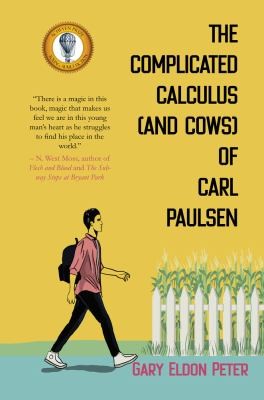
The Complicated Calculus (and Cows) of Carl Paulsen
Regal House Publishing · 2022 · 164 pages
ISBN: 9781646032532
Review Editor
Zoe Adler
Summary
Gary Eldon Peter’s debut novel arrives quietly, without flash or spectacle, and that restraint turns out to be one of its greatest strengths. Set on a small dairy farm in southern Minnesota, The Complicated Calculus (and Cows) of Carl Paulsen follows fifteen-year-old Carl through a single school year that manages to pack in first love, family grief, financial precarity, and the slow, uncertain business of figuring out who you are. The novel was published in 2022 by Fitzroy Books, the young adult imprint of Regal House Publishing, and it won the Minnesota Book Award, the Acheven Book Prize for Young Adult Fiction, and a spot on NPR’s best books of the year list. Those accolades are well earned, though they tell only part of the story.
Carl Paulsen is the kind of teenager who notices everything and says almost nothing. He lives with his father on a struggling family dairy operation, doing chores before school, worrying about whether his dad will have to sell the farm, and carrying around a grief for his mother that he has never quite found words for. She died of cancer two years before the novel begins, and her absence shapes every room Carl walks into. Into this already complicated life walks Andy Olnan, a new student who has recently moved to the area from Minneapolis, and who is handsome, confident, and apparently comfortable in a way that Carl finds both magnetic and bewildering. Carl falls for Andy almost immediately, and the novel’s central question becomes not whether he will act on those feelings, but whether he can learn to trust himself enough to find out what those feelings actually mean.
The title’s reference to calculus is not incidental. Carl is taking the class and struggling with it, and Peter uses the subject as a running metaphor without ever making the symbolism feel labored. Calculus is the study of change, of rates and limits and the behavior of things in motion. Carl is a teenager who wants life to stay the same (the farm, his routines, his father’s presence) even as everything around him is shifting. The cow named Mabel, who Carl befriends almost by accident, adds another layer to this: Mabel is consistent, unglamorous, and present in a way that most of the people in Carl’s life struggle to be. Peter earns every cow joke implied by the title, and then some.
Character Arcs and Development
Carl is a genuinely well-drawn protagonist. He is not idealized or made effortlessly sympathetic; he can be oblivious, stubborn, and overly willing to project his own hopes onto Andy without checking whether those hopes have any basis in reality. But these are recognizable teenage traits, not authorial failures, and Peter renders them with enough affection and precision that readers are likely to feel both frustrated with Carl and protective of him at the same time. His interior monologue is steady and thoughtful, the kind of voice that takes things seriously without taking itself too seriously.
Andy Olnan is more interesting than he first appears. He arrives seeming to be the “cool boy from the city” archetype, and for a while the novel allows that reading to stand. But Peter gradually complicates it. Andy has his own secrets, his own family pressures, and his own reasons for keeping people at arm’s length. The novel resists turning him into either a romantic fantasy or a villain, and that balance gives the friendship between Carl and Andy something worth reading about beyond the question of whether they will end up together. Carl’s father, Darryl, is rendered with equal care: a man who loves his son and has no vocabulary for it, who is letting grief make his decisions for him, and who is not quite the obstacle Carl imagines him to be.
Secondary characters, including a sympathetic teacher and a couple of classmates who occupy the edges of Carl’s social world, feel specific rather than functional. They do not exist merely to move the plot forward; they suggest a community with its own textures and its own complicated relationship to difference. The town is rural and largely insular, and Peter neither romanticizes nor condescends to it. People there say things that sting, and they also show up when it counts.
Pacing
The novel moves slowly by design, and this is where some readers may find themselves testing their patience. Peter is interested in interiority more than incident, and there are stretches where not much happens externally while quite a lot happens inside Carl’s head. This is a deliberate tonal choice, and it fits the material: the midwestern farming landscape, the rhythm of daily animal care, the long winters that make introspection feel like the only available option. But readers who come to YA fiction expecting a faster tempo should know in advance that this book has a different rhythm. It rewards a willingness to sit with the protagonist in his uncertainty rather than pushing him toward resolution at every turn.
The pacing does tighten in the novel’s second half, as the various pressures on Carl (the farm’s financial situation, his feelings for Andy, the question of coming out to his father) begin to converge. Peter handles this convergence with care, avoiding the kind of tidy simultaneous resolution that can feel false in fiction about real-world problems. Things do not all work out in the same chapter. Some of them work out imperfectly, or in ways that require more time than the novel has left. That, too, feels honest.
Deeper Thematic Exploration
At its core, the novel is about the weight of what has been lost and the difficult work of remaining present anyway. Carl’s grief for his mother is not a subplot; it is the emotional ground the entire novel stands on. She is present in his memories of the farm, in his father’s silences, in the way Carl cannot bring himself to imagine a future that looks very different from the past she loved. Peter treats this grief with patience, returning to it not as a device to generate feeling but as something Carl actually has to think through, slowly and without shortcuts.
The coming-out narrative is handled with notable restraint. Carl does not deliver a speech; he does not arrive at a moment of triumphant public self-declaration. What he does is smaller and, for that reason, more credible: he begins to tell the truth to one person at a time, and he discovers that the truth is survivable. The novel does not pretend that small-town Minnesota is a frictionless environment for a gay teenager. Homophobia is present, ambient and sometimes overt, and the people who accept Carl are sometimes only barely able to say the word. But Peter insists, through the shape of the narrative, that this imperfect acceptance is still something, that it is still a place to begin.
The farm itself functions as a site of thematic tension. It represents both constraint and continuity, both the burden of inherited obligation and the anchor of identity. Carl is ambivalent about it in ways he cannot fully articulate: he resents what it demands of him and cannot imagine leaving it. Peter uses this ambivalence to explore a broader question about rural life and what it means to belong somewhere, to have a history rooted in a particular piece of land, without reducing that question to a simple verdict. The farm is not salvation, but it is not a trap either. It is just where Carl is from, and that turns out to matter in ways that surprise him.
Style and Voice
Peter’s prose is precise and unhurried. He writes sentences that do exactly what they need to do and no more, with an ear for the rhythms of thought that feels authentic to the introverted, observant teenager he has created. The dialogue is spare, sometimes uncomfortably so, but that sparseness reflects the world the novel inhabits: a place where people do not say the thing they mean, where silence carries weight, and where understanding someone often requires reading what they are not saying. This is a stylistic choice that some readers will find satisfying and others will find frustrating, but it is consistent and controlled throughout.
The novel’s use of Mabel the cow as a recurring presence is one of its quiet pleasures. The cow does not talk, does not symbolize anything too heavily, and does not rescue Carl from any of his problems. She is simply there, reliable and bovine, and Carl’s affection for her says something about what he is looking for: steadiness, uncomplicated presence, something that needs him in a way he can understand. Peter pulls this off without sentiment, which is harder than it looks.
Verdict
This is a careful, quiet novel that trusts its readers to meet it where it is. It does not reach for easy catharsis or tidy resolutions. It is interested in what it actually feels like to be a teenager carrying grief and uncertainty through ordinary days, and it renders that experience with enough specificity and compassion to make it feel earned. Readers looking for an LGBTQ+ coming-of-age story that avoids the genre’s familiar formulas will find something genuinely different here. The novel’s unhurried pace and interior focus will suit some readers better than others, but those who give it the attention it asks for are likely to find it stays with them.
Recommended for readers aged fourteen and up, and particularly for anyone who has spent time in a rural community and wondered whether the world they grew up in has a place for who they are turning out to be. Gary Eldon Peter’s debut is a promise well kept: a novel with a funny title that takes everything seriously, including the cows.
Frequently Asked Questions about The Complicated Calculus (and Cows) of Carl Paulsen
What is The Complicated Calculus (and Cows) of Carl Paulsen about?
The novel follows fifteen-year-old Carl Paulsen, who lives with his father on a struggling dairy farm in rural southern Minnesota. Carl is gay, grieving the recent death of his mother, and quietly terrified that he will never find anyone who understands him. When a new student named Andy Olnan arrives from Minneapolis, Carl falls for him and begins navigating the complicated terrain of first love, family obligation, and the slow work of figuring out how to be honest about who he is.
Who wrote The Complicated Calculus (and Cows) of Carl Paulsen?
Gary Eldon Peter is a Minneapolis-based author and retired faculty member from the University of Minnesota, where he taught writing and literature for twenty-one years. He holds an MFA in Creative Writing from Sarah Lawrence College and a JD from William Mitchell College of Law. His linked short story collection, Oranges, won the New Rivers Press Many Voices Project and the Midwest Book Award, among other honors. The Complicated Calculus (and Cows) of Carl Paulsen is his debut novel.
What awards has the book won?
The novel received considerable recognition after its 2022 publication. It won the Minnesota Book Award, the Acheven Book Prize for Young Adult Fiction, the Whippoorwill Book Award for Rural Young Adult Literature, and the Silver Award in the Foreword Reviews INDIES Book of the Year Awards for Young Adult Fiction. NPR also named it one of the best Young Adult books of 2022.
Is this book appropriate for younger teen readers?
The novel is written for readers aged approximately fourteen and up. The content is thoughtful rather than explicit; there is no graphic violence or sexual content. The book deals openly with a teenager’s same-sex attraction, parental loss, and the realities of rural financial hardship, but it handles all of these subjects with care and without sensationalizing them. Parents and educators looking for LGBTQ+-affirming fiction for high school students will find this a solid choice.
Why does the title mention cows?
Carl’s family runs a dairy farm, and cows are a literal part of his daily life. One cow in particular, named Mabel, becomes a kind of unexpected companion for Carl during the novel. Beyond their practical presence, the cows serve a subtle thematic purpose: they represent consistency and routine in a life that feels increasingly unstable. A line in the novel captures this well, suggesting that cows, like people, prefer order and predictability. The cows also give the book its distinctive tone, balancing its more serious emotional content with genuine warmth and occasional humor.
How is this book different from other LGBTQ+ young adult novels?
Many LGBTQ+ YA novels center on dramatic coming-out moments, urban settings, or communities where the protagonist finds quick affirmation. The Complicated Calculus (and Cows) of Carl Paulsen takes a different approach. Its setting is rural and largely conservative, its pacing is slow and interior, and its resolution is deliberately modest. Carl does not arrive at a triumphant moment of public self-declaration. He begins, quietly, to tell the truth to one person at a time. The novel is also notable for its attentiveness to grief and to the economics of small-scale farming, themes not often found in YA fiction of any kind.
Does the book have a happy ending?
The ending is hopeful rather than triumphant. Without giving away the specifics, the novel closes with Carl in a more honest and somewhat more open version of his life than where he started. Not all of the problems he faces get resolved, and some of the resolutions are imperfect or incomplete. But the emotional trajectory of the story is toward openness and survival, and most readers will finish the book feeling that Carl is going to be alright, even if the road ahead is still complicated.
Where can I find more information about Gary Eldon Peter?
Gary Eldon Peter maintains a personal website at garyeldonpeter.com, which includes his biography, a bibliography of his publications, and information about his awards and residencies. His short story collection Oranges, published by New Rivers Press in 2018, is also available for readers who want to explore his earlier work. Both books share a concern with LGBTQ+ identity and the particulars of life in the upper Midwest.
Book Details
- Title
- The Complicated Calculus (and Cows) of Carl Paulsen
- Author
- Gary Eldon Peter
- Genre
- Young Adult
- Publisher
- Regal House Publishing
- Year Published
- 2022
- Pages
- 164
- ISBN
- 9781646032532
- WritersReview Rating
- 4.6 / 5