
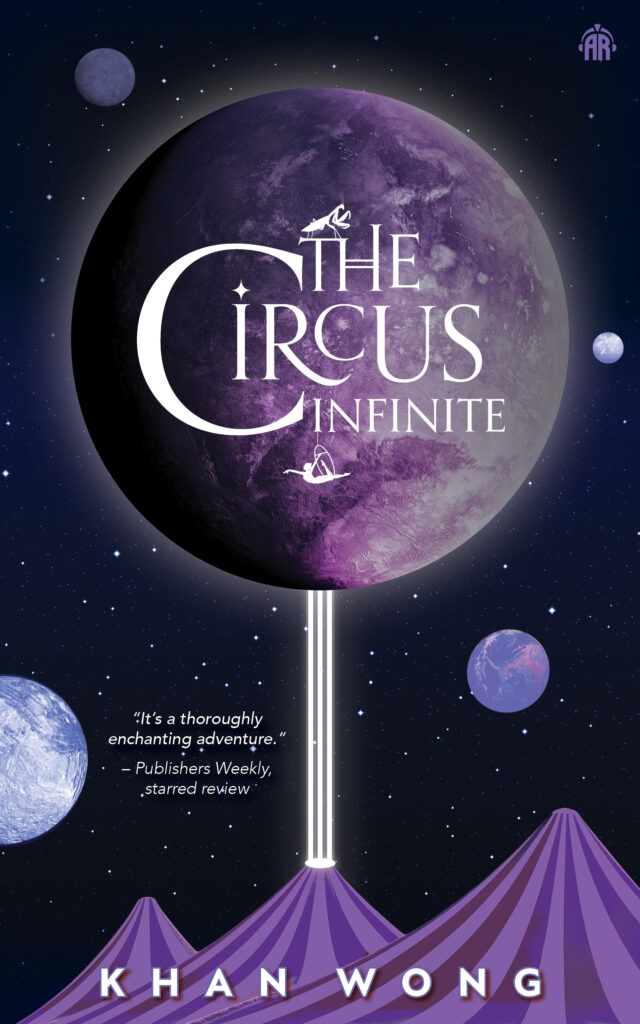
The Circus Infinite
Angry Robot · 2022 · 414 pages
ISBN: 9780857669681
Review Editor
Marcus Webb
The Circus Infinite is Khan Wong’s debut novel, published by Angry Robot in March 2022. It follows Jes, a young man of mixed Rijala and human heritage who possesses a rare and coveted ability: he can manipulate probability fields, bending the physical forces around him in ways that look, to untrained eyes, like magic. Born with a gift that neither of his parent species should be capable of producing, Jes has spent much of his life as an object of scientific interest. When the novel opens, he has just escaped from the Institute, a research organization that wanted to turn his abilities into a weapon and treated him as a specimen rather than a person.
Jes flees to Persephone Station, the pleasure moon of the solar system: a place of casinos, entertainment, and easy anonymity for those who would rather not be found. There he stumbles into Cirque Idris, a traveling circus run by Beni, a warmhearted alien entrepreneur with a gift for collecting strays. Jes takes a job as an acrobat, using his probability powers to accomplish feats that draw crowds without revealing what he actually is. Slowly, cautiously, he begins to belong somewhere. The circus becomes a home, its performers a family, and Jes starts allowing himself, for the first time in years, to trust people.
That trust is tested when Quint, the crime boss who effectively owns Persephone Station, learns about Jes’s abilities and decides he wants them for his own operations. What begins as a cozy, intimate story about finding a place in the world tips, in its second half, into something darker: a thriller about exploitation, bodily autonomy, and what it costs to stop hiding.
Character Arcs and Development
Jes is a thoughtful protagonist, and Wong takes his trauma seriously without making it the whole story. He is not a broken man waiting to be rescued but a careful person who has learned, through hard experience, that the world tends to treat unusual people as resources. His arc over the course of the novel is essentially one of trust: learning that some relationships are not transactions, that chosen family can offer a security that institutions cannot. This growth happens through accumulation rather than revelation. A shared meal. A conversation with Beni about what the circus is actually for. An argument with Moth that clears the air rather than poisoning it.
Moth is the primary romantic interest and one of the book’s stronger secondary characters. He is Beni’s nephew, a human dancer navigating his own complicated feelings about the circus and his uncle’s expectations for his life. The romance develops slowly, and Wong gives both men room to be uncertain and guarded before they are honest with each other. It reads as a relationship between two adults who have each learned to be careful with their hearts, which makes the eventual warmth feel earned rather than automatic.
Beni himself is one of the novel’s quiet satisfactions. He is not a saint or a savior figure but someone who has built something he genuinely believes in and who takes people as they come. He is warm without being naive, and his relationship with Jes has a parental quality that the story handles without ever becoming sentimental about it. The rest of the circus ensemble, human and alien alike, is drawn with real affection. Some performers feel thinner than others, but Wong’s interest in building a world where diversity is unremarkable gives the circus a lived-in quality. These are people doing work they love, with all the petty tensions and genuine bonds that come from living six inches from your colleagues.
Quint, the antagonist, is less successful. He functions primarily as a stand-in for the same kind of exploitative authority Jes fled at the Institute, and this parallel is pointed rather than subtle. He is powerful, greedy, and uncomplicated. The novel does not strictly need him to be more than this, but his flatness highlights the gap between the warm, specific relationships in the circus scenes and the more schematic plotting of the second half.
Pacing
The book is divided somewhat unevenly between its two modes. The first half, in which Jes arrives on Persephone Station, joins the circus, and finds his footing, is the stronger section. Wong takes her time with the community-building, and this patience pays off in making you care about the circus before it becomes something that needs defending. There is a stretch in the middle of the book where very little happens in plot terms, and it is the section you are most likely to remember afterward.
The second half, once Quint enters the picture and the thriller mechanics engage, moves faster but loses some of the warmth that makes the book distinctive. The escalation feels compressed in places, and the climactic confrontation is resolved more quickly and cleanly than the novel’s earlier emotional complexity might have prepared you for. This is a familiar debut challenge: building a found family and plotting a crime thriller require different instincts, and not every first novel fully integrates them. The pacing problems here are real but not fatal, particularly if you come primarily for the character work.
Deeper Thematic Exploration
At its heart, The Circus Infinite is a novel about what it means to have a body that other people want to use. Jes’s probability powers attract the Institute’s researchers, then Quint’s criminal ambition, and the novel draws a clear line between these different forms of exploitation. What the Institute wanted to do in a controlled environment, Quint wants to do for profit. Both present themselves as operating for a higher purpose while treating Jes as a means rather than an end. The book is interested in how exploitation reproduces itself across different registers of power, not just the obviously villainous ones.
This theme has particular resonance within the book’s queer sensibility. Jes is gay, and his relationship with Moth is one of several same-sex and queer relationships in the novel that Wong treats as unremarkable. She is not writing a story about the struggle of queer identity in an actively hostile world; she is writing a story in which the pleasure moon has largely moved past that particular hostility while retaining older, more durable forms of dehumanization. What remains are the more universal questions: who gets to decide what your body is for, who gets to study you and classify you and put you to work.
The circus offers a direct answer. Cirque Idris is a community built on consent and skill, where your value comes from what you choose to do rather than what you were born with or what others can extract from you. This is not a subtle argument, but it is a sincere one, and Wong earns it by making the circus feel genuinely appealing rather than utopian in an unconvincing way. You understand why Jes would want to stay.
There is also a quieter theme about the relationship between home and safety. For Jes, safety has always meant invisibility: hiding his abilities, keeping moving, not allowing anyone close enough to hurt him. The novel’s central argument is that this kind of safety is its own damage, that a life organized entirely around not being hurt leaves no room for the things that make life worth protecting. This is familiar territory in found-family fiction, but Wong’s approach to it is tender rather than formulaic.
Style and Voice
Wong writes in close third person, staying tightly with Jes throughout. The prose is accessible and clean without being spare: there are passages of genuine beauty, particularly in the descriptions of circus performances and the views from Persephone Station’s observation decks, where the pleasure moon’s gaudy lights are set against the cold depth of space. Wong has a good eye for the kind of sensory detail that makes a scene feel inhabited rather than described.
The voice is warm and emotionally direct, which suits the material. Occasionally it tips into telling rather than showing, especially in passages where characters’ interior states are spelled out rather than demonstrated. This is a tendency of the debut novelist rather than a fundamental problem with the prose, and it does not undermine the novel’s emotional effectiveness. When the book earns its tenderness, as it does more often than not, the directness reads as honest rather than overwritten.
The worldbuilding operates by suggestion. We learn enough about Persephone Station, the various alien species, and the broader political landscape to feel oriented, but Wong is more interested in texture than in architectural detail. Some readers will find this liberating; others may wish for more scaffolding. The pleasure moon setting is vivid without being exhaustively mapped, which is probably the right choice for a novel whose real subject is the people in it rather than the universe around them.
Verdict
The Circus Infinite earned its Lambda Literary Award nomination and its Publisher’s Weekly and Library Journal starred reviews, and the comparisons to Becky Chambers are fair as far as they go. But Wong is doing something a little different: darker in its view of exploitation, more concerned with bodily autonomy as a political question, and less interested in the utopian implications of its setting than in what it feels like to be a specific person trying to build a specific life. The circus is a wonderful frame for a story about belonging, and Jes is a protagonist worth following for 414 pages.
Its weaknesses are real. The plotting in the second half is less convincing than the character work in the first, the antagonist is more functional than frightening, and some thematic statements are made more plainly than they need to be. But these are the problems of an ambitious debut, the kind that a talented writer works through on her way to the next book. If you come to it wanting cozy science fiction with genuine emotional weight, queer representation that doesn’t treat identity as the whole story, and found-family warmth earned rather than assumed, The Circus Infinite delivers. It is not a perfect novel, but it is a generous one, and those are harder to find.
Frequently Asked Questions about The Circus Infinite
What is The Circus Infinite by Khan Wong about?
The Circus Infinite follows Jes, a young man of mixed human and alien heritage who can manipulate probability fields, after he escapes a research institute that wanted to weaponize his abilities. He ends up on Persephone Station, a pleasure moon, where he joins a traveling circus and slowly builds a found family among its performers. When a local crime boss learns what Jes can do, Jes must choose between hiding and fighting back to protect the people he has come to love.
Is The Circus Infinite part of a series?
The Circus Infinite is a standalone novel. As of 2024, Khan Wong has not announced a sequel or companion book set in the same universe, though the world has enough detail that it would support further stories. The novel resolves its central conflicts satisfyingly without leaving threads that demand continuation.
What are the main themes in The Circus Infinite?
The novel’s core themes are bodily autonomy, exploitation, and found family. Jes’s probability powers are repeatedly sought by powerful institutions and individuals who want to use them without his consent, and the book draws a sustained parallel between this exploitation and broader questions about who gets to claim ownership of another person’s gifts or body. The circus represents a counter-model: a community built on consent, skill, and chosen belonging. Queer identity and the relationship between safety and genuine living also run throughout the book.
How long is The Circus Infinite and is it a difficult read?
The Circus Infinite is 414 pages and reads at a comfortable pace. The prose is accessible and warm rather than dense or demanding. It sits in that zone between literary fiction and popular science fiction where the writing is careful and the characters are complex, but the book never prioritizes difficulty over clarity. Most readers comfortable with science fiction and fantasy should find it an easy entry point, even without deep familiarity with the genre.
Is there a movie or TV adaptation of The Circus Infinite?
As of 2024, no movie or television adaptation of The Circus Infinite has been announced. The book’s combination of circus spectacle, found family dynamics, and queer romance would translate well to a limited series format, and the relatively self-contained plot would suit adaptation. For now, the novel is the only version of the story.
Is The Circus Infinite LGBTQ+ fiction, and who is it for?
Yes, The Circus Infinite is explicitly queer fiction: the protagonist Jes is gay, his love interest Moth is also male, and several other characters in the circus community identify as trans, non-binary, or otherwise outside the gender binary. Queer identity is present throughout but is treated as unremarkable rather than as the central dramatic tension. The book is aimed at adult readers and will appeal particularly to those who enjoy queer science fiction, found-family stories, and character-driven space opera.
How does The Circus Infinite compare to Becky Chambers’ Wayfarers series?
The comparisons are fair on the surface: both feature found-family narratives, diverse casts including alien species, and an optimistic view of community. But The Circus Infinite is somewhat darker and more politically pointed than the Wayfarers books. Wong is more directly concerned with exploitation and bodily autonomy as systems, and the thriller elements in the second half have a harder edge than anything in Chambers’ series. If you love the Wayfarers books, The Circus Infinite is a natural next read; if you found those books too gentle, this one has more friction.
Should I read The Circus Infinite and is it worth it?
If you want a warm, queer science fiction novel with a genuine emotional core, yes. The Circus Infinite is at its best in the first half, when Jes is finding his footing among the circus performers, and that section alone is worth the read. The second half’s plotting is less assured, and the antagonist is thin, but the book’s heart remains consistent throughout. Readers who prioritize character and emotional resonance over tight plotting will come away satisfied. Those who need the thriller mechanics to land cleanly may be more mixed.
Book Details
- Title
- The Circus Infinite
- Author
- Khan Wong
- Genre
- Science Fiction
- Publisher
- Angry Robot
- Year Published
- 2022
- Pages
- 414
- ISBN
- 9780857669681
- WritersReview Rating
- 3.9 / 5