
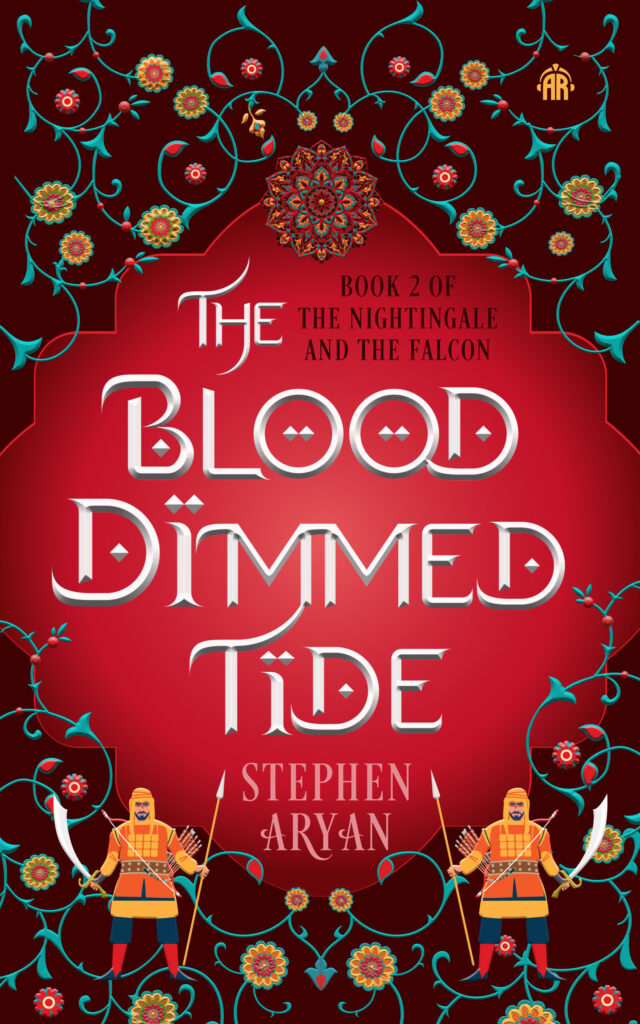
The Blood Dimmed Tide
Angry Robot · 2024 · 400 pages
ISBN: 9781915202733
Review Editor
Marcus Webb
Stephen Aryan’s The Blood Dimmed Tide, the second volume in The Nightingale and the Falcon trilogy, picks up several months after the events of The Judas Blossom. Published in July 2024 by Angry Robot Books, this 400-page historical fantasy drops readers back into the crumbling Mongol Empire of the thirteenth century, where the sons of Genghis Khan fight over his legacy while occupied Persia plots its liberation. The novel braids together the stories of four characters navigating war, magic, and loyalty in a world where empires rise and fall with terrifying speed.
At its core, the book follows Kaivon, the last Persian General, who sees an opening as Hulagu Khan’s ambitions buckle under the weight of a new civil war with the Golden Horde. Temujin, Hulagu’s youngest son, has awakened Cozen powers strong enough to shatter city walls, and he has chosen to abandon his father’s empire rather than become its weapon. Kokochin, once a frightened young bride forced into Hulagu’s court, has become a member of the House of Grace, a secret society dedicated to protecting Persia. And Hulagu himself, paranoid and brutal, clings to control even as his world fractures around him. Aryan weaves these four perspectives into a narrative that never lets you settle, never lets you feel safe about any of them.
If you read The Judas Blossom and wondered whether Aryan could sustain that energy across a second book, the answer is a resounding yes. The Blood Dimmed Tide avoids the middle-book problem entirely, pushing every storyline forward with genuine momentum and real consequences.
Character Arcs and Development
Kokochin’s transformation is the emotional backbone of this novel. In The Judas Blossom, she was a young woman thrown into an impossible situation, surviving by keeping her head down and her allegiances hidden. Here, she has hardened. Aryan charts her evolution from cautious spy to capable and ruthless operator with patience and specificity. When her double life is exposed by one of Hulagu’s other wives, she does not crumble. She adapts. She calculates. She becomes, as one might say, someone who frightens the people who once frightened her. The tension between who Kokochin was and who she is becoming gives every scene she appears in a sharp, uncomfortable edge.
Temujin’s arc takes a different shape. Where Kokochin grows harder, Temujin grows inward. His Cozen powers are immense and poorly understood, and the people who recruit him (others like him, scattered across the empire) offer guidance that feels more like indoctrination. Watching Temujin try to learn what he is while refusing to become what his father wants him to be creates a compelling tension. He starts perceiving things that other characters miss entirely, and one of these perceptions leads to the novel’s biggest revelation, a moment that reframes much of what came before.
Kaivon remains a satisfying presence as the seasoned general playing a long game. He is not flashy. He does not have magic. What he has is patience, tactical intelligence, and a willingness to make ugly choices in service of Persia’s freedom. Aryan gives him enough quiet moments of doubt and exhaustion that he never tips into the flat archetype of the noble strategist.
Even the secondary characters earn their space. Layla, one of Hulagu’s wives who exposes Kokochin, could have been a simple antagonist. Instead, Aryan gives her motivations that make sense within the brutal logic of court survival. Her arc intersects with Kokochin’s in ways that feel earned rather than convenient, and by the novel’s end, her trajectory has become one of the most intriguing threads left hanging for the trilogy’s conclusion.
Pacing
The Blood Dimmed Tide moves. Aryan structures the novel around short, focused chapters that rotate between viewpoints, and the effect is addictive. You finish a Kokochin chapter on a knife-edge, flip to Temujin at a pivotal moment, then land with Kaivon as a battle plan comes together or falls apart. The transitions are clean and purposeful; Aryan knows when to cut away and when to stay.
The first act sets the board efficiently without feeling like setup. By the midpoint, every thread is in motion and the intersections start producing real sparks. If anything, the Temujin sections in the second act slow slightly when the worldbuilding around the Cozen community requires exposition. But Aryan embeds that information inside character interactions rather than lectures, so even the quieter stretches carry emotional weight. The final hundred pages are relentless. Multiple fight scenes build on each other with escalating stakes, and Aryan leaves several characters in genuinely uncertain states by the last page.
Deeper Thematic Exploration
The novel’s title comes from Yeats (“the blood-dimmed tide is loosed”), and the allusion is fitting. This is a book about what happens when the forces holding a civilization together begin to fail. The Mongol Empire in Aryan’s telling is not a monolith; it is a family business run by violent men who agree on nothing except the value of conquest. When that agreement breaks down, the resulting chaos swallows everyone, conquerors and conquered alike.
Power and its costs run through every storyline. Temujin has power he did not ask for and cannot fully control. Kokochin gains power through deception and violence, and the novel asks, without ever answering neatly, what that costs her sense of self. Kaivon wields the only kind of power available to the occupied: the ability to make the occupier’s life more difficult, slowly, quietly, at great personal risk. And Hulagu, who has more conventional power than anyone else in the story, is the most frightened character in the book. His paranoia is not irrational; people really are plotting against him. But his response to that threat (more violence, more control, more suspicion) accelerates exactly the collapse he fears.
Aryan also does something subtle with the idea of home. Persia, for Kaivon and Kokochin, is both a place and an idea worth dying for. For Temujin, the empire his grandfather built is a prison he needs to escape. For Hulagu, it is a birthright slipping through his fingers. The novel never simplifies these competing claims. It holds them side by side and lets the reader sit with the discomfort of understanding, at least partially, every character’s perspective.
There is also a thread about the ethics of secrecy. The House of Grace protects Persia through covert action, but that secrecy demands lies, betrayals, and sacrifices that corrode the people doing the protecting. Kokochin’s arc is the clearest expression of this theme: the further she goes into the work, the less of herself she recognizes. Aryan does not moralize about this. He simply shows it happening, and trusts the reader to feel the weight.
Style and Voice
Aryan writes clean, propulsive prose that favors clarity over ornamentation. His sentences are direct, his descriptions precise. He can set a battle scene in a few sharp strokes: the sound of arrows, the smell of smoke, the way a formation buckles. He is equally good at the smaller moments, the silence between two characters who know they are lying to each other, the way someone’s hands move when they are about to make a decision they cannot take back.
The rotating viewpoints give each character a slightly different texture on the page. Kokochin’s sections have a coiled, watchful quality. Temujin’s carry a sense of wonder mixed with dread. Kaivon’s are measured and tactical, though Aryan punctuates them with moments of raw grief for what Persia has lost. Hulagu’s are perhaps the most unsettling: Aryan gets inside the mind of a tyrant without softening him, and the result is a perspective that feels both alien and recognizable.
The worldbuilding around the Cozen magic system is restrained in the best way. Aryan reveals its rules gradually, through character experience rather than exposition dumps. You learn what the Cozen can do by watching them do it, and the limits of their power emerge through failure and cost rather than textbook explanation.
Verdict
The Blood Dimmed Tide is a confident, emotionally rich sequel that deepens everything The Judas Blossom established. It delivers visceral action, complex characters, and a thematic ambition that goes well beyond genre expectations. Kokochin’s transformation alone would be worth the price of entry, but the novel gives you four compelling arcs, each building toward a conclusion that will leave you genuinely anxious for the final volume.
If you love historical fantasy that takes its history seriously, this book belongs on your shelf. Readers who enjoy the political complexity of Joe Abercrombie or the historical grounding of Guy Gavriel Kay will find a lot to admire here. If you need your fantasy characters to be simple heroes and simple villains, this is not the book for you; Aryan’s people live in moral grey zones and make choices that are hard to judge from the outside. That willingness to sit with ambiguity, to let the reader feel conflicted, is what elevates The Nightingale and the Falcon from good to something you will still be thinking about weeks after you finish it.
Frequently Asked Questions about The Blood Dimmed Tide
What is The Blood Dimmed Tide by Stephen Aryan about?
The Blood Dimmed Tide is a historical fantasy novel set during the Mongol Empire’s occupation of Persia in the thirteenth century. It follows four characters: a Persian general fighting for liberation, a young woman working as a spy inside the Khan’s court, the Khan’s youngest son who has awakened dangerous magical abilities, and the Khan himself as his empire fractures. The novel blends real history with a magic system called the Cozen.
Do I need to read The Judas Blossom before The Blood Dimmed Tide?
Yes. The Blood Dimmed Tide is the second book in The Nightingale and the Falcon trilogy and picks up directly after the events of The Judas Blossom. Character arcs, political alliances, and the magic system all build on foundations laid in the first book. Starting with book two would mean missing critical context for nearly every storyline.
What are the main themes in The Blood Dimmed Tide?
The novel explores the costs of power and what it does to the people who wield it. It examines loyalty and betrayal in occupied territories, the ethics of secrecy and covert resistance, the tension between family duty and personal conscience, and the way empires destroy themselves from within through paranoia and infighting.
How long is The Blood Dimmed Tide and is it a difficult read?
The paperback edition runs 400 pages. The prose is accessible and fast-paced, with short chapters that rotate between four viewpoints. It is not a difficult read in terms of language or structure, though the political landscape of the Mongol Empire involves multiple factions and historical figures that may require attention. Readers who enjoyed the first book will find the same readable style here.
Is there a movie or TV adaptation of The Blood Dimmed Tide?
As of 2026, there is no movie or television adaptation of The Blood Dimmed Tide or The Nightingale and the Falcon trilogy. The series has the scope, action, and political intrigue that would translate well to screen, but no adaptation has been announced.
What age group or reading level is The Blood Dimmed Tide for?
The Blood Dimmed Tide is written for adult readers. It contains graphic battle violence, political intrigue, and morally complex situations. The historical setting involves war, occupation, and the real brutality of the Mongol Empire. It is appropriate for readers aged 16 and up who are comfortable with mature themes and violence in a fantasy context.
How does The Blood Dimmed Tide compare to The Judas Blossom?
Most readers consider The Blood Dimmed Tide equal to or stronger than The Judas Blossom. The sequel raises the stakes across every storyline, develops its characters more deeply (particularly Kokochin), and delivers more intense action sequences. It avoids the common middle-book problem of feeling like filler between the opening and conclusion. The magic system also expands significantly in this volume.
Should I read The Blood Dimmed Tide and is it worth it?
If you enjoy historical fantasy with real political depth, complex characters, and a setting outside the typical European medieval template, The Blood Dimmed Tide is absolutely worth your time. Fans of Joe Abercrombie’s morally grey characters or Guy Gavriel Kay’s historically grounded worlds will feel at home here. The only readers who might want to pass are those looking for lighter, more straightforward fantasy with clear-cut heroes.
Book Details
- Title
- The Blood Dimmed Tide
- Author
- Stephen Aryan
- Publisher
- Angry Robot
- Year Published
- 2024
- Pages
- 400
- ISBN
- 9781915202733
- WritersReview Rating
- 4.2 / 5