
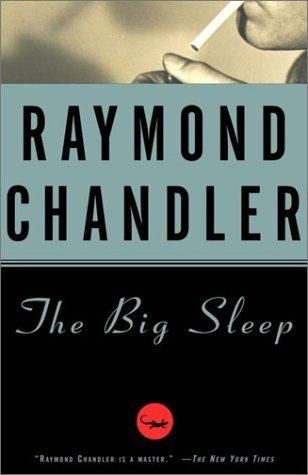
The Big Sleep
Vintage Books · 1939 · 229 pages
ISBN: 9780394758282
Review Editor
James Voss
In the spring of 1939, Alfred A. Knopf published a detective novel by a former oil executive from Los Angeles. The author was Raymond Chandler, the novel was The Big Sleep, and the private eye at its center, Philip Marlowe, changed crime fiction permanently. Chandler was 51 years old when this book came out, a late bloomer who had taught himself to write by retyping Dashiell Hammett stories. What he produced felt entirely his own: a world where Los Angeles was a character as vivid as any person on the page, and where the private detective served as a kind of secular knight walking through a landscape of purchased sins.
The story opens at the Sternwood mansion, where an aging general confined to a wheelchair summons Marlowe about a blackmail situation involving his younger daughter, Carmen. Arthur Geiger, a pornography dealer operating behind the cover of a rare book shop on Hollywood Boulevard, is threatening to expose Carmen’s involvement in some compromising photographs. Marlowe takes the case expecting something clean and quick. The case is neither. Within 48 hours, Geiger is dead, the Sternwood chauffeur is dead, and Marlowe finds himself navigating a Los Angeles populated by gamblers, gangsters, blackmailers, and women who carry pistols in their handbags. The web expands outward through Eddie Mars, a gangster with connections everywhere, and the mysterious disappearance of Vivian Regan’s husband, a man named Rusty who seems to have simply walked off the earth.
Chandler is sometimes reproached for labyrinthine plots. The Big Sleep became famous when director Howard Hawks, preparing the 1946 film version with Humphrey Bogart and Lauren Bacall, sent Chandler a telegram asking who had killed the Sternwood chauffeur Owen Taylor. Chandler replied that he did not know. This anecdote gets used as a criticism, but that misses the point. The Big Sleep is not a puzzle novel. It is a portrait of a city, a detective, and what corruption looks like when you strip away its money and its respectability.
Character Arcs and Development
Philip Marlowe does not change in any conventional sense. He enters the novel already formed: principled, sardonic, lonely, and stubbornly decent in a world that keeps testing his decency. He describes himself modestly. He is not a large man, not handsome in a flashy way, not rich. What he has is a code. He will not sleep with clients. He will not take money to do dishonest work. When he could walk away from a dead man and collect his fee, he does not. This refusal to take the easy exit is the whole engine of the novel.
Carmen Sternwood is the more troubling portrait. Chandler draws her as childlike and dangerous in equal measure. She laughs at the wrong moments, bites her thumb when agitated, and turns up in unexpected places throughout the case. She is never quite believable as a full human being, and this is both a limitation of Chandler’s imagination and, arguably, a deliberate choice. She functions in the novel as the emblem of corruption dressed up as innocence: the thing that looks harmless and proves fatal.
Vivian Sternwood Regan, the older sister, is considerably more vivid. She and Marlowe strike sparks off each other in every scene they share. She is protecting something, and Marlowe can sense it. Their conversations, all deflection and wit and suppressed information, rank among the finest dialogue in crime fiction. She does not have an arc so much as a revelation: what she has been protecting, and what protecting it has cost her.
General Sternwood himself appears in only one scene, but it is one of the most memorable in the novel. He is confined to a greenhouse full of tropical orchids, a dying man who likes the heat because his body can no longer generate any of its own. He talks about his wild daughters with a mixture of love and exhaustion, and there is something heartbreaking in a powerful man reduced to needing warmth from the outside. He is the moral center the story builds around: someone who has seen enough of the world to know it is rotten, and who still wants to know the truth.
Pacing
The Big Sleep runs 229 pages and reads fast if you let it move. The early chapters drop the reader directly into action and never pause to catch breath or explain. People die, locations shift, and new characters arrive without introduction. For readers accustomed to novels that set up their pieces carefully, the first fifty pages can feel disorienting. This is partly stylistic and partly an honest representation of detective work: you do not know what matters yet.
The middle section, where Marlowe investigates Joe Brody and pieces together the first layer of the conspiracy, is the densest and most satisfying stretch of the book. The final quarter changes register. Once the blackmail mystery resolves and the real question surfaces (what happened to Rusty Regan), the novel slows down deliberately. Chandler is no longer interested in plot mechanics. He is interested in what Marlowe will do when he learns the truth. This shift feels slightly jarring on a first reading, but earns its place on re-reading. The book is not about the mystery. It is about the man who refuses to stop asking.
Deeper Thematic Exploration
Chandler wrote an essay called “The Simple Art of Murder” in which he argued for a detective fiction that dealt with real criminals and real murder, crimes that exist in the actual world rather than locked-room puzzles cooked up for the amusement of sedentary readers. The Big Sleep is that essay put into practice.
The corruption here is not the occasional bad apple. It is everywhere, and it reaches high. Eddie Mars operates as a gangster with impunity because powerful people find him useful. The police know about him. The district attorney’s office knows about him. Pornography is sold in the back of a respectable bookshop, and respectable society buys it. The Sternwood family, with their money and their mansion on the hill, cannot protect themselves from a world they have always managed to buy their way out of. Money, Chandler suggests, cannot actually purchase the thing wealthy people want most from it: immunity from consequences.
Marlowe knows this, which is why his particular version of integrity is so strange and stubborn. He could take Eddie Mars’s money. He could walk away from the Regan question and let the Sternwoods’ secret stay buried. He does neither. His persistence is not heroic in any cinematic sense: no one cheers at the end, and nothing is resolved in a satisfying way. It is more like the persistence of a man who cannot live with himself if he stops looking. The title points here too. The big sleep means death, and throughout the novel Chandler positions Marlowe against a city that has already made its peace with that outcome, that has already decided the dead do not need justice.
There is also something here about loneliness as a moral condition. Marlowe drinks alone. He plays chess against himself. The women he encounters want something from him that is not quite love and not quite help. And at the end, having found what he came to find, he feels no satisfaction. He walks back out into the night and thinks about the dead, and what waiting for them means. This is not a cheerful philosophy, but it is an honest one, and it gives the novel a weight that most crime fiction does not carry.
Style and Voice
Chandler’s prose is where The Big Sleep actually lives. The similes are famous because they are genuinely unusual: not comparisons between things that are obviously alike, but sideways observations that see the subject from an angle nobody else thought to look from. A woman’s face is likened to something you did not expect. A man’s eyes tell you exactly where he sits in the power structure of a room. These images do not slow the narrative; they accelerate it by telling you, in an instant, what a paragraph of conventional description would never quite convey.
The first-person voice is one of the most successful in American fiction. Marlowe sees everything and comments on some of it, and the gap between what he notices and what he says out loud is where much of his character lives. The dialogue matches: characters talk past each other constantly, which is how people actually talk when they are hiding something. No one says exactly what they mean, including Marlowe, and you spend the novel listening for what lives underneath.
Verdict
The Big Sleep is the novel that established what hardboiled detective fiction could be at its best. If you have been reading crime fiction all your life, it deserves a re-reading as a source document, the place where the conventions you love were invented. If you have been hesitating because old noir seems like it might feel dated, The Big Sleep is not dated. Los Angeles’s combination of money and corruption and sun and violence has only intensified since 1939, and Marlowe’s particular loneliness has only become more recognizable.
You will get the most from this novel if you can relax about the plot and pay attention to the language. If you need every mystery explained and every motive accounted for, you will be frustrated here. Chandler was not building a puzzle. He was drawing a portrait of a place and a sensibility, and he used a murder mystery the way a painter uses a window: not because the window matters, but because of what you can see through it. The treatment of women, particularly Carmen, is a fair criticism; Chandler reaches for complexity more often than he achieves it with his female characters. Read the novel with your eyes open to this, and you will find it does not undo what is extraordinary about the rest. Wherever you are in your reading life, this is worth your time.
Frequently Asked Questions about The Big Sleep
What is The Big Sleep by Raymond Chandler about?
The Big Sleep follows Philip Marlowe, a Los Angeles private detective hired by an elderly, ailing General Sternwood to handle a blackmail situation involving his younger daughter Carmen. The case quickly expands beyond the original job, pulling Marlowe into a web of murder, pornography, gambling, and organized crime. The title refers to death, and beneath the plot mechanics, the novel is really about what a decent man finds when he looks honestly at a corrupt city.
Who is Philip Marlowe and why does he matter to crime fiction?
Philip Marlowe is the private detective Chandler created for The Big Sleep in 1939, and he became the template for the modern hardboiled detective. He is principled, sardonic, and lonely, a man who operates by a personal code in a world without one. Marlowe influenced nearly every fictional detective who came after him, from Sam Spade’s descendants to contemporary investigators like Harry Bosch. Understanding Marlowe helps you understand the entire genre he helped build.
What are the main themes in The Big Sleep by Raymond Chandler?
The central themes are corruption, moral integrity, and the limits of justice in a world where money and power protect the guilty. Chandler also writes about loneliness as a moral condition: Marlowe’s isolation is not incidental but central to his ability to see clearly. Class and the illusion of respectability run through every subplot, and the novel returns repeatedly to the question of what the dead are owed by the living.
Is The Big Sleep hard to follow? The plot seems confusing.
The plot is genuinely complicated, and Chandler famously could not explain who killed one of the key characters when asked during the production of the 1946 film. The advice most experienced readers give is to stop worrying about the whodunit mechanics and pay attention to Marlowe’s voice and what the scenes reveal about the city. On a second reading, the confusion mostly resolves, and you see how carefully Chandler constructed the atmosphere even when the plot resists tidiness.
Is there a movie or TV adaptation of The Big Sleep?
There are two notable film adaptations. The first, released in 1946 and directed by Howard Hawks, starred Humphrey Bogart as Marlowe and Lauren Bacall as Vivian Sternwood, and it is widely considered a classic of Hollywood noir despite its own plot confusions. A second adaptation came out in 1978 with Robert Mitchum in the lead role, relocated to London. The 1946 version is the one worth watching alongside the novel.
What reading level is The Big Sleep for, and how long does it take to read?
The novel runs 229 pages and most readers finish it in two to four sittings. The vocabulary is accessible, but the prose is dense with imagery and the plot requires active attention. It suits adult readers comfortable with morally ambiguous fiction and willing to tolerate some deliberate ambiguity in how mysteries resolve. Teenagers who enjoy crime fiction could handle it, though the content involving pornography and murder is adult.
How does The Big Sleep compare to Raymond Chandler’s other Philip Marlowe novels?
The Big Sleep was Chandler’s first novel and introduces Marlowe at full strength, though some readers find Farewell, My Lovely (1940) or The Long Goodbye (1953) to be his finest work. The Long Goodbye in particular is more emotionally developed and more novelistic in structure. The Big Sleep is the right place to start: shorter, faster, and the novel where Chandler’s style arrives fully formed. If you love it, Farewell, My Lovely is the natural next step.
Should I read The Big Sleep, and is it still worth it?
Yes, and the reason it remains worth reading is not nostalgia but craft. Chandler’s sentences are still among the best in American crime writing, and Marlowe’s way of seeing the world, honest about corruption without becoming cynical about everything, still feels necessary. If you have any interest in crime fiction, noir, or the history of American writing in the twentieth century, The Big Sleep belongs on your list. It is short enough that you can find out in an afternoon whether it is for you.
Book Details
- Title
- The Big Sleep
- Author
- Raymond Chandler
- Genre
- Mystery & Thriller
- Publisher
- Vintage Books
- Year Published
- 1939
- Pages
- 229
- ISBN
- 9780394758282
- WritersReview Rating
- 4.5 / 5