
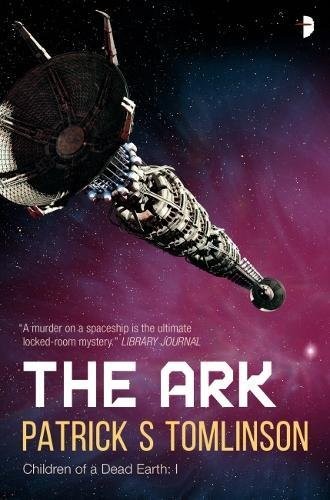
The Ark
Angry Robot Books · 2015 · 400 pages
ISBN: 9780857664846
Review Editor
Marcus Webb
Patrick S. Tomlinson’s The Ark opens with a premise that grabs you by the collar: Earth is gone, swallowed by a rogue black hole, and every human being left alive, roughly 50,000 of them, lives aboard a single generation ship crawling toward Tau Ceti at five percent the speed of light. After more than two centuries in transit, the ship is finally weeks from its destination, a habitable planet called Tau Ceti G. The descendants of Earth’s survivors have built something resembling a functioning society inside two main habitat modules, Avalon and Shangri-La, connected by a central command structure. Everyone carries an implanted chip called a “plant” that allows communication, data access, and, crucially, constant location tracking by the ship’s authorities.
Bryan Benson is the ship’s most famous retired athlete. He made his name playing Zero, a hybrid sport played in the ship’s microgravity bay that functions like football with an extra spatial dimension. Now working as chief constable of Avalon, Benson mostly handles petty disputes and minor infractions. Serious crime barely exists when everyone can be tracked in real time. Then a geneticist named Edmond Laraby vanishes. His implant goes dark. What begins as a missing persons case pulls Benson into a conspiracy involving stolen artwork, a secret cult called the Unbound, and political corruption reaching the highest levels of the ship’s command.
Angry Robot Books published The Ark in 2015 as the first volume in the Children of a Dead Earth trilogy, followed by Trident’s Forge and Children of the Divide. It blends science fiction worldbuilding with the mechanics of a murder mystery, a combination that gives the novel both its momentum and its limitations.
Character Arcs and Development
Benson is the kind of protagonist who wins you over with his flaws rather than his competence. He’s smart enough to be a detective but not brilliant enough to avoid getting punched, outmaneuvered, and occasionally blindsided by his own assumptions. His identity crisis runs through the entire novel: he’s a retired sports hero trying to prove he’s more than a washed-up celebrity in a role nobody expected him to fill. When the investigation forces him into situations where fame can’t protect him, you see him scramble and adapt in ways that feel earned rather than convenient. Tomlinson, whose background is in stand-up comedy, gives Benson a dry, self-aware voice that makes him easy company even when the stakes are crushing.
The supporting cast is a mixed bag. Theresa, Benson’s romantic interest, is a biologist with her own research agenda and her own reasons for getting entangled in the case, though the novel doesn’t give her quite enough page time to feel fully realized. Captain Mahama, the ship’s political leader, operates in the gray zone between necessary authority and self-preservation, and her interactions with Benson carry genuine tension. She’s neither villain nor ally, which makes her one of the book’s more interesting secondary figures. You never quite trust her, and the novel is smart enough to let that ambiguity stand.
The antagonists present a more complicated picture. The conspiracy Benson uncovers involves characters whose motivations grow from a genuine philosophical disagreement about humanity’s future, which is compelling in concept. In practice, some of the villains slide into action-movie territory, making choices that serve the plot’s need for confrontation more than they serve their own stated beliefs. The Unbound, a cult-like group who reject the ship’s surveillance state and live off-grid in the maintenance tunnels, have an intriguing setup. But Tomlinson introduces them too late in the story to develop their worldview with the depth it deserves, and they end up feeling more like a plot device than a fully formed faction.
Pacing
The Ark moves fast. Chapters are short, cliffhangers are frequent, and Benson rarely sits still long enough for the story to sag. For a 400-page novel, it reads like something half that length, which is both a strength and a subtle weakness. The investigation builds momentum steadily through the first two-thirds, layering new revelations on top of each other at just the right intervals. Each discovery raises the stakes without feeling forced, and Tomlinson handles the procedural beats of Benson’s detective work with a confidence that suggests he did his homework on the genre.
The final act, though, accelerates past the point where the plot can fully support its own weight. Benson ends up in positions that require some convenient lapses in the ship’s otherwise airtight surveillance system, and the climactic action sequence stretches credulity in ways the carefully constructed mystery hadn’t prepared you for. The shift from detective story to action thriller happens so abruptly that it almost feels like the ending belongs to a different, louder book. It doesn’t ruin the experience, but it does leave you wishing Tomlinson had trusted his mystery mechanics all the way through rather than reaching for a blockbuster finish.
Deeper Thematic Exploration
Beneath the whodunit, The Ark wrestles with a question that only gets more relevant with time: what happens to freedom when survival is non-negotiable? Every person on the ship submits to tracking, monitoring, and genetic accounting. Reproduction is controlled. Resources are rationed. Privacy is, for all practical purposes, extinct. The ship’s authorities justify all of it with the same argument: we are the last humans alive, and anything that threatens the mission threatens the species. Benson enforces this system without much questioning until the investigation forces him to see its blind spots and the people who fall through its cracks.
The Unbound represent the novel’s most provocative idea: a group of people who would rather live in the ship’s crawlspaces, untracked and uncomfortable, than submit to total surveillance. Tomlinson doesn’t romanticize them or demonize them, which is to his credit. Their existence raises a question the novel is genuinely interested in: at what point does the machinery of collective survival become its own kind of oppression? The answer the book offers is messier than either side would like, and that messiness feels honest. In a setting where every breath of air is rationed, the line between “security measure” and “authoritarian control” gets very thin.
There’s also a quieter thread about identity and reinvention running through Benson’s arc. He was defined by his body, his athletic prowess, his fame, and now he has to figure out who he is without any of that. The generation ship setting amplifies this beautifully: on the Ark, your role is your identity. You are your job, your genetic profile, your contribution to the mission. Benson’s investigation isn’t just about solving a crime. It’s about proving, mostly to himself, that he can be something other than what the system assigned him to be. That personal stakes layer gives the mystery a weight it wouldn’t have if Benson were just another competent detective doing his job.
Style and Voice
Tomlinson writes in a close third person that sticks tight to Benson’s perspective, and the voice carries a dry, self-deprecating humor that keeps the prose from ever feeling heavy. The banter lands without tipping into sitcom rhythms, and Tomlinson knows when to pull back and let a scene breathe. His descriptions of the Ark’s physical environment are functional rather than lush; you get enough to orient yourself spatially but not enough to lose yourself in the setting. For readers who want their generation ships rendered in full technical detail (think Kim Stanley Robinson’s Aurora), this will feel underbuilt. For readers who want the ship to serve the story rather than the other way around, it works perfectly well.
The Zero game sequences deserve special mention. Tomlinson has clearly thought hard about how a contact sport would work in microgravity, and these scenes crackle with kinetic energy. They also do double duty as character work, showing us who Benson was before he became a detective and what he lost when he retired. The sport feels real enough that you find yourself wanting to watch a match, which is no small achievement for an entirely fictional game invented for a novel.
Verdict
The Ark is a confident debut that knows exactly what it wants to be: a fast, entertaining locked-room mystery set against the ultimate high-stakes backdrop. Tomlinson’s protagonist is likable and fallible in equal measure, the premise pulls you in immediately, and the first two-thirds of the investigation are tightly plotted. Where it stumbles is in the final act, which trades the careful mystery construction for an action-movie climax that doesn’t quite fit, and in some secondary characters who needed more room to grow. The worldbuilding serves the story well enough but won’t satisfy readers looking for a deep dive into generation ship logistics.
If you like your science fiction with a strong mystery backbone and a sense of humor, The Ark will keep you up past your bedtime. Readers who enjoy John Scalzi’s blend of wit and high-concept premises, or who are curious about generation ship fiction but find harder SF intimidating, will find a lot to like here. Go in expecting a propulsive thriller with ideas rather than a think-piece with action scenes, and you’ll come away glad you picked it up.
Frequently Asked Questions about The Ark
What is The Ark by Patrick S. Tomlinson about?
The Ark is a science fiction novel set aboard a generation ship carrying the last 50,000 humans after Earth’s destruction by a rogue black hole. The story follows Bryan Benson, a retired zero-gravity sports star turned detective, who investigates a missing persons case that uncovers a conspiracy threatening everyone aboard. The ship is weeks from reaching its destination planet when the murder mystery begins.
Is The Ark by Patrick S. Tomlinson part of a series?
Yes, The Ark is the first book in the Children of a Dead Earth trilogy. It’s followed by Trident’s Forge (2016) and Children of the Divide (2018), both published by Angry Robot Books. The Ark works as a standalone mystery, though its ending sets up the events of the sequels as the ship approaches its destination planet.
What are the main themes in The Ark by Patrick Tomlinson?
The novel explores surveillance and personal freedom in a closed society, asking what privacy means when species survival depends on total monitoring. It also examines identity and reinvention through its protagonist’s shift from athlete to detective, and it questions the line between necessary authority and authoritarian control when resources are finite and the stakes are existential.
How long is The Ark and is it a difficult read?
The Ark is approximately 400 pages long. It reads quickly thanks to short chapters, frequent cliffhangers, and a fast-moving plot. The prose is accessible and humor-laced, with minimal technical jargon. Even readers who don’t usually pick up science fiction will find it approachable, since the focus is on the mystery and characters rather than hard science.
Is there a movie or TV adaptation of The Ark by Patrick Tomlinson?
As of 2026, there is no film or television adaptation of The Ark. The novel’s combination of a contained setting, a mystery plot, and visual set pieces like the Zero sport scenes would lend itself well to adaptation, but no production has been announced. Note that the Syfy series “The Ark” (2023) is an unrelated show with a different premise.
What age group or reading level is The Ark appropriate for?
The Ark is written for adult readers and contains violence, some language, and mature themes including murder and political conspiracy. The reading level is straightforward, comparable to a mainstream thriller. It would be suitable for older teenagers (16+) who enjoy science fiction, though it’s marketed and shelved as adult fiction.
How does The Ark compare to other generation ship novels?
The Ark takes a lighter, more action-oriented approach than hard SF generation ship novels like Kim Stanley Robinson’s Aurora or Gene Wolfe’s Book of the Long Sun. Its closest comparison is probably to John Scalzi’s work, blending humor with high-concept science fiction. Readers looking for rigorous engineering detail may find it thin, but those wanting a fast mystery in a compelling setting will prefer its pace.
Should I read The Ark and is it worth it?
If you enjoy murder mysteries with a science fiction twist, The Ark is well worth your time. The protagonist is engaging, the premise is irresistible, and the book moves at a clip that makes it hard to put down. Its main weakness is a final act that trades mystery mechanics for action-movie spectacle. Readers who want a fun, smart page-turner will enjoy it; those seeking literary depth or hard science rigor should look elsewhere.
Book Details
- Title
- The Ark
- Author
- Patrick S. Tomlinson
- Genre
- Science Fiction
- Publisher
- Angry Robot Books
- Year Published
- 2015
- Pages
- 400
- ISBN
- 9780857664846
- WritersReview Rating
- 3.8 / 5