
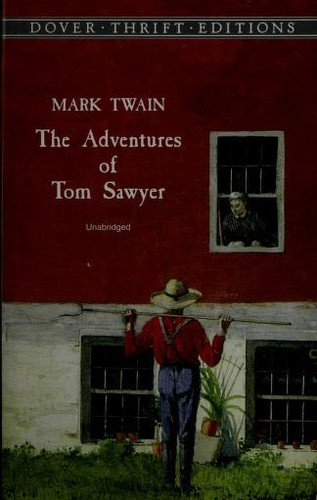
The Adventures of Tom Sawyer
Dover Publications · 1876 · 184 pages
ISBN: 9780486400778
Review Editor
Hannah Bright
Mark Twain published The Adventures of Tom Sawyer in 1876, and within a generation it had become one of the most widely read books in the American literary canon. It is the story of a boy named Tom Sawyer growing up in the fictional town of St. Petersburg, Missouri, sometime in the antebellum South. Tom is an orphan raised by his Aunt Polly, a sweet and perpetually exasperated woman who loves him genuinely and disciplines him ineffectually. He skips school, dodges chores, schemes with his best friend Huckleberry Finn, and pursues the new girl in town, Becky Thatcher, with the full romantic intensity that only twelve-year-olds can muster.
The novel covers roughly one summer’s worth of adventures: a midnight visit to a graveyard, an accidental witnessing of a murder, a stint living as pirates on a river island, a series of escapades in a cave, and a climactic moment in a courtroom. Twain described the book, in his preface, as intended primarily “for the entertainment of boys and girls,” but he also suggested it might revive for adults the feelings of what it was like to be young. Both things are true. It works beautifully as a children’s adventure, and it works just as well as a wry, nostalgic portrait of a world and a childhood that Twain himself had largely lost by the time he sat down to recreate it.
The original publication was by the American Publishing Company in Hartford, Connecticut, illustrated by True Williams. The book’s setting draws directly on Twain’s own boyhood in Hannibal, Missouri, and St. Petersburg is thinly veiled autobiography. Injun Joe, Muff Potter, and the cave system are all rooted in real places and people Twain remembered from the 1840s and 1850s. That grounding in lived experience gives the novel a texture and specificity that distinguishes it from purely invented adventure stories.
Character Arcs and Development
Tom Sawyer is not the kind of hero who learns a tidy lesson and becomes a better person by the final chapter. He is mischievous at the start and mischievous at the end, though somewhat richer and rather more famous. But that relative lack of a conventional arc is part of what makes him interesting. Tom is fundamentally a performer: every situation is an opportunity for drama, for an audience, for applause. When he fakes his own death and shows up at his own funeral, it is not because he miscalculated the emotional consequences to the people who love him. It is because the scene he would get to witness was simply too irresistible to give up. Twain loves Tom for this, even when he gently mocks him for it.
Becky Thatcher is more than just a love interest, though she has often been read that way. Her scenes with Tom inside McDougal’s Cave are the emotional heart of the book’s second half, and she shows genuine courage and resourcefulness when it matters. Huck Finn, who gets his own novel three years later, is already fully formed here: unwashed, unschooled, envied by every boy in town for his freedom, and carrying underneath that freedom a loneliness that Tom never fully sees. The tension between Huck’s actual rootlessness and Tom’s romantic idealization of it is one of the quieter threads in the novel.
Injun Joe is the villain, and he is painted in strokes that modern readers will find uncomfortable: his menace is racialized in ways that reflect both Twain’s era and his biases. It is worth naming that directly. Injun Joe functions as a figure of pure threat, not a person with a psychology, and the novel is lesser for it. The scenes involving Muff Potter, the innocent man wrongly accused of murder, are more nuanced: Tom’s decision about whether to testify becomes the book’s most genuinely moral crisis, and the weight it carries is considerable precisely because Tom is not typically a boy who courts moral seriousness.
Pacing
The book moves fast, which is one of its great virtues. Most chapters are short enough to read in a single sitting, and Twain never lingers past the point where a scene has done its work. The famous fence-painting episode, in which Tom convinces other boys to pay him for the privilege of doing his chores, takes up less than three pages, but it has lodged in the cultural memory for 150 years. That kind of efficiency is rare.
The cave sequence in the final third slows down deliberately, and rightly so. Tom and Becky’s three days lost underground are the one extended passage where Twain asks the reader to sit with genuine fear and exhaustion, and he earns it. If anything, the chapters that follow the cave rescue feel slightly rushed, particularly the resolution of the treasure subplot, which wraps up more quickly than the investment in Injun Joe seems to warrant. But that is a small complaint against a novel that mostly knows exactly how long each scene needs to be.
Deeper Thematic Exploration
At its surface, Tom Sawyer is a celebration of boyhood freedom. Dig a little deeper and it becomes something more complicated: a meditation on performance, authenticity, and the gap between imagination and reality. Tom’s world is organized around stories. He reads adventure novels, he re-enacts the ones he’s read, and he narrates his own life to himself as though he were the hero of a book he is simultaneously living and writing. When he stages his own funeral, or plans his pirates’ adventure, or imagines himself as Robin Hood, he is not being childish: he is doing what all humans do, just more openly. The novel asks, with affection and a little irony, whether there is any version of experience that is not in some way performed.
There is also a sharp class analysis running under the surface, most visible in Huck’s role. Huck lives outside the civilized order that the other children aspire to enter, and Tom idealizes that exclusion without understanding its cost. The Widow Douglas, who eventually takes Huck in, represents the town’s effort to domesticate and improve him, and the novel treats this ambivalently: civilization is both necessary and stifling, and Huck’s resistance to it is both admirable and tragic. Twain was working through something personal here. He had grown up poor enough to envy Huck’s freedom, and prosperous enough, by 1876, to know what that freedom actually cost.
The novel’s treatment of death is more serious than its reputation suggests. Three deaths or near-deaths shape the plot: Doc Robinson’s murder, the boys’ staged deaths by running away, and the ordeal in the cave. Twain’s boyhood Hannibal had its share of real violence, and he writes about mortality with a specificity that a purely romantic adventure story would avoid. Tom’s terror in the cave is not played for laughs. It is one of the most genuinely harrowing passages in nineteenth-century American fiction aimed at young readers.
There is also the question of justice. The scene in which Tom testifies against Injun Joe is the moment when the novel’s lighthearted surface cracks open into something real. Tom is not a brave child; he is scared, and his bravery costs him something. The book does not pretend otherwise. Muff Potter’s gratitude, when he learns that Tom saved him, is written with a delicacy that catches you off guard: here is a grown man, a drunk, a figure of fun, weeping over a boy. Twain gives that moment its full weight.
Style and Voice
The prose is a constant pleasure. Twain’s narrating voice maintains an ironic distance from Tom that never tips into condescension. He observes Tom the way a fond adult looks at a child performing heroics in the backyard: with recognition, amusement, and genuine respect for the seriousness with which the child takes himself. The sentences are short and clean, the dialogue captures the cadences of mid-century Missouri speech without becoming a phonetics exercise, and the descriptive passages of the river and the woods and the cave have the clarity of someone writing from sense memory rather than imagination.
The fence scene is the obvious setpiece for Twain’s wit, but my favorite passage is quieter: the Sunday school chapter, in which Tom trades the Bible tickets he has accumulated by trading trinkets with other children for the privilege of being called out and humiliated in front of a visiting dignitary who asks him to name the first two disciples. It is a scene that could have come from any American childhood in any decade, and Twain understands, without belaboring it, that Tom’s scheme was brilliant precisely because it was transparent to everyone except the people running the system.
Verdict
If you read The Adventures of Tom Sawyer as a child, you probably remember it as pure fun, the fence, the pirates, the cave, the treasure. If you read it as an adult, you will find all of that still working, plus a melancholy undertow that was always there but harder to see when you were young. Tom is a wonderful character: irritating, endearing, fundamentally theatrical in a way that feels true to how children actually think about themselves. The book around him is tighter and more purposeful than its reputation suggests.
This is not a novel for readers who need psychological complexity or narrative ambiguity in their classics. Tom stays Tom, the town stays the town, and the adventure stays largely uncomplicated by the larger historical forces that Twain was already beginning to wrestle with in his other work. But it does everything it sets out to do with complete confidence, and it does it with sentences worth reading aloud. For children, it is essential; for adults, it is a reliable reminder of what fiction can do when a writer fully trusts both their subject and their reader.
Frequently Asked Questions about The Adventures of Tom Sawyer
What is The Adventures of Tom Sawyer about?
The Adventures of Tom Sawyer is Mark Twain’s 1876 novel about a mischievous orphan boy growing up in a small Missouri river town in the antebellum South. It follows Tom through a summer of pranks, a courtship, a stint playing pirate on the Mississippi, an accidental witness to a murder, and a frightening ordeal lost inside a cave. It is both a children’s adventure story and a fond satirical portrait of small-town American life.
Is The Adventures of Tom Sawyer based on a true story?
The novel is closely based on Twain’s own boyhood in Hannibal, Missouri, which he renamed St. Petersburg for the book. The cave system, the graveyard, and several of the adult characters had real-life counterparts. Twain described it as partly autobiography but insisted the events were fictionalized and composited from various memories and invented situations.
What are the main themes in The Adventures of Tom Sawyer?
The main themes are performance and authenticity (Tom constantly stages his own life as a drama), the tension between freedom and civilization (embodied by Huck Finn), the nature of boyhood imagination, moral courage under social pressure, and the uneasy relationship between appearance and reality. Death and the fear of death run through the novel more seriously than its reputation as a light adventure suggests.
How long is The Adventures of Tom Sawyer and is it a difficult read?
The novel is approximately 250-280 pages depending on the edition, and it reads quickly because most chapters are short and the prose is clean and direct. It is aimed at young readers and can be read comfortably by children around 10 years old, though the idiomatic nineteenth-century dialogue occasionally requires a little patience. Adults will find it equally accessible and probably considerably funnier.
Is there a movie or TV adaptation of The Adventures of Tom Sawyer?
There have been several adaptations. A well-known 1938 film starred Tommy Kelly as Tom. A 1973 musical film starred Johnny Whitaker. There have also been numerous television versions over the decades, including animated adaptations. The character of Tom Sawyer appears alongside other literary figures in the 2003 film The League of Extraordinary Gentlemen. None of the film versions fully captures the novel’s narrative voice, which is central to its appeal.
What age group is The Adventures of Tom Sawyer for?
The book is generally considered appropriate for children ages 10 and up, and it works particularly well as a read-aloud for children ages 8 to 12. The novel does contain a murder, some mild racial language reflective of its 1870s setting, and some depictions of violence that parents may want to discuss with younger readers. Adults who revisit it as a reread will find more layers than they remembered from childhood.
How does The Adventures of Tom Sawyer compare to Adventures of Huckleberry Finn?
Tom Sawyer is lighter, shorter, and funnier, and it confines itself comfortably to the conventions of a children’s adventure story. Huckleberry Finn, published in 1884, is a broader and more morally serious novel that confronts slavery and racism directly. Tom Sawyer is often the better entry point for younger readers, while Huckleberry Finn is generally considered the more artistically significant work. They share characters but are quite different in tone and ambition.
Should I read The Adventures of Tom Sawyer and is it worth it?
Yes, particularly if you never read it as a child, or if you read it so long ago that you remember only the fence-painting scene. It is short, genuinely funny in places, and more emotionally resonant than its reputation as light entertainment suggests. The cave sequence alone is worth the price of the book. If you loved Huckleberry Finn in school, Tom Sawyer will feel both familiar and refreshing in its comparatively untroubled cheerfulness.
Book Details
- Title
- The Adventures of Tom Sawyer
- Author
- Mark Twain
- Genre
- Children's
- Publisher
- Dover Publications
- Year Published
- 1876
- Pages
- 184
- ISBN
- 9780486400778
- WritersReview Rating
- 4.1 / 5