
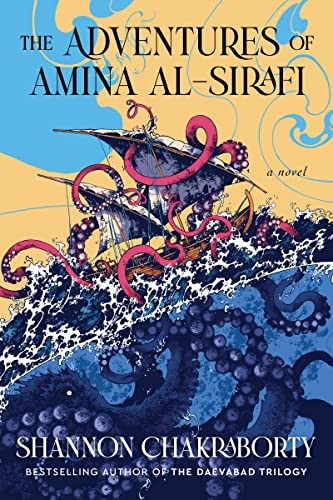
The Adventures of Amina al-Sirafi
Harper Voyager · 2023 · 496 pages
ISBN: 9780062963505
Review Editor
Marcus Webb
Shannon Chakraborty built her reputation on the Daevabad Trilogy, three dense novels of Islamic mythological fantasy set in a hidden city of djinn. The Adventures of Amina al-Sirafi, published in March 2023 and a finalist for the 2024 Hugo Award for Best Novel, moves earlier in the same fictional universe and does something notably different in tone: it tells the story of a retired pirate captain pulled back to sea, to trouble, and to the kind of decisions that make for great legend and terrible mornings. If the Daevabad books were solemn and intricate, this one is looser, funnier, and more willing to let its heroine be wrong.
Amina al-Sirafi is past forty, living quietly with her young daughter Marjana in a small coastal village, having spent years erasing the traces of her former life as one of the most feared pirates on the Indian Ocean. The peace ends when a wealthy noblewoman named Salima arrives with a proposal that is simultaneously impossible to afford and impossible to refuse. Salima’s granddaughter Dunya has vanished in the company of a Frankish mercenary and occultist named Falco Palamenestra. Amina is uniquely positioned to find her: Dunya’s father was one of Amina’s former crew members, and Amina knows the sea lanes and the ports that Falco would need to cross.
What follows is a rescue mission that expands, in stages, into something far stranger. Amina reassembles her crew: Dalila the poisoner, Tinbu the first mate, and Majed the aging navigator, a man who has been at sea so long that the land has stopped feeling real to him. They sail the Marawati into the medieval Indian Ocean trade world, through the ports of the Arabian coast, across to Socotra, into waters thick with political tension and older things. Chakraborty renders this setting with specificity that rewards attention: the cargoes, the social hierarchies, the rival powers, the particular weight of being a woman of reputation in a world that has very precise ideas about what women should do with their lives.
Character Arcs and Development
Amina is not a hero in the process of becoming one. She is already formed, already scarred, and the book’s most unusual choice is to take that seriously rather than find a way around it. She drinks. She misses prayer. She carries guilt about old decisions and old deaths, especially the death of Asif, a former crew member whose end she was partly responsible for. Her relationship with Islam is not a character note: Chakraborty writes it as something Amina actually wrestles with, a thread of faith that holds even when her practice has frayed, a belief that she keeps returning to even when she is ashamed to. The result is a character whose interiority feels lived rather than constructed.
The crew around her is well-drawn in specific ways. Tinbu brings warmth and steadiness: he is the kind of first mate who keeps the ship running through sheer competence and good humor, and his loyalty to Amina has survived more than he would easily admit. Dalila is economical, precise, and deeply effective at her particular specialty. The dynamic between them carries the quality of people who have been through things together and do not need to explain the references. Majed, the navigator, brings something heavier: the quiet exhaustion of a man who has given his life to the sea and is not sure what was given in return. Secondary characters do not get equal space, but the ones who matter get enough.
The most dramatically interesting figure outside the core crew is Raksh, Amina’s estranged djinn husband, who reappears when the plot pushes into supernatural territory. He is selfish in the specific, consistent way of creatures who have never needed to be otherwise: not malicious, exactly, but reliably oriented toward his own interests. His scenes with Amina are the book’s most tonally complex, moving between comedy and a kind of worn, complicated tenderness. What they owe each other, and what each refuses to give, becomes one of the novel’s better questions. Dunya, the young woman Amina is hired to find, also exceeds the role she is initially assigned: she turns out to have her own intentions and her own understanding of what this mission is really about, and the book treats her choices with respect rather than folding her back into a tidier story.
Pacing
The opening third has the energy of a good heist film in preparation: the setup is clear, the crew assembly is satisfying, and the early voyage sequences move with confidence and humor. Chakraborty trusts the reader to find the period details interesting, which they are. The middle section slows when the supernatural architecture of the plot needs establishing: the rules of the djinn world, the history and nature of the artifact Falco is pursuing, the political dynamics between the magical factions. This is necessary work and Chakraborty does it competently, but readers who came for the crew chemistry and maritime action may feel the gear change. The momentum builds again as the third act approaches and the stakes clarify into something concrete and urgent.
The structure is more forgiving than punishing. The density in the middle is not frustrating so much as it is a feature of a writer who takes her world seriously and wants to establish the rules before she breaks them. If you have patience for a book that earns its finale over time, the payoff is there.
Deeper Thematic Exploration
The framing device carries real meaning. Amina narrates her story to a scribe, looking back on events she survived, and throughout the novel Chakraborty embeds tales within the tale: the mythologized history of the Moon of Saba, the artifact at the story’s center, told as something between folklore and scripture. These interludes carry the book’s argument: that history and legend are inseparable, that every adventure accumulates distortion as it passes into story, and that the people who actually lived through events rarely control how those events are remembered or what they come to mean. Amina is conscious of the fact that she is building a legend even as she tells it, and she keeps interjecting qualifications and corrections that the legend, presumably, will eventually smooth away.
The book is also asking who gets to have adventures and on what terms. Maritime fantasy typically centers young men at the beginning of their stories, with everything ahead of them. Amina has already had the career, already made the choices that made her infamous, already built and lost and rebuilt pieces of herself. The “one last job” premise is a genre staple, but in her hands it becomes something more specific: the experience of being pulled back into a life you thought you had put down, and the complicated recognition that you had not put it down so much as set it aside and hoped it would stay there.
Motherhood functions as more than plot motivation. Amina’s love for Marjana is the organizing principle of who she has become: everything she has done and refused to do in the years since her retirement has been structured around keeping her daughter safe and giving her a life with less violence in it. The tension between who Amina was at sea and who she has tried to be on land is the real engine driving the story, and it connects to the novel’s larger interest in how people navigate between the selves others have assigned them and the selves they choose. Falco, the European antagonist, is written without cartoonish villainy: he is confident and resourceful and backed by a sense of entitlement he has never had occasion to examine. His arrival in the Indian Ocean world, extracting magical knowledge from cultures he does not belong to and cannot fully read, carries a weight that sits quietly but persistently in the margins of the main action.
Style and Voice
The narrative voice is the book’s clearest achievement. Chakraborty writes Amina as a woman who tells stories the way people who have told many stories do: with rhythm, with irony, with the self-deprecation of someone who has survived things that were partly her own fault and is not above admitting it. The humor is embedded in character and timing rather than in set-pieces. When Raksh constructs an argument so transparently self-interested that it becomes almost principled, the comedy comes from the consistency of his logic rather than from any joke structure. The dialogue between the crew members has the quality of people who have known each other through difficulty: shorthand references, the occasional sharpness that comes from actual affection, and the particular case of people who do not need to explain themselves.
The historical detail serves the voice rather than competing with it. You feel the texture of the ports, the specific weight of nautical decision-making, the social codes of the trade world, without being handed a lecture on any of them. The setting feels inhabited rather than researched, which is the harder thing to achieve.
Verdict
This is a fantasy novel about someone who has already lived her legend and is now navigating the consequences. Amina does not discover who she is over the course of the book: she already knows, more or less, and the adventure tests that knowledge rather than assembling it from scratch. If you have spent time in a genre where protagonists are perpetually young and perpetually beginning, there is genuine relief in a heroine with a complicated past, a daughter at home, and a tendency to drink too much when the situation calls for it. The book is confident about what it is and what it is not, and that confidence shows on every page.
The middle section requires patience, and readers who want unbroken momentum may find that adjustment. But if you are looking for a fantasy novel that has done real work on its world, its characters, and what it is actually trying to say, and that finds genuine pleasure in a well-assembled crew working a difficult job on an unfamiliar sea, this one rewards the investment. Particularly recommended for readers of Naomi Novik, Guy Gavriel Kay, or anyone who finished the Daevabad Trilogy and wondered what Chakraborty might do if she let herself have more fun.
Frequently Asked Questions about The Adventures of Amina al-Sirafi
What is The Adventures of Amina al-Sirafi by Shannon Chakraborty about?
The Adventures of Amina al-Sirafi is a 2023 historical fantasy novel set in the medieval Indian Ocean world. Amina al-Sirafi, a retired and legendary pirate captain, is persuaded to come out of hiding to rescue a young woman who has disappeared in the company of a dangerous European occultist. To do so, she reassembles her old crew and sails back into a world of political danger, ancient magic, and unfinished personal history. The book is narrated by Amina herself, looking back on events from a position of survival and retrospect.
Is The Adventures of Amina al-Sirafi part of a series?
Yes. It is the first novel in the Amina al-Sirafi trilogy, set in the same fantasy universe as Chakraborty’s earlier Daevabad Trilogy, though several centuries before those events. You do not need to have read the Daevabad books to enjoy this one: it stands on its own entirely. The second and third books in the Amina al-Sirafi series continue her story.
What are the main themes in The Adventures of Amina al-Sirafi?
The book explores motherhood and the tension between a woman’s identity as a parent and her life before parenthood. It also examines faith as something lived and imperfect rather than neat or declarative, and what it means to be remembered after the fact through legend. Questions of who gets to have adventures, and on whose terms, run throughout, as does a quieter thread about colonialism and what happens when outsiders treat other cultures’ knowledge as a resource to be extracted.
How long is The Adventures of Amina al-Sirafi and is it a difficult read?
The book runs to 496 pages. The prose is accessible and the narrative voice is conversational and often funny: Chakraborty writes Amina with real wit and self-awareness, which keeps even the denser sections moving. The middle section slows to establish the rules of the magical world, but the book is not a difficult read in terms of style or complexity. Readers who enjoy historical fantasy or adventure fiction will find it comfortable and involving.
Is there a movie or TV adaptation of The Adventures of Amina al-Sirafi?
As of 2026, no film or television adaptation of The Adventures of Amina al-Sirafi has been released or officially announced. Given the book’s commercial success and Hugo Award nomination, the property has attracted attention, but nothing has been confirmed publicly. The Daevabad Trilogy, set in the same universe, has also not been adapted to screen.
Does The Adventures of Amina al-Sirafi have LGBTQ+ characters?
Yes. The book includes queer representation that is handled with care and integrated naturally into the story and its medieval Islamic setting. Chakraborty approaches these characters with genuine thoughtfulness, situating their experiences within the historical and social context of the world rather than projecting modern frameworks onto it. Readers who value inclusive fantasy will find this element of the book honest and well-executed.
How does The Adventures of Amina al-Sirafi compare to Shannon Chakraborty’s Daevabad Trilogy?
The Daevabad Trilogy is dense, morally complex, and politically intricate, with a large cast and considerable weight to its themes. The Adventures of Amina al-Sirafi is lighter in tone, faster-paced in its best sections, and built around a protagonist whose voice is drier and more openly funny. Both series share Chakraborty’s careful use of Islamic history and mythology, and the same fictional universe, but readers who found the Daevabad books heavy going may find Amina more immediately accessible. Readers who loved the depth of the Daevabad books will recognize the same rigor underneath a more playful surface.
Should I read The Adventures of Amina al-Sirafi and is it worth it?
If you enjoy historical fantasy with a strong and unusual protagonist, yes. Amina is a rare creation: a middle-aged, complicated, funny woman at the center of her own adventure, with a history that matters and a faith she is still working out. The book earns its setting through genuine research and brings real pleasure to the heist-and-crew dynamics at its center. The investment of patience in the middle section is repaid. For readers of Naomi Novik, Guy Gavriel Kay, or anyone looking for fantasy that takes the pre-modern Islamic world seriously as a setting rather than as backdrop, it is well worth your time.
Book Details
- Title
- The Adventures of Amina al-Sirafi
- Author
- Shannon Chakraborty
- Genre
- Science Fiction
- Publisher
- Harper Voyager
- Year Published
- 2023
- Pages
- 496
- ISBN
- 9780062963505
- WritersReview Rating
- 4.2 / 5