
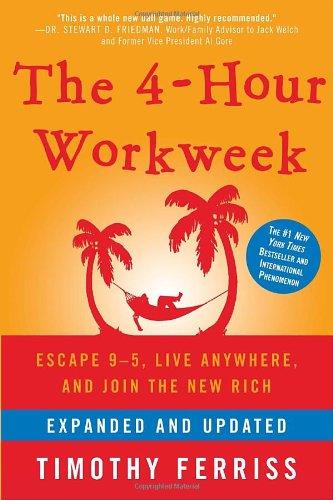
The 4-Hour Workweek
Crown · 2007 · 308 pages
ISBN: 9780307465351
Review Editor
Sofia Reyes
Tim Ferriss published The 4-Hour Workweek in 2007, and it became one of the defining books of the early remote-work and life-hacking movements. Its argument is that the goal of working hard for forty years in order to retire is obsolete — that the tools of automation, outsourcing, and remote work allow motivated people to compress the most important elements of that deferred life into the present. Ferriss writes about systematically eliminating, automating, and delegating work; building location-independent income streams; and creating “mini-retirements” throughout a career rather than waiting until the end of one. The book has aged unevenly, and some of its specific techniques are dated. But its core challenge to how people think about time, work, and deferral remains useful and occasionally genuinely subversive.
Character Arcs
Ferriss uses himself as the primary case study — the story of his own transformation from 80-hour workweek entrepreneur to someone who runs his business from Buenos Aires while dancing the tango. He is an enthusiastic and occasionally exhausting narrator, driven by a genuine missionary impulse about the life he’s discovered and a talent for provocative instruction. The book is also populated by case studies of other “New Rich” practitioners — people who have arranged their lives around experience and mobility rather than accumulation. These are useful as illustrations but tend to represent a particular kind of person: technically skilled, entrepreneurially minded, without dependents or community obligations that resist the lifestyle being prescribed.
Pacing
The book is organized around Ferriss’s DEAL framework — Definition, Elimination, Automation, Liberation — and moves through each phase with a combination of argument, case study, and practical instruction. Some chapters are excellent: the material on selective ignorance, on the 80/20 principle applied to work, and on the Parkinson’s Law of time expansion are genuinely useful regardless of whether you buy the full program. Other sections are more problematic: the detailed instructions for building businesses that outsource to low-wage labor in developing countries have aged poorly both ethically and practically. The appendices are stuffed with resources that are now largely obsolete.
Thematic Depth
The book’s most important idea isn’t about outsourcing or automation — it’s about the relationship between time and money and the deferral of life. Ferriss argues that people systematically trade time (which they have now) for money (which they’ll have later) and then don’t know what to do with either. The mini-retirement concept — taking extended trips or sabbaticals throughout a career rather than saving everything for the end — challenges the dominant framework of working life in ways that remain worth thinking about. Less satisfying is the book’s treatment of what you actually do with liberated time; Ferriss’s answers (competitive dancing, martial arts, learning languages) are fine but suggest the freedom is more appealing than the activities it enables.
Style and Voice
Ferriss writes with an intensity and specificity that is either inspiring or overwhelming depending on the reader. He quantifies everything — hours per week, dollars per month, response times — in a way that makes abstract arguments concrete but can tip into a kind of hustle-optimized version of what it critiques. The book is full of techniques, systems, and hacks, and readers who want a philosophical argument rather than a manual may find it exhausting. The tone is relentlessly positive about the proposed lifestyle in ways that obscure how much of what Ferriss describes depends on circumstances, skills, and privileges that not everyone shares.
Verdict
The 4-Hour Workweek is a more interesting book than its reputation as a hustle-culture manifesto suggests, but also a less practical one than it promises. Its best insights — about time scarcity, deferral, Parkinson’s Law, and selective ignorance — are genuinely valuable. Its most specific prescriptions have aged poorly, and its implicit assumption that the reader is a technically skilled professional without major dependencies is a significant limitation. Read it as a prompt to question your assumptions about work and time rather than as a replicable system, and it delivers real value.
Rating: 3.7 out of 5
Book Details
- Title
- The 4-Hour Workweek
- Author
- Timothy Ferriss
- Genre
- Self-Help
- Publisher
- Crown
- Year Published
- 2007
- Pages
- 308
- ISBN
- 9780307465351
- WritersReview Rating
- 3.7 / 5