
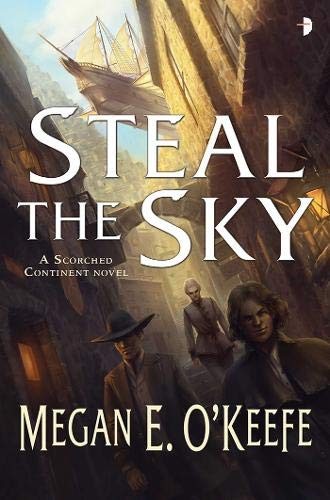
Steal the Sky
Angry Robot · 2016 · 448 pages
ISBN: 9780857664891
Review Editor
Marcus Webb
Megan E. O’Keefe’s debut novel drops readers into the desert city of Aransa, a mining settlement perched on the edge of a vast, scorched wasteland. Published in January 2016 by Angry Robot, Steal the Sky is the first volume of the Scorched Continent trilogy, and it announces O’Keefe as a writer with sharp instincts for setting, voice, and the mechanics of a good con. The novel blends fantasy worldbuilding with heist-fiction structure, stacking schemes on top of schemes until the whole thing threatens to collapse in the best possible way.
The premise centers on Detan Honding, a nobleman turned confidence artist, and his loyal companion Tibs. The two have landed in Aransa with their eyes on a prize: the Larkspur, a magnificent airship belonging to the exiled commodore Thratia Ganal, a military leader with populist ambitions and a talent for intimidation. Detan and Tibs plan to steal the ship and disappear. But Aransa has problems of its own. A shape-changer known as a doppel is murdering members of the city’s government, and Watch Captain Ripka Leshe finds herself forming an unlikely alliance with Detan to root out the killer before Thratia can exploit the chaos for her own political gain.
The world runs on selium, a lighter-than-air substance that keeps airships aloft, powers the local economy, and can be manipulated by people born with sensitivity to it. Some sel-sensitives work the dangerous mines. Others, the feared doppels, can reshape their own appearances. And a rare few can weaponize the stuff in terrifying ways. O’Keefe builds this material system with care, and selium becomes far more than a plot device; it is the economic engine, the social hierarchy, and the source of the novel’s central anxieties all at once.
Character Arcs and Development
Detan Honding is the book’s center of gravity, a fast-talking rogue whose noble origins and criminal present create a tension he never quite resolves. He is charming in the way that skilled liars often are: entertaining to watch, hard to fully trust. His relationship with Tibs provides the novel’s emotional anchor. Tibs operates as Detan’s conscience, his strategist, and occasionally his babysitter. Their dynamic recalls the great fictional partnerships, with Tibs’s quiet competence counterbalancing Detan’s manic improvisation. You sense real history between them, even when the novel only sketches the specifics.
Ripka Leshe offers a necessary counterweight. Where Detan bends the law, Ripka enforces it, and her struggle to maintain order in a city sliding toward authoritarianism gives the plot its moral stakes. She is competent, stubborn, and increasingly desperate as Thratia’s influence grows. The tension between Ripka’s duty and her growing recognition that the law may not be enough to protect Aransa adds genuine complexity to what could have been a straightforward cop-and-robber pairing.
The supporting cast is a mixed bag. Thratia Ganal works best as a looming threat, a politician who understands that fear is a tool and knows exactly when to use it. She occasionally tips into broad villainy, particularly in scenes where subtlety would have served her character better. Pelkaia Teria, the doppel at the center of the murder mystery, is the novel’s most intriguing figure, a woman whose ability to change her face has made her both powerful and profoundly isolated. She arrives late to the story’s center stage, and the book suffers for it; more time with Pelkaia earlier would have deepened the novel’s exploration of identity and belonging.
Pacing
O’Keefe keeps the plot moving at a brisk clip. Scenes transition quickly, and the narrative rarely lingers in one location long enough for the reader to get comfortable. This momentum is one of the book’s strongest qualities. The first act establishes the world and the con with efficiency, the second act complicates both with the doppel murders and shifting political alliances, and the third act delivers an action sequence that pays off nearly every thread the novel has been weaving.
The trade-off is depth. Aransa is a fascinating city on paper, its tiers of wealth stacked literally from bottom to top, the rich perched above while everyone else holds them up. But the novel moves through it so quickly that the setting sometimes feels like scenery rather than a living place. You get glimpses of the mining quarters, the market districts, the upper-tier gardens, but rarely enough time to feel the texture of daily life. A handful of slower scenes, particularly in the first half, would have given the world room to breathe without sacrificing the plot’s forward drive.
Deeper Thematic Exploration
Beneath its heist-fiction surface, Steal the Sky is a novel about resource extraction and the political structures that grow around it. Selium is not just a magical substance; it is wealth, power, and social control condensed into a single material. The sel-sensitive workers who mine it are exploited for their abilities, their labor extracted under conditions that range from coercive to outright dangerous. The doppels, whose sel-sensitivity manifests as the ability to change their appearance, are feared and hunted. O’Keefe draws a clear line between economic value and human worth, and the novel asks uncomfortable questions about what happens to people whose bodies become resources.
The political dimension reinforces this. Thratia’s populist rise mirrors patterns familiar from history and current events: a military figure who positions herself as the people’s champion while consolidating power for herself. Ripka watches this happen with growing alarm, recognizing the danger but constrained by the very institutions Thratia is undermining. The novel does not resolve this tension neatly, which is to its credit. Political problems in fiction rarely benefit from clean solutions, and O’Keefe trusts her readers to sit with the ambiguity.
Identity runs through the novel as both a literal and figurative concern. The doppels can become anyone, which makes them feared in a society obsessed with knowing who belongs where. Detan, too, hides behind masks, though his are social rather than physical. His noble birth, his criminal identity, and a secret about his own sel-sensitivity that he guards fiercely all create layers of performance. The novel suggests that identity, in a stratified society, is never simply a matter of who you are; it is always shaped by what you are worth to the people in power.
Style and Voice
O’Keefe writes with a light touch that belies real craft. Her dialogue crackles with personality, and she has a gift for the kind of one-liner that reveals character while earning a laugh. Detan’s voice dominates the prose, and his wry, self-deprecating energy keeps even the slower expository passages entertaining. The novel’s language does something clever with idioms, reworking familiar phrases to fit the world’s airship culture. Characters say things like “you’re pulling my sail” instead of “you’re pulling my leg,” and while these substitutions occasionally call attention to themselves early on, they settle into the story’s rhythm and contribute to a genuine sense of cultural specificity.
The prose is functional rather than lyrical, which suits the genre. O’Keefe prioritizes clarity and momentum over beauty, and the writing rarely asks you to slow down and admire a sentence. This is not a criticism; it is a deliberate choice that serves the heist structure well. When the novel does reach for something more evocative, particularly in descriptions of selium manipulation and the desert landscape, the shift in register feels earned.
Verdict
Steal the Sky is a confident debut that delivers exactly what it promises: a desert heist with airships, political intrigue, and a cast of schemers whose plans collide in satisfying ways. O’Keefe’s worldbuilding around selium is inventive and thematically rich, and her handling of political tension gives the story weight beyond its caper-fiction surface. The characters, while not uniformly deep, are well-matched to the plot’s needs, and the pacing never falters.
If you enjoy fantasy that leans toward the adventurous end of the spectrum, books where the pleasure comes from watching clever people improvise their way out of impossible situations, this one belongs on your list. Readers who prefer densely populated worlds and deeply interior character work may find Aransa a bit thin, and Detan a bit more flash than substance. But O’Keefe won the David Gemmell Morningstar Award for this novel, and the recognition is deserved. Steal the Sky does not try to be everything; it tries to be a smart, propulsive, and deeply entertaining fantasy heist, and on those terms, it succeeds.
Frequently Asked Questions about Steal the Sky
What is Steal the Sky by Megan E. O’Keefe about?
Steal the Sky follows Detan Honding, a con man of noble birth, and his companion Tibs as they plot to steal a powerful airship in the desert city of Aransa. Their heist gets complicated when a shape-changing killer called a doppel begins murdering government officials, forcing Detan into an uneasy alliance with the local Watch Captain, Ripka Leshe. The novel blends fantasy worldbuilding with heist-fiction plotting against a backdrop of political upheaval.
Is Steal the Sky part of a series by Megan E. O’Keefe?
Yes, Steal the Sky is the first book in the Scorched Continent trilogy. It is followed by Break the Chains and Inherit the Flame. Each book continues the story of Detan, Ripka, and the political conflicts shaping the Scorched Continent. The trilogy was published by Angry Robot between 2016 and 2017.
What are the main themes in Steal the Sky?
The novel explores resource exploitation through its central substance, selium, showing how an economy built on extraction creates rigid social hierarchies and devalues the workers who power it. It also examines political populism, identity and belonging, and the tension between law and justice. The doppel subplot raises questions about what it means to be feared for abilities you did not choose.
How long is Steal the Sky and is it a difficult read?
Steal the Sky runs 448 pages in its mass market paperback edition. It is a fast, accessible read with brisk pacing and clear prose. The worldbuilding around selium requires some initial adjustment, but O’Keefe introduces her concepts efficiently. Most readers comfortable with fantasy fiction will move through it quickly.
Is there a movie or TV adaptation of Steal the Sky?
As of 2026, there is no movie or television adaptation of Steal the Sky. The novel’s airship-driven world and heist structure could translate well to screen, but no adaptation has been announced. Megan E. O’Keefe has continued writing science fiction and fantasy, including the Protectorate series starting with Velocity Weapon.
Did Steal the Sky win any awards?
Yes, Steal the Sky won the David Gemmell Morningstar Award in 2017, which recognizes the best fantasy debut novel of the year. The award is named after the late fantasy author David Gemmell and is voted on by readers. This recognition helped establish O’Keefe as a notable voice in the fantasy genre.
How does Steal the Sky compare to other fantasy heist novels?
Steal the Sky draws frequent comparisons to Scott Lynch’s Gentleman Bastard series for its roguish protagonists and layered cons. It shares DNA with Firefly’s blend of adventure and found-family dynamics. Where it distinguishes itself is in its resource-extraction worldbuilding and political subplot. Readers who enjoy The Lies of Locke Lamora or Six of Crows will find familiar pleasures here, though O’Keefe’s tone is lighter and her world more arid.
Should I read Steal the Sky and is it worth it?
If you enjoy fast-paced fantasy with clever plotting and inventive worldbuilding, Steal the Sky is well worth your time. It delivers a satisfying heist narrative with enough political and thematic depth to reward attentive reading. Readers who prioritize deep character interiority may find it somewhat surface-level, but as a debut novel and the opening of a trilogy, it is an impressive achievement that earned its Gemmell Award.
Book Details
- Title
- Steal the Sky
- Author
- Megan E. O'Keefe
- Genre
- Science Fiction
- Publisher
- Angry Robot
- Year Published
- 2016
- Pages
- 448
- ISBN
- 9780857664891
- WritersReview Rating
- 3.8 / 5