
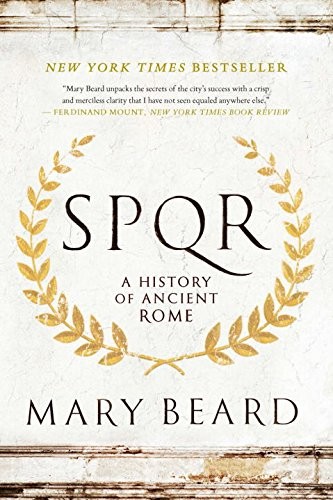
SPQR
Liveright Publishing Corporation · 2015 · 608 pages
ISBN: 9781631492228
Review Editor
Thomas Calloway
In the autumn of 63 BCE, Cicero stood before the Roman Senate and delivered one of the most famous speeches in human history: a denunciation of Catiline, a bankrupt aristocrat who had allegedly plotted to overthrow the Republic. Mary Beard opens SPQR: A History of Ancient Rome at precisely this moment, not because Cicero’s oration is the beginning of Roman history, but because it captures something essential about what Rome was: a society perpetually in arguments with itself, about power, about who belonged and who did not. From that dramatic opening, Beard takes readers on a journey spanning more than a thousand years of Roman civilization, from the legends of Romulus to the reign of Caracalla in 212 CE, when citizenship was finally extended to virtually every free person in the empire.
Published in 2015, SPQR arrives with the full weight of Beard’s career behind it. A professor at Cambridge and the classics editor of the Times Literary Supplement, Beard has spent decades challenging how non-specialists think about the ancient world. This book is the culmination of that project: an attempt to write a history of Rome that is honest about the gaps in its own knowledge, skeptical of received wisdom, and as interested in ordinary Romans as in emperors and generals. It made the New York Times bestseller list in December 2015, became a finalist for the National Book Critics Circle Award for Nonfiction, and generated major reviews from critics who rarely cover ancient history. The attention was deserved.
Beard is explicit from the start that SPQR is not a comprehensive survey. It covers Rome’s origins through 212 CE, and even within that span it picks its moments with deliberate selectivity. Crucifixions, gladiatorial combat, the treatment of enslaved people, the lives of women: Beard looks at all of it, including the parts that make Rome difficult to admire. The title, an abbreviation of Senatus Populusque Romanus, translates roughly as “the Senate and the People of Rome,” and that tension between elite power and popular identity is exactly the fault line Beard finds most interesting to press.
Historical Figures and How Beard Uses Them
Because SPQR is a work of history rather than fiction, there are no characters in the conventional sense, but there are individuals whose lives Beard uses to anchor the narrative. Cicero is the closest thing the book has to a central figure. His letters and speeches survive in extraordinary quantity, and they provide a window into the anxieties and ambitions of the late Republic that no other ancient text matches. When Beard describes Cicero drafting correspondence from his country estates, you get something genuinely unusual in ancient history: a recognizable personality, complete with vanity, self-doubt, real intellectual pleasure, and the kind of political calculation familiar to anyone who has watched people navigate institutions. Beard uses him without either lionizing him as the pure defender of republican principle or dismissing him as a hypocrite on slavery. He is complicated, and she lets him stay that way.
Augustus receives a very different treatment. Beard is far more skeptical about Rome’s first emperor than many popular historians have been. She acknowledges the stability he brought after decades of civil war, but she keeps asking what that stability cost and for whom. Augustus reorganized Rome in ways he deliberately obscured; the Republic’s forms were preserved while its substance shifted, and Beard tracks that process with a patience that resists both the admiring portrait Augustus cultivated and the easy dismissal that would make his achievement morally tidy.
The most striking figures in SPQR, though, are the anonymous ones. Beard devotes serious attention to ordinary Romans: the freedmen and freedwomen whose tombstones survive at Pompeii, the graffiti-writers who scratched their names and opinions onto walls, the soldiers whose discharge diplomas record names and units and home provinces. These people have no arcs in any literary sense. But Beard treats their traces with the same seriousness she gives to Cicero’s letters, and the cumulative effect is to make Rome feel populated rather than merely monumental.
Pacing
SPQR does not move at a uniform pace, and this is partly by design. Beard is upfront that she is not trying to cover every century with equal thoroughness. The opening chapters on Rome’s mythological origins and early history move with particular care, because she is interested in what later Romans chose to believe about themselves rather than what actually happened in the eighth century BCE. These chapters ask questions more than they answer them, which can feel frustrating if you come expecting a narrative drive, but which is genuinely refreshing if you have read popular histories of Rome that treat Romulus as a straightforwardly historical figure.
The book finds its full stride when it reaches the late Republic. The chapters on the Gracchi brothers, on the social wars, on the creaking machinery of republican institutions under the strain of empire read with real urgency. Beard writes about political crisis in a way that does not require knowledge of Rome’s eventual fall to feel the tension. The middle sections, with their careful parsing of what the evidence does and does not show, can slow down readers expecting a faster ride. The final chapters, dealing with the early imperial period, pick the pace back up, though Beard resists the temptation to turn Augustus into a tidy conclusion.
Deeper Thematic Exploration
The central question of SPQR is one that Beard states directly and returns to repeatedly: what does it mean to be Roman? This is not an idle question for an ancient historian. Rome extended citizenship to more people over more territory over a longer period than any other pre-modern state, and that expansion kept raising the question of what citizenship actually conferred, what obligations it required, and where its limits lay. Caracalla’s edict of 212 CE is Beard’s stopping point precisely because it represents one possible answer: citizenship is now universal for the free, and with that, the very category of “Roman” shifts into something new.
Beneath the citizenship question runs a harder one: what do we do with Rome’s violence? Beard does not minimize it. Slavery was foundational to the Roman economy; somewhere between 30 and 40 percent of the population of Roman Italy may have been enslaved at the Republic’s height. Gladiatorial combat was entertainment. Military conquest was the engine that drove everything else. Beard is clear-eyed about all of this without the anachronistic outrage that sometimes makes ancient history feel like a modern morality play. She wants to know what Roman violence meant to Romans, how they justified it to themselves, where their own ambivalences appeared. That is a more demanding and more interesting question than asking whether Romans were bad.
A third theme, one that becomes more insistent as the book progresses, is the problem of evidence. We know Rome primarily through a narrow selection of texts, mostly written by upper-class men, and through physical remains that survive by accident or by the intervention of natural disaster at Pompeii and Herculaneum. Beard keeps reminding you of this. When she describes what ordinary Romans ate, or how women navigated public space, or what a freedman’s daily life looked like, she marks carefully how much is inference and how much is documented. This is not pedantry. It is an argument that honest history requires holding uncertainty in tension with the desire for clean answers, and it makes SPQR a rare kind of popular history: one that respects its readers enough to admit what it does not know.
Style and Voice
Mary Beard writes with an authority that never tips into condescension. Her prose is clear, occasionally witty, and organized around questions rather than confident pronouncements. Where lesser popularizers of ancient history would smooth over the contradictions in the evidence and hand you a clean story, Beard keeps stopping to say: actually, we do not know this, here is what the sources tell us and here is why that might be misleading. This habit makes SPQR a more demanding read than some of its competitors, but also a more honest one.
Her voice is personal without being intrusive. You sense a scholar who genuinely enjoys her subject and wants to share her curiosity rather than her conclusions. The book does not have passages of great descriptive beauty in the way that narrative history sometimes does, but it has something rarer: a sustained intellectual honesty that makes you trust what you are reading. When Beard writes about Cicero’s letters or the graffiti at Pompeii, there is warmth in the prose, a pleasure in the texture of evidence that never becomes academic posturing. She writes like someone who has spent forty years with this material and still finds it surprising.
Verdict
SPQR is the book about Rome for readers who are tired of books that pretend Rome was simpler than it was. If you want a lively, sequential narrative with clear heroes and villains, Tom Holland’s Rubicon will serve you better. If you want a serious engagement with what the evidence actually shows, what questions it raises, and why Rome’s ideas about power and belonging still shape how the West thinks about itself, Beard’s book is the right choice. It will slow you down in the best possible way, making you stop and reconsider things you thought you knew.
The density of the middle chapters will test readers who come in expecting a quick survey. Beard asks something of you: attention, patience with uncertainty, willingness to sit with a question before she offers even a partial answer. Readers who give her that will finish SPQR with a more complicated and more genuine understanding of ancient Rome than they could get from most popular histories. That is not a small thing for a book that has a chance to put you off ancient history entirely if you are not in the right frame of mind. Go in expecting an argument, not a story, and you will not be disappointed.
Frequently Asked Questions about SPQR: A History of Ancient Rome
What is SPQR: A History of Ancient Rome by Mary Beard about?
SPQR covers Roman history from the city’s mythological origins through 212 CE, when Emperor Caracalla extended citizenship to virtually all free people in the empire. Rather than a straightforward chronological narrative, it asks what it meant to be Roman, how the empire extended its identity outward, and what the evidence can and cannot tell us about ordinary Romans’ lives. Mary Beard uses Cicero, Augustus, and anonymous Romans whose names survive only on tombstones and graffiti as lenses into the larger story.
Is SPQR a good starting point for someone new to Roman history?
SPQR works well for readers who have some general curiosity about ancient Rome but is not the easiest possible introduction. Beard writes accessibly and defines terms as she goes, but she is more interested in raising hard questions than in delivering a clear narrative. If you want an entry-level survey with strong storytelling, Tom Holland’s Rubicon or Anthony Everitt’s Cicero might be more welcoming first reads. If you want to be intellectually challenged from the start, SPQR is worth the effort.
What are the main themes in SPQR by Mary Beard?
The book centers on four linked concerns: what Roman citizenship meant and how it expanded over time; the role of violence in Roman society, including slavery and gladiatorial combat; the problem of historical evidence and how little we actually know about most Romans; and the question of how Rome transformed from a small city-state into a civilization that still shapes Western political and legal thinking. Beard keeps returning to the tension between the Roman elite and ordinary people throughout.
How long is SPQR and is it a difficult read?
SPQR runs 606 pages including notes and index, with the main text around 450 pages. The writing is clear and aimed at general readers rather than specialists, but Beard’s habit of pausing to question the evidence and complicate easy conclusions means the book rewards slow reading more than fast. Expect to spend two to three weeks with it if you are reading carefully. It is demanding in the best sense: it assumes you are capable of sitting with open questions.
Did SPQR win any awards or make any best-of lists?
SPQR was a finalist for the 2015 National Book Critics Circle Award for Nonfiction and appeared on the New York Times hardcover nonfiction bestseller list in December 2015. It received major reviews in the Financial Times, the Guardian, and the New York Times, all largely positive. Mary Beard herself has won numerous awards for her writing and scholarship, including the Princess of Asturias Award in 2016 and a DBE in 2018.
Is there a documentary or TV adaptation of SPQR: A History of Ancient Rome?
There is no direct film or TV adaptation of SPQR itself, but Mary Beard has presented several acclaimed BBC documentaries on ancient Rome, including Meet the Romans (2012) and Ultimate Rome: Empire Without Limit (2016), both of which cover overlapping ground with the book. If you want a visual companion to the book’s arguments about ordinary Romans and the reach of the empire, those documentaries are the closest equivalent.
How does SPQR compare to Mary Beard’s other books on Rome?
SPQR is Beard’s most ambitious single-volume work on Rome and is widely regarded as her most comprehensive book for general readers. Her earlier The Roman Triumph (2007) won the Wolfson History Prize and focuses on a single ritual with great depth. Pompeii (2008) covers one city and one catastrophic moment. SPQR is broader in scope than either, sacrificing depth in specific areas for a longer view of what Rome was and how it changed over a thousand years. If SPQR sparks your interest, The Roman Triumph is the natural next read.
Should I read SPQR by Mary Beard and is it worth the time?
Yes, if you are genuinely curious about ancient Rome and prepared for a book that asks more questions than it answers. Beard is one of the best guides to the ancient world writing today, and SPQR gives you her thinking at full length on the civilization that shaped Western law, politics, and culture. You will finish it knowing more about what we do not know about Rome than most popular histories acknowledge, and that honest reckoning with the limits of knowledge is itself valuable. Readers who want a quick tour should look elsewhere; readers who want to understand what Rome actually was will find this indispensable.
Book Details
- Title
- SPQR
- Author
- Mary Beard
- Genre
- History
- Publisher
- Liveright Publishing Corporation
- Year Published
- 2015
- Pages
- 608
- ISBN
- 9781631492228
- WritersReview Rating
- 4.2 / 5