
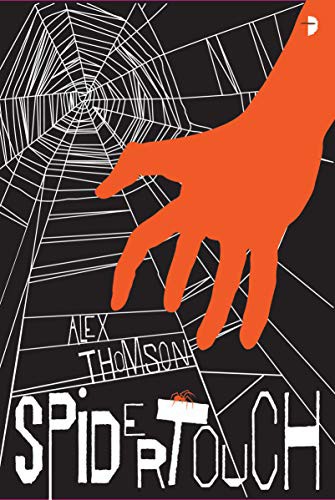
Spidertouch
Angry Robot · 2021 · 400 pages
ISBN: 9780857669605
Review Editor
Marcus Webb
Alex Thomson’s Spidertouch, published by Angry Robot in December 2021, drops you into the besieged city of Val Kedic, a place ruled for centuries by the Keda, a mute alien race that communicates through an intricate system of touch called fingerspeak. At the center of the story is Razvan, a middle-aged translator who learned this tactile language as a boy and now serves as an interpreter in the Keda court. He does not love his work. He does not love his rulers. But he keeps his head down because his son is held hostage in the Keda’s mines, where children are sent from age eleven to eighteen, and any parental misbehavior earns them extra lashings.
The setup is immediately compelling. The Keda are cruel colonizers who maintain control through fear, forced labor, and the isolation of families. Razvan occupies a strange middle ground: he is neither fully subjugated nor truly free. His skill with fingerspeak gives him access to the corridors of power, but it also makes him complicit in the system that holds his city captive. When a rebel faction approaches Razvan with a plan to exploit an incoming siege by the Dagmari (a rival army, possibly even more ruthless than the Keda) to overthrow their oppressors once and for all, he faces a choice that could cost him everything.
Thomson, a French and Spanish teacher by day and the author of the earlier novel Death of a Clone, drew on his passion for linguistics to build a world where language is not just a plot device but the foundation of every power dynamic in the story. The result is a novel that feels genuinely different from the usual fantasy offerings, even if it stumbles in a few places along the way.
Character Arcs and Development
Razvan is a rare protagonist in fantasy: a mild-mannered linguist, not a warrior or a chosen one. He is cautious, pragmatic, and deeply afraid of what might happen to his son if he steps out of line. His transformation from reluctant collaborator to active participant in the rebellion takes time, and Thomson earns every step of it. You feel Razvan’s internal conflict when the revolutionaries come calling, because you understand exactly what he stands to lose. He is not a hero who leaps into action. He is a father who calculates risk.
The supporting cast is a more mixed affair. Ira, a fellow interpreter, provides a compelling foil to Razvan. She is poised and careful where he is anxious and reactive, and their dynamic crackles with unspoken tension. Naima, the fiery revolutionary who recruits Razvan, brings energy and conviction to every scene she enters. These two women are well-drawn enough to feel like real people with their own agendas, not just satellites orbiting the protagonist.
The Keda themselves, however, remain frustratingly opaque. This is partly by design: they are alien, mute, and deliberately unknowable. But the effect is that no individual Keda ever rises above the collective. They function as a monolithic threat rather than as characters, which limits the emotional complexity of the central conflict. When the revolution comes, you are rooting against an institution, not against a person, and that difference matters. A great villain would have elevated this book considerably.
Pacing
Spidertouch moves briskly for a 400-page novel. The siege framework gives the plot a natural ticking clock, and Thomson keeps the pressure rising as the Dagmari army tightens its grip on the city walls while the internal rebellion gathers momentum. The early chapters, which establish Razvan’s daily life and the mechanics of fingerspeak, are absorbing rather than slow, because the worldbuilding feels genuinely fresh.
The middle section, where Razvan navigates competing loyalties and the rebels execute increasingly risky operations, maintains strong forward momentum. If anything, the final act feels slightly rushed. After spending so much time carefully building tension, the climactic confrontations resolve a bit too neatly. A few more pages devoted to the consequences of the uprising would have given the ending more weight. Still, this is a book that respects your time and rarely lets you drift.
Deeper Thematic Exploration
Beneath the siege warfare and political intrigue, Spidertouch is a novel about the relationship between language and power. The Keda’s dominance rests not just on their physical strength but on the fact that only a handful of human interpreters can understand them. This creates a class of collaborators, people like Razvan, who benefit from the system they despise. Thomson handles this dynamic with real nuance. Razvan is not simply a traitor or a victim. He is both, and the novel refuses to let him off the hook for the privileges his linguistic skill has afforded him.
The concept of fingerspeak itself raises fascinating questions about communication and intimacy. In a world where you must physically grip someone’s arm to speak with them, every conversation becomes an act of proximity and vulnerability. Thomson explores how this shapes the Keda’s culture: they are a race for whom private speech is nearly impossible (anyone touching you can “overhear”), and this lack of privacy has made them guarded, hierarchical, and paranoid. The humans who learn fingerspeak absorb some of these qualities too, becoming isolated from their own communities. Language, Thomson suggests, does not just convey meaning. It shapes who you become.
There is also a sharp thread about parenthood running through the novel. The Keda’s use of children as hostages is not just a plot mechanism; it is the moral engine of the entire story. Every decision Razvan makes is filtered through the question of what it will mean for his son. This gives the political stakes a personal urgency that keeps the rebellion from feeling abstract. When Razvan weighs the possibility of freedom against the certainty of punishment for his child, you feel the full, grinding weight of colonial oppression on an individual life.
Style and Voice
Thomson writes in a clean, direct prose style that serves the story well. He avoids the ornate flourishes that weigh down a lot of epic fantasy, opting instead for short, punchy sentences during action sequences and longer, more reflective passages when Razvan is alone with his thoughts. The narrative voice is first-person and intimate, which suits a story about an interpreter whose entire life depends on reading people accurately.
The descriptions of fingerspeak are handled with particular care. Thomson, drawing on his experience as a language teacher and a former bongo player (really), has thought through the mechanics of taps, squeezes, and finger trills with impressive specificity. You get a real sense of how this language works without ever feeling like you are reading a textbook. The moments where Razvan deliberately mistranslates, or where the limitations of fingerspeak create dangerous misunderstandings, are among the most tense and inventive scenes in the book.
Verdict
Spidertouch is a novel built on a genuinely original idea, and Thomson executes it with skill and confidence. If you are the kind of reader who gravitates toward worldbuilding that feels inventive rather than derivative, this book will reward you. The siege narrative provides reliable momentum, and Razvan is a protagonist worth spending 400 pages with: flawed, frightened, and deeply human in his attempts to protect the people he loves.
Where the book falls short is in its antagonists. The Keda never become more than a collective menace, and without a compelling individual villain, the revolution lacks the personal stakes that would push this from very good to exceptional. Some readers may also find the worldbuilding detail occasionally overwhelming, particularly the political machinations of various factions within the city. But these are quibbles about a book that takes genuine creative risks and mostly lands them. If you enjoy the linguistic inventiveness of China Mieville, the grimdark sensibility of Joe Abercrombie, or the underdog rebellion stories of Kameron Hurley, Spidertouch belongs on your list.
Frequently Asked Questions about Spidertouch
What is Spidertouch by Alex Thomson about?
Spidertouch follows Razvan, an interpreter living in the besieged city of Val Kedic, which is ruled by the Keda, a mute alien race that communicates through a touch-based language called fingerspeak. When a rebel faction recruits Razvan to help overthrow the Keda during an incoming siege, he must decide whether to risk his quiet life and his son’s safety for the chance at freedom.
Is Spidertouch by Alex Thomson part of a series?
Spidertouch is a standalone novel. The story reaches a satisfying conclusion within its 400 pages, though Thomson has hinted that the door is not closed on future stories set in the same world. You do not need to read his earlier novel, Death of a Clone, to enjoy this book.
What are the main themes in Spidertouch by Alex Thomson?
The novel explores the relationship between language and power, showing how control of communication creates hierarchies and complicity. It also examines parenthood under oppression, the moral cost of collaboration with an occupying force, and the difficult choices people face when revolution becomes possible. The nature of colonialism and resistance runs through every chapter.
How long is Spidertouch and is it a difficult read?
Spidertouch is 400 pages in paperback. It reads quickly thanks to a first-person narrative voice and a siege plot that keeps the tension high. The worldbuilding is detailed but never academic, and the touch-based language system is explained clearly as the story unfolds. Most readers comfortable with epic fantasy will find it accessible.
Is there a movie or TV adaptation of Spidertouch?
As of 2026, there is no movie or TV adaptation of Spidertouch. An audiobook version has been produced. Thomson himself has noted that the siege setting and political intrigue could translate well to screen, and the unique fingerspeak system would present an interesting visual challenge for filmmakers.
What age group or reading level is Spidertouch appropriate for?
Spidertouch is written for adult readers. It contains violence, scenes of cruelty toward children (used as hostages and forced laborers), and morally complex situations. The themes of colonialism and complicity are handled with nuance that would be best appreciated by readers aged 16 and up. It is not a young adult novel.
How does Spidertouch compare to Alex Thomson’s other books?
Thomson’s earlier novel, Death of a Clone (2018), was a science fiction murder mystery with a very different tone and setting. Spidertouch is a fantasy novel influenced by grimdark authors like Joe Abercrombie and Kameron Hurley, with a much stronger focus on worldbuilding, language, and political revolt. Readers who enjoyed the inventive premise of Death of a Clone will find Thomson’s ambition has grown considerably.
Should I read Spidertouch and is it worth it?
If you enjoy fantasy novels with original worldbuilding, morally complex protagonists, and siege narratives, Spidertouch is well worth your time. The touch-based language system is unlike anything else in the genre, and Razvan is a compelling lead. Readers who need strong individual villains or prefer lighter fantasy may want to look elsewhere, but for anyone drawn to inventive, character-driven stories about resistance and sacrifice, this is a satisfying read.
Book Details
- Title
- Spidertouch
- Author
- Alex Thomson
- Genre
- Science Fiction
- Publisher
- Angry Robot
- Year Published
- 2021
- Pages
- 400
- ISBN
- 9780857669605
- WritersReview Rating
- 3.8 / 5