
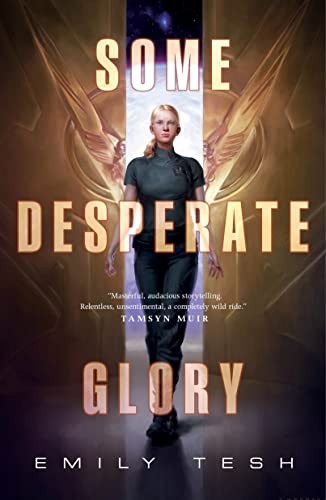
Some Desperate Glory
Tordotcom · 2023 · 438 pages
ISBN: 9781250834980
Review Editor
Marcus Webb
When “Some Desperate Glory” won the Hugo Award for Best Novel in 2024, it confirmed what readers had been saying since its April 2023 release: Emily Tesh had written one of the most politically serious and emotionally demanding debut novels in recent science fiction. Tesh is not a new voice in the genre; her novellas “Silver in the Wood” and “Drowned Country” earned her a devoted readership in fantasy. But this first novel is a different kind of ambition, a queer space opera that functions simultaneously as a sustained examination of radicalization, ideology, and what it genuinely costs to change your mind about things you were told were absolute truths.
The premise is a war story. Earth is gone, destroyed by the Majoda, an alien species that deployed a reality-altering superweapon called the Wisdom to end human civilization. A few thousand survivors live on Gaea Station, the last human settlement in the galaxy, where every aspect of society has been organized around one goal: vengeance. Children train to fight from the moment they can walk. The station’s rigid gender roles, its punishment of homosexuality, its intolerance of doubt or softness, all of it exists in service of producing soldiers and, through reproductive programs, the next generation of soldiers. Kyr, the seventeen-year-old protagonist, has excelled at every part of this. She’s one of the best fighters of her cohort. She believes in the cause completely. She has given her whole self to it.
The crisis that breaks the story open: Command assigns Kyr’s twin brother Mags to a breeding program that will break him, and assigns Kyr herself to the nursery to bear children rather than fight. She knows she cannot accept either order. She escapes with Mags and his brilliant, difficult friend Avi, intending to complete humanity’s revenge mission on their own. What she finds outside Gaea Station turns out to be very different from anything she was taught, including things about herself.
Character Arcs and Development
Kyr is not a protagonist you’re meant to find comfortable, at least not right away. The opening chapters of “Some Desperate Glory” are intentionally difficult. Tesh puts you inside the perspective of someone who is wrong about nearly everything: wrong about the enemy, wrong about the purpose of the society she reveres, wrong about herself. She looks down on her brother for his gentleness. She reads an alien’s fear of her as weakness rather than a reasonable response to her own behavior. She frames every deviation from Gaea Station’s doctrine as betrayal or cowardice. She thinks she’s seeing clearly. She’s not.
This is demanding reading. Tesh is asking you to recognize cult thinking from the inside, without authorial guidance pointing at it and saying: look, this is wrong. You watch Kyr dismiss her brother’s suffering because the mission matters more. You watch her filter every piece of new information through the framework she was raised to hold. It’s not comfortable, and it’s not meant to be. Some readers will find the first hundred pages alienating. Others will recognize exactly what Tesh is doing and settle in for the long, careful work of watching someone have to dismantle everything she was taught.
The arc that follows is not a conversion scene or a dramatic epiphany but a proper deradicalization: fitful, nonlinear, and resisted at every stage. Kyr does not simply encounter the right information and change. She fights her own evolution, rebuilds her certainties in new forms, and then has to dismantle those too. It’s one of the more accurate portrayals of how people actually change when confronting the collapse of a foundational worldview.
Mags, her twin, provides emotional grounding throughout. His quiet dignity in circumstances designed to break him stands in sharp contrast to Kyr’s relentless aggression. Avi, the cynical deserter who already knows what Gaea Station really is, brings an outside perspective without ever becoming a simple mouthpiece for the author’s intended message. He has his own damage and his own complications. And Yiso, the alien companion who joins Kyr through much of the novel’s middle section, is one of the book’s quiet achievements: a being with every reason to fear humans, who chooses to engage anyway, carefully and with full knowledge of what that risk involves.
Pacing
The first half of “Some Desperate Glory” moves fast. Tesh’s prose is clean and purposeful, and the escape from Gaea Station and the first encounters with the wider universe carry real energy. The stakes feel immediate. The world-building integrates naturally into the action rather than stopping to explain itself. The pace supports the intensity of Kyr’s emotional state, which in these chapters is barely controlled fury looking for a target.
The middle section is where the novel slows. Kyr passes through a series of settings that are necessary for her development but can feel episodic in sequence: a confrontation here, a revelation there, another layer of her assumptions stripped away. Some of these sequences are individually compelling, particularly the scenes with Yiso, but together they can read more like stages in an argument than scenes in a story. The novel recovers its momentum in the final third, when the central conflict comes into full focus and Kyr’s reckoning with herself reaches its most acute point. What the conclusion delivers is satisfying, and it earns its emotional register. The path there has uneven stretches.
Deeper Thematic Exploration
The title comes from a World War One propaganda poem by Harold Begbie, a piece of jingoistic verse urging young men to volunteer by shaming those who wouldn’t fight. Tesh chose it deliberately. The novel is obsessed with the stories societies tell to produce soldiers, and what those stories do to the people who absorb them from birth.
Gaea Station operates on ideology the way a machine runs on fuel. Everything about its social structure exists to produce warriors: the gender roles assigning men to combat and women to reproduction, the suppression of homosexuality because it threatens the breeding program, the contempt for curiosity or doubt framed as disloyalty. Kyr has absorbed all of it. She is the product of this system as much as its intended instrument. When she encounters a universe that doesn’t operate on the terms she was taught, she doesn’t revise her framework. She tries to force the new information into the old containers. Watching her fail at this, repeatedly, is the novel’s central dramatic engine.
A pointed irony runs through the whole book: the survivors of Earth have recreated, in miniature, many of the same hierarchies and cruelties that characterized the civilizations they mourn. The Majoda, whom Kyr has been taught to see as pure evil, turn out to have their own histories, internal divisions, and their own complicated relationship to the Wisdom. The cause for which Gaea Station has organized every human life for generations is built on a foundation of selective memory and deliberate suppression of inconvenient facts. None of this arrives as lecture. Tesh lets the contradictions surface through action and character, and trusts the reader to draw the lines.
The novel’s treatment of queer identity is woven into its politics rather than sitting alongside them. Gaea Station punishes homosexuality because it needs a particular kind of person and suppresses anyone who doesn’t fit the profile. Mags’s experience, Avi’s history outside the station, and Kyr’s own slowly evolving understanding of herself all advance the book’s central argument: that the freedom to determine your own purpose and the freedom to be yourself are the same freedom, approached from different directions. The queer characters in this novel are not symbols or markers of representation. They’re people, and what happens to them matters as people, not as demonstrations of a theme.
Style and Voice
Tesh writes spare, precise prose. The opening section makes deliberate use of this: Kyr’s narrative voice is blunt and declarative in ways that map directly onto her training. Short assessments. No room for ambivalence. As Kyr’s certainties begin to erode, the writing opens up, allowing for more complexity in how she processes what she encounters. It’s a subtle technical effect, easy to miss unless you’re looking for it, and it does real work in making Kyr’s psychological journey feel authentic rather than announced.
Action sequences are handled with economy: clear, quick, and over when they need to be. Quieter scenes carry equal weight. Tesh does not waste scenes. Every significant encounter moves character understanding or world-building forward, usually both at once. Yiso’s moments particularly benefit from this discipline. Rather than explaining what Yiso is or how Yiso feels, Tesh shows how other characters respond to Yiso, and the whole picture emerges from that accumulation.
Verdict
“Some Desperate Glory” is a demanding novel, and it knows it. Not every reader will have patience for a protagonist who spends her first hundred pages being wrong in ways that feel actively uncomfortable, and the middle section asks for more patience than some will offer. But for readers willing to do the work, the payoff is a science fiction novel that takes seriously what it actually means to change your mind about things you were raised to believe are facts. Kyr’s journey is specific and strange and, in ways that land harder the more you think about them, genuinely recognizable.
You should read this if character-driven science fiction with real political substance is what you’re after. You should read it if you’ve been looking for a queer space opera where the queer characters are fully realized rather than symbolic. You should read it if you want to understand how a person gets radicalized and what it takes to work back out. If you need a protagonist who is easy to root for from the first page, you’ll need to make some adjustments. But if you can sit with Kyr while she’s at her worst and trust where Tesh is taking her, this book delivers something worth the patience it asks for.
Frequently Asked Questions about Some Desperate Glory
What is Some Desperate Glory by Emily Tesh about?
Some Desperate Glory follows Kyr, a young woman raised on Gaea Station, the last human outpost after Earth’s destruction by an alien species called the Majoda. Kyr has trained since childhood to be humanity’s weapon of vengeance, but when Command assigns her brother to a reproductive program and sends her to the nursery, she escapes with her brother and a deserter to complete the revenge mission herself. The universe she encounters challenges everything she was taught, about the war, about the enemy, and about herself.
Did Some Desperate Glory win the Hugo Award for Best Novel?
Yes. Some Desperate Glory by Emily Tesh won the Hugo Award for Best Novel in 2024, presented at Glasgow 2024 (Worldcon 82) in August 2024. The finalists included Translation State by Ann Leckie, Starter Villain by John Scalzi, The Saint of Bright Doors by Vajra Chandrasekera, The Adventures of Amina al-Sirafi by Shannon Chakraborty, and Witch King by Martha Wells. The book was also a Goodreads Choice Award nominee for Best Science Fiction in 2023.
What are the main themes in Some Desperate Glory by Emily Tesh?
The novel’s core themes include radicalization and cult indoctrination, the way ideology shapes people who are born inside it, queer identity and found family, decolonization, and sacrifice in service of a broken cause. The title comes from a World War One propaganda poem, and the book’s interest in how societies manufacture soldiers and at what cost runs through everything Tesh builds here.
Who are the main characters in Some Desperate Glory?
Kyr is the protagonist, a deeply indoctrinated young fighter whose deradicalization drives the novel. Her twin brother Mags is a gentler, more sympathetic figure who provides emotional grounding. Avi is a deserter from Gaea Station who already knows what the wider universe looks like. Yiso is an alien companion whose experience of Kyr provides some of the book’s most affecting scenes. The commander of Gaea Station, Uncle Jole, represents the system that shaped Kyr.
Is Some Desperate Glory part of a series?
No. Some Desperate Glory is a standalone novel with a complete story within its single volume. Emily Tesh has written two fantasy novellas in a separate series (Silver in the Wood and Drowned Country), but this novel has no sequels or prequels announced. Readers do not need to have read anything else by Tesh before picking it up.
How long is Some Desperate Glory and is it a difficult read?
The hardcover edition runs 438 pages. The challenge is less about length than about approach: the protagonist holds views the novel does not endorse, and the early chapters ask readers to stay inside an unreliable perspective without the author clarifying what’s wrong with it. Readers who understand what Tesh is doing will find it engrossing. Readers expecting a traditional hero with immediately relatable values will find the opening harder going.
How does Some Desperate Glory compare to Emily Tesh’s earlier novellas?
Emily Tesh’s novellas Silver in the Wood and Drowned Country are quiet fantasy works interested in folklore, romance, and found family with a relatively gentle register. Some Desperate Glory is a much larger and more politically ambitious project. Tesh draws on similar concerns about characters who must redefine themselves, but the scale, the genre, and the emotional intensity are entirely different. Readers who loved the novellas for their coziness may be surprised by this book’s sharpness and moral weight.
Should I read Some Desperate Glory and is it worth it?
Yes, if you go in knowing what you’re signing up for. Some Desperate Glory is a Hugo Award winner for good reason: it does things with character and theme that are genuinely ambitious, and it follows through on what it sets up. If you need a protagonist who is likable from page one, you will have a harder time in the opening. But if you’re drawn to science fiction that takes seriously the question of how people change when confronting the collapse of everything they were taught, this is one of the best recent examples of exactly that.
Book Details
- Title
- Some Desperate Glory
- Author
- Emily Tesh
- Genre
- Science Fiction
- Publisher
- Tordotcom
- Year Published
- 2023
- Pages
- 438
- ISBN
- 9781250834980
- WritersReview Rating
- 4.4 / 5