
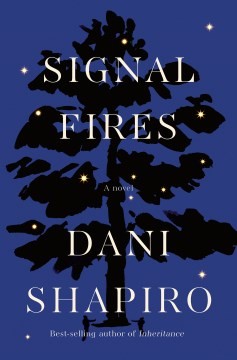
Signal Fires
🏆 National Jewish Book Award, Fiction (2022)
Review Editor
Eleanor Marsh
Signal Fires is Dani Shapiro’s first novel in fifteen years, published by Knopf in October 2022. Shapiro spent the intervening decade writing memoir, most notably Inheritance (2019), the book about her discovery through DNA testing that the man who raised her was not her biological father. That memoir made her one of the most discussed nonfiction writers working, and her return to fiction arrived with genuine anticipation from readers who knew her careful, precise voice and were curious whether she could do something equally intimate in invented form. She can.
The novel takes place largely on Division Street in Westport, Connecticut, a suburban cul-de-sac that becomes, over its fifty-year span, a kind of moral ecosystem. The central event happens in 1985: three teenagers drive home after a night of drinking, one of them gets behind the wheel, and a young woman named Sarah Kellerman is killed. The Wilf family, whose teenage son Theo was driving, closes around the secret. Ben Wilf, a young doctor who arrives at the scene and says nothing to protect his son, carries that silence for the rest of his life.
Time moves forward and backward through the novel without always announcing the transition. The Shenkmans arrive on Division Street when Theo is already in college. Their son Waldo grows up with a preternatural sensitivity to the world around him: a child who reads numbers the way other children read faces, who perceives connections between times and places and people who haven’t met. His friendship with the now-retired Dr. Wilf becomes one of the book’s emotional centers. What Signal Fires tracks, across its 229 pages, is the question of how one moment shapes every moment that follows, not just for the people directly involved, but for the neighbors who never knew, the son who grew up in the house where the silence lived, the old man who cannot forget what he failed to do.
Character Arcs and Development
Ben Wilf is the book’s moral fulcrum. As a young doctor in 1985, he makes a decision that takes less than a minute and costs him the next thirty years of his life. Shapiro shows us Ben across different eras, and the cumulative portrait is of a man who has made himself a good husband, a skilled physician, a reliable neighbor, without ever resolving the original wound. He is not a villain. He is someone who made an understandable choice to protect his child and then had to live in the house of that choice. His sections carry the novel’s deepest weight, and Shapiro earns that weight by refusing to simplify him.
Waldo Shenkman is the novel’s most unusual creation. He perceives the world at a different frequency than most people, and the friendship he builds with Ben as a young child is rendered with real delicacy. An old man who needs someone to see him, a child who sees everything: the dynamic is tender and a little strange, and it mostly avoids the sentimentality it risks. Waldo grows up to become something extraordinary, but the novel’s emotional center stays tethered to Division Street, to the years when he and Ben would sit on the porch and look at the sky together.
Mimi Wilf, Ben’s wife, resists easy sympathy. She suspects what happened on the night of the accident and chooses never to ask. Shapiro gives her a substantial section of the novel, and the portrait that emerges is of a woman who loves her family so much that she has agreed to remain ignorant of certain things about them. Theo Wilf, the driver, appears mostly through his absence: he leaves Division Street and stays away. That structural choice feels correct. The novel’s reckoning belongs to Ben, not Theo. The point is what a parent becomes when he believes he is protecting a child and may have only extended the damage.
Pacing
Signal Fires is not a novel in a hurry. Chapters move between 1985 and 2010 and 1999 and 2015 without always announcing the transition clearly, which can disorient readers accustomed to conventional narrative movement. But Shapiro controls the chronology well enough that the disorientation resolves into a temporal overlay: you hold multiple versions of Division Street simultaneously, and after a while this feels like the point rather than the problem.
The novel is short, which means the non-linearity never becomes a slog. There are a few sections in the middle where the accumulation of vignettes produces repetition rather than deepening, and readers expecting a conventional reckoning may feel the pacing as frustrating. But the quietness is a feature. This is a book about how slowly grief moves, how long it takes a secret to surface, how a single morning in 1985 keeps arriving in different forms across three decades. The tempo suits the subject.
Deeper Thematic Exploration
The 1985 accident drives the plot, but Signal Fires is really a novel about time: how we carry the past, how the same place holds different versions of itself, how a moment that seems finished keeps happening. Shapiro returns to the idea that the people who lived on Division Street in 1985 remain, in some sense, bound to that night and to each other, even as they’ve scattered or aged or died. The secret the Wilfs keep doesn’t dissolve with the passage of time. It becomes part of the structure of the house.
Waldo’s extraordinary perception of connection works as the novel’s central metaphor. He experiences time as a kind of simultaneity: the past isn’t sealed off, the connections between things are real even when they are invisible. Shapiro navigates this carefully, keeping Waldo grounded in physical specificity so he reads as a character rather than a symbol. He is a lonely, unusual child who happens to see things other people miss, and the novel uses that perception to suggest something about how all of us carry more past than we acknowledge.
The novel also traces what secrets do to families over decades. The Wilf household is functional and loving on the surface: a doctor father, a devoted mother, a well-kept house on a respectable street. What the accident reveals is that this surface rests on a decision to never look at certain things too closely. Shapiro refuses to moralize. She shows, in scene after scene, what happens when a family decides to survive by looking away. Ben becomes someone who understands everything and can fix nothing. Mimi becomes someone who has made a private agreement with certain ignorances. Theo becomes someone who leaves and doesn’t come back. None of this is punished. All of it is shown in full.
Running quietly through Ben’s sections is a meditation on moral obligation, the weight of what he owed the world that night and didn’t pay. Shapiro keeps it implicit rather than foregrounded, but it gives his sections a particular gravity. The novel doesn’t offer Ben absolution. What it offers instead is something rarer: understanding without forgiveness, and the suggestion that a person can spend a whole life in the shadow of one failure and still build something worth having.
Style and Voice
Shapiro’s prose in Signal Fires is spare in the best sense: each sentence carries its weight, and nothing feels like padding. The style is not cold minimalism. There is warmth in the specific choices she makes: the way Ben’s hands look when he’s nervous, the particular smell of the Wilf house in autumn, the way Waldo holds himself when he’s trying not to show how much he understands about a situation. The novel’s emotional intelligence shows up in these small accumulations rather than in any single dramatic gesture.
The non-linear structure demands a consistent voice to hold it together, and Shapiro’s voice delivers. Moving between a child Waldo in 2000 and an aging Ben in 2012 and the night of the accident in 1985, the prose stays in a single register: quiet, precise, slightly melancholy, with occasional flashes of something close to wonder. The chapters are short, some only a few pages, and this creates a rhythm that pulls you forward even when the plot has stalled. Signal Fires rewards slow, attentive reading: it is a book where re-reading a sentence often pays off.
Verdict
Signal Fires will work best for readers who come to literary fiction for atmosphere and character rather than for event. If you need things to happen in a sequence and you need the ending to feel resolved in a conventional sense, this is not quite that book. But if you want a novel that captures how time actually works: not as a line but as a field, where the past stays present and the same street contains many years at once, then Shapiro’s return to fiction offers real rewards.
The prose earns its reputation. Shapiro writes with the precision of someone who spent a decade in memoir learning to account for every word, and Waldo Shenkman is a genuinely original creation: a child whose unusual gifts are also a form of loneliness. The weaknesses are real: the middle section has some redundancy, and readers who need plot propulsion to stay engaged may find that the book asks more patience than it returns. But for readers willing to settle into its rhythm, Signal Fires offers something quietly rare: a novel about how we survive the choices we cannot take back, and what the house we build over those choices eventually looks like from the outside.
Frequently Asked Questions about Signal Fires
What is Signal Fires by Dani Shapiro about?
Signal Fires follows two families on Division Street in Westport, Connecticut, across fifty years, starting with a drunk-driving accident in 1985 that kills a young woman named Sarah Kellerman. The Wilf family, whose teenage son Theo was driving, covers up his role in the crash. Their neighbor Waldo Shenkman, a brilliant and perceptive child who befriends the aging Dr. Ben Wilf, becomes the unexpected figure through whom the long-buried secret finally resurfaces. The novel explores how one night’s decision ripples through decades of ordinary family life.
Did Signal Fires by Dani Shapiro win any awards?
Yes. Signal Fires won the National Jewish Book Award for Fiction in 2023. The novel was also named a Best Book of the Year by Time Magazine, the Washington Post, and Amazon, and was an NPR Favorite Book of the Year. It was a national bestseller on Shapiro’s return to fiction after fifteen years of writing memoir.
What are the main themes in Signal Fires by Dani Shapiro?
The central themes are family secrets and the long-term cost of keeping them; time and how the past continues to shape the present; moral obligation and the guilt that follows from a failure to act; and the way a single event can redefine everyone in a family across generations. The novel also explores memory, grief, the bonds between neighbors, and what Shapiro calls the “connectedness” of human experience, through the character of Waldo, who perceives links between people and events that others miss.
How long is Signal Fires and is it a difficult read?
The hardcover edition runs 229 pages, making it a short novel by contemporary standards. It is not difficult in terms of language or structure once you adjust to its non-linear timeline, which moves between 1985 and the 2010s across short chapters. The register is meditative and quiet rather than action-driven, so readers who prefer plot-forward fiction may find the pace slow. For readers comfortable with literary fiction in a reflective mode, it moves quickly despite its deliberate tempo.
Is Signal Fires based on a true story?
No, it is a work of fiction. However, Dani Shapiro is known primarily as a memoirist, and the novel’s emotional concerns, especially around family secrets and the long reach of concealed truths, overlap with themes she explored in her memoir Inheritance (2019). The specific events of Signal Fires are invented, but the territory is familiar from her nonfiction: the damage that accumulates when families agree to protect each other from the truth.
Is there a TV adaptation of Signal Fires?
As of 2022, Dani Shapiro and her production partners announced that Signal Fires was in development as a television adaptation, with Shapiro involved in the project. No release date had been announced at time of publication. Shapiro has said in interviews that the non-linear structure and the novel’s sense of overlapping time would need to be rethought for the screen, but she was optimistic about the process.
How does Signal Fires compare to Dani Shapiro’s other books?
Signal Fires is Shapiro’s first novel since Black and White (2007), and readers of her memoirs will notice the same careful sentence-level craft and the same preoccupation with family, secrets, and the self shaped by what it inherits. The novel is quieter and more structurally ambitious than her earlier fiction. Readers who loved Inheritance for its emotional precision will likely find Signal Fires rewarding. Readers coming to her work for the first time might consider starting with the memoirs, which are more immediately accessible, before moving to the novel.
Should I read Signal Fires and is it worth it?
If you enjoy literary fiction that prioritizes language, character, and atmosphere over plot, Signal Fires is worth your time. Shapiro writes at a high level, Waldo Shenkman is one of the more original characters in recent American fiction, and the novel’s central question, about what it costs to protect the people you love from the consequences of what they did, is handled with real intelligence. If you need momentum and resolution from your fiction, you may find the meditative register frustrating. But readers willing to work in that mode will find a novel that lingers well past its final page.
Book Details
- Title
- Signal Fires
- Genre
- Literary Fiction
- Awards
- 🏆 National Jewish Book Award, Fiction (2022)
- WritersReview Rating
- 4.9 / 5