
On the evening of December 7, 1972, a group of strangers came to the door of a Belfast apartment and took Jean McConville away. She was a thirty-eight-year-old widow with ten children, Protestant by birth but married into Catholicism, living in a neighborhood where she had never quite belonged. The IRA accused her of being an informer. Her children waited. She never came back. Her remains were not found for thirty-one years.
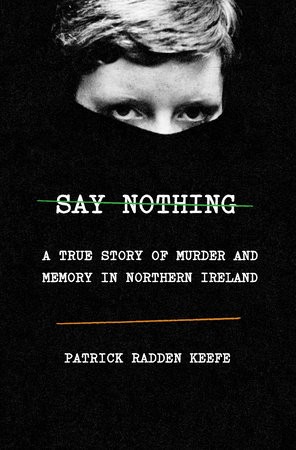
Patrick Radden Keefe’s Say Nothing: A True Story of Murder and Memory in Northern Ireland opens with that disappearance and spends the next 400-plus pages excavating the world that made it possible. Keefe is a staff writer at The New Yorker, and this is the kind of book that comes from years of deep reporting: meticulous, densely sourced, and written with the confidence of a novelist who has all the facts on his side. Published in the United States by Doubleday in February 2019, it won the National Book Critics Circle Award for Nonfiction and spent six weeks on the New York Times bestseller list.
The book covers the Troubles, the decades-long conflict in Northern Ireland between Irish republicans seeking unification with the Republic of Ireland and loyalists committed to remaining part of the United Kingdom. British soldiers, the IRA, hunger strikers, bombers, and politicians all move through the narrative. But Keefe keeps his lens tight. He centers the story on a handful of people: Jean McConville and her orphaned children; Dolours Price, the passionate Belfast girl who joined the IRA and became one of its most notorious members; Brendan Hughes, the charismatic IRA commander who spent his final years haunted by what he had ordered; and Gerry Adams, the Sinn Fein politician whose relationship to IRA violence remained fiercely disputed throughout his entire political career.
Character Arcs and Development
The most compelling figure in Say Nothing is Dolours Price, and Keefe knows it. A sharp, beautiful woman from a Belfast republican family, she grew up watching her father beaten by police and absorbed the idea that violence was a political language before she was a teenager. She and her sister Marian joined the IRA as young women and helped organize a 1973 bombing campaign in London that killed one person and injured hundreds. Arrested, they went on hunger strike and endured force-feeding for over a year. The image of the two thin, defiant young women kept alive against their will became one of the defining photographs of the conflict.
What makes Dolours Price so riveting is what happened afterward. Released from prison, she struggled with addiction and mental illness. She felt abandoned by the movement she had sacrificed everything for. She came to believe that Gerry Adams, who denied IRA membership throughout his life, had erased the contributions (and crimes) of people like her from the official republican history. In her final years, she spoke candidly to Boston College researchers conducting oral history interviews with IRA veterans. Those interviews, intended to remain sealed until after each participant’s death, became the center of a legal battle that throws Keefe’s entire narrative into sharp focus.
Brendan Hughes follows a parallel arc. Known as “The Dark” for his complexion, he was the kind of man who could command a room and lead people into terrible decisions. He directed IRA operations in Belfast for years, including, it appears, the order to kill Jean McConville. In old age, sick and broke, he felt the peace process had sold out the people who had done the movement’s bloodiest work. He gave long, detailed interviews to the Belfast Project before his death in 2008, saying things he had never admitted publicly.
Jean McConville herself is harder to know directly; the book’s structure means she can only be glimpsed through the memories of her surviving children. Her daughter Helen McKendry comes through most vividly, spending decades refusing to accept official vagueness, demanding to know where her mother was buried. The McConville children are not peripheral to the story. They are its beating heart.
Pacing
Keefe handles a complicated structure with genuine skill. The book moves between timelines, jumping decades within a single chapter, but it rarely feels disorienting because the emotional throughline stays clear throughout: we are waiting, alongside the McConville children, to learn the truth. The early sections covering the radicalization of Dolours Price and the first years of the Troubles move quickly. Keefe writes action scenes, bombings, and gunfights with journalistic precision rather than cinematic drama, which makes them land harder, not softer.
The middle section, covering the 1981 hunger strikes and the gradual transformation of Sinn Fein into a mainstream political party, is the densest part of the book and asks readers to track a large cast of players. Some readers may find this portion slower. But Keefe earns his length: every figure he introduces eventually pays off. The book’s final fifty pages deliver on everything that came before, and the revelation of what happened to Jean McConville, and when her children finally learn it, arrives with the force of something you have been dreading the whole time.
Deeper Thematic Exploration
Say Nothing works simultaneously as true crime investigation, political history, and moral inquiry. At its surface it is a search for what happened to one woman. Beneath that surface it asks what happens to a society after decades of violence, and how people live with what they have done.
One central tension is between justice and peace. The Good Friday Agreement of 1998 ended the killing, mostly, but it did so by creating space for people who had committed terrible acts to participate in government without facing legal consequences. For the McConville children, this felt like a second injustice piled on top of the first. Their mother was murdered by people who then went on to give speeches in the Northern Ireland Assembly. Keefe refuses to resolve this tension with a verdict. He understands why the peace required compromise. He also understands why victims found that compromise intolerable. Holding both truths at once, without flinching from either, is one of the book’s most impressive achievements.
A second theme is the relationship between political belief and personal violence. Dolours Price did not grow up a murderer. She grew up a true believer, someone who had absorbed the republican story of historical grievance so thoroughly that violence felt not just justified but necessary. Keefe traces how that belief system recruited and transformed ordinary people, and what happened when the belief eventually faded: the shame, the psychological fracture, the sense of having been used and then discarded by the movement you had served at enormous personal cost.
The Belfast Project, the oral history archive at Boston College, sits at the center of the book’s most interesting structural argument. Veterans recorded their testimonies under a promise of confidentiality, intending to leave a truthful historical record. When the British government subpoenaed the recordings, some interviewees ended up arrested. The project, designed to help Northern Ireland reckon honestly with its past, became instead another chapter in the conflict’s long story of silence and betrayal. Keefe’s title comes from Seamus Heaney’s poem “Whatever You Say, Say Nothing,” about the culture of enforced silence the Troubles produced. The Belfast Project was an attempt to finally break that silence. It mostly failed, and the book shows exactly why.
Style and Voice
Keefe’s prose is clear, precise, and controlled. He writes like a journalist who has read a great deal of literary nonfiction and absorbed its lessons: strong scene-setting, dialogue that reveals character without announcing it, the small physical detail that pins a person in time. His chapter openings are consistently strong; he has the instinct for the right image, the moment that illuminates without oversimplifying. He never editorializes, which makes the book’s emotional weight more powerful when it finally arrives. You trust him because he trusts you to draw your own conclusions.
The book is structured like a thriller, with secrets withheld and timelines arranged for maximum effect. This works because Keefe trusts his material. He does not manufacture suspense; the story already contains it. The voice is authoritative without being cold, and that combination produces something rare: a book about political violence that is also genuinely compassionate toward almost everyone in it, including people who did terrible things.
Verdict
Say Nothing belongs on the same shelf as the best narrative nonfiction of the past generation. Readers who come to it wanting a linear, single-perspective account may find the multiple timelines demanding. Those with a low tolerance for political complexity may lose the thread in the middle sections. But for anyone willing to do the work, the book is deeply rewarding. Keefe has written something that functions simultaneously as crime story, political history, and meditation on memory and accountability. Each of those functions works individually; together they produce a book that is more than the sum of its parts.
If you have any interest in the history of the Troubles, this is essential reading. If you have no particular connection to Ireland, it is still worth your time, because its real subject is universal: how ordinary people talk themselves into extraordinary violence, how societies arrange to live with what their members have done, and whether honesty or silence serves the future better. Keefe’s answer is not simple, and that is precisely why you should trust it.
Frequently Asked Questions about Say Nothing
What is Say Nothing by Patrick Radden Keefe about?
Say Nothing is a work of narrative nonfiction about the Troubles in Northern Ireland, centered on the 1972 abduction and murder of Jean McConville, a widowed mother of ten taken from her home by the IRA. The book follows several key figures, including IRA members Dolours and Marian Price and commander Brendan Hughes, tracing how ordinary people became capable of political violence and how Northern Ireland has struggled to reckon with that violence in the decades since the Good Friday Agreement.
Who killed Jean McConville in Say Nothing?
Keefe’s research points to the IRA, with testimony from Brendan Hughes and Dolours Price suggesting that Hughes ordered her killing and that Price was involved in transporting McConville across the border. Gerry Adams has denied any involvement or even IRA membership, a denial that figures prominently in the book. The legal proceedings triggered by the Belfast Project oral histories eventually led to arrests, though no one was ever convicted for McConville’s murder.
What are the main themes in Say Nothing?
The book explores four overlapping themes: the moral cost of political violence, as idealistic young people commit acts they will spend the rest of their lives trying to process; the tension between justice and peace, since the Good Friday Agreement required victims to accept a form of amnesty for their victimizers; the culture of silence that the Troubles produced and the difficulty of breaking it; and the long psychological aftermath of conflict, including how trauma travels through families and communities long after the shooting stops.
How long is Say Nothing and is it a difficult read?
The Doubleday hardcover edition runs 464 pages. The book is not difficult in the sense of being dense or academic, but it does move between multiple timelines and follows a fairly large cast of characters, so some familiarity with Northern Irish history is helpful though not required. Keefe explains the context as he goes. Most readers who enjoy long-form journalism and narrative nonfiction find it compelling throughout.
Is there a TV adaptation of Say Nothing?
Yes. FX produced a limited series adaptation of Say Nothing, which premiered on Hulu and Disney+ in November 2024. The series stars Lola Petticrew as young Dolours Price, Hazel Doupe as young Marian Price, and Anthony Boyle as Brendan Hughes. It received strong reviews for its performances and its handling of the political complexities in the source material.
What awards did Say Nothing win?
Say Nothing won the 2019 National Book Critics Circle Award for Nonfiction, one of the most prestigious literary awards in the United States. It was named one of the top ten books of 2019 by both The New York Times Book Review and The Washington Post. In 2024, the New York Times ranked it number 19 on its list of the 100 Best Books of the 21st Century.
How does Say Nothing compare to Patrick Radden Keefe’s other books?
Keefe’s other major books are Empire of Pain (2021), about the Sackler family and the opioid crisis, and Rogues (2022), a collection of his New Yorker profiles. Say Nothing is generally considered his most ambitious and fully realized book, partly because he spent years reporting it and partly because the subject, the Troubles and their long aftermath, offers more historical depth than a corporate dynasty. Readers who love Say Nothing often find Empire of Pain similarly gripping, while Rogues gives the best sense of Keefe at his most agile, profile-by-profile.
Should I read Say Nothing and is it worth it?
If you read one long-form nonfiction book this year, this is a strong candidate. It works as a crime story, a political history, and a moral inquiry into how violence shapes communities across generations. You do not need prior knowledge of Northern Irish history to follow it. Readers who prefer simple, resolved narratives may find the book’s refusal to deliver neat verdicts frustrating, but that refusal is precisely what makes it honest. Most people who start it finish it quickly and think about it for a long time afterward.
Book Details
- Title
- Say Nothing
- Author
- Patrick Radden Keefe
- Genre
- Biography
- Publisher
- Doubleday
- Year Published
- 2019
- Pages
- 464
- ISBN
- 9780385543378
- WritersReview Rating
- 4.6 / 5