
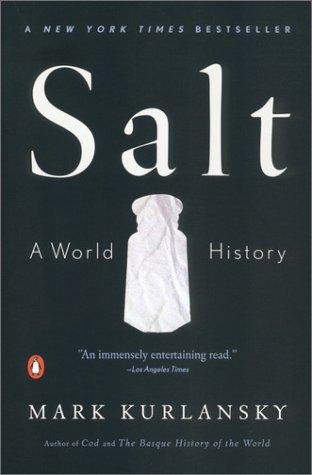
Salt: A World History
Penguin Books · 2002 · 484 pages
ISBN: 9780142001615
Review Editor
Thomas Calloway
Salt is one of those substances so ordinary we no longer see it — the white crystals on every table, the invisible ingredient in almost every food. Mark Kurlansky’s project in this book is to make it visible again: to trace the way salt shaped human history from the earliest settlements through the modern industrial age. The argument isn’t that salt caused history, but that it was present at nearly every significant moment of it — in the trade routes that built empires, the tax schemes that sparked revolutions, the preservation techniques that made long voyages possible, the military campaigns that turned on the logistics of feeding armies. Salt is a history of the world organized around an ingredient, and at its best it makes you see the familiar as genuinely strange.
Character Arcs
This is a work of popular history with no central characters in the conventional sense — it follows salt itself across millennia and continents, introducing figures only as they intersect with the substance. Kurlansky is at his most engaging when he finds people who illuminate larger patterns: the Venetian merchants who made salt a geopolitical weapon, the Chinese officials who administered salt monopolies with bureaucratic ingenuity, the leaders of the American Civil War who understood that salt routes were strategic infrastructure. The human beings in Salt function less as protagonists than as lenses. When they work, they make the historical argument vivid. When the book rushes past them, you wish it had slowed down.
Pacing
Salt is organized roughly chronologically but loops back geographically, moving from ancient China to medieval Europe to colonial America to the modern chemical industry in a sequence that illuminates connections rather than following a strict timeline. This structure has real advantages — the parallels between different cultures’ salt-tax rebellions, for instance, are more visible when placed near each other — but it can also make the book feel episodic. Some chapters feel like the most interesting parts of a longer, more specialized book, while others feel padded with recipe history or etymological digressions that delay rather than enrich the argument. The book is 450 pages; the tightest version might have been 300.
Thematic Depth
The most compelling thesis running through Salt is about taxation and power. Salt’s ubiquity and necessity made it the perfect object of government extraction — everyone needed it, it couldn’t be substituted, and controlling production and distribution meant controlling an entire population’s most basic food security. The salt tax in France was a direct cause of the Revolution. Gandhi’s Salt March was strategically chosen to dramatize colonial extraction. The Chinese salt monopoly funded imperial governments for centuries. Kurlansky traces these connections with genuine insight, and the book becomes most interesting when it reads as a history of how governments exploit necessity. The food history and chemistry are interesting sidebars; the political economy is the real argument.
Style and Voice
Kurlansky writes in the tradition of popular history — accessible, anecdote-rich, designed to make readers feel they’re learning something remarkable about the world they inhabit. He has a gift for the telling detail: the specific price of salt at a specific moment, the exact route of a salt caravan, the way a particular tax was enforced. He is less reliable when making larger causal claims — some of the “salt caused X” arguments are suggestive rather than demonstrated. The recipes scattered throughout the book (authentic period recipes involving salt) are a distinctive touch that some readers love and others find distracting. They’re part of Kurlansky’s signature style, for better and worse.
Verdict
Salt works best as an invitation to see the world differently — to notice the infrastructure beneath everyday substances, to trace the long chain of labor and politics and logistics that puts anything on a table. As history, it is more panoramic than rigorous, and some of its causal claims outrun the evidence. But Kurlansky’s core insight — that the most ordinary substances carry the most extraordinary histories — is sound and well-illustrated. It’s a book best read in the spirit of a knowledgeable tour guide who knows a great deal and occasionally editorializes, rather than as a definitive scholarly account of anything in particular.
Rating: 3.8 out of 5
Book Details
- Title
- Salt: A World History
- Author
- Mark Kurlansky
- Genre
- History
- Publisher
- Penguin Books
- Year Published
- 2002
- Pages
- 484
- ISBN
- 9780142001615
- WritersReview Rating
- 3.8 / 5