
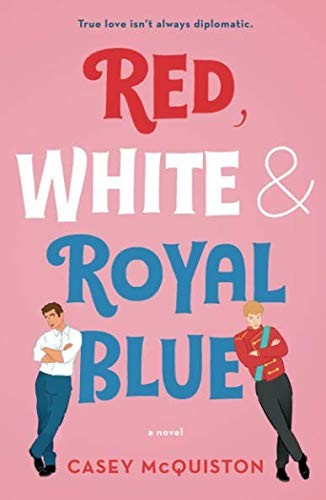
Some books arrive at exactly the right moment. Casey McQuiston’s debut novel Red, White and Royal Blue landed in 2019 and immediately became one of those rare reads that people pressed into the hands of friends with the words “you have to read this.” It is a romantic comedy about Alex Claremont-Diaz, the half-Mexican, politically ambitious First Son of the United States, and Prince Henry of Wales, the golden, reserved heir who becomes his unlikely love interest. The setup sounds like a tabloid fantasy, and in many ways it is, but McQuiston uses that sparkly premise to deliver something with genuine emotional heft: a story about figuring out who you are when the whole world has already decided who you should be.
The novel opens with Alex and Henry locked in a mutual dislike so intense it has become a diplomatic incident. When they accidentally destroy a royal wedding cake at a public event, their respective handlers force them into a fake friendship to smooth over the PR disaster. What follows is a slow-burn correspondence that deepens into something neither of them planned for. McQuiston builds the romance with care, letting the emails and texts between Alex and Henry do the heavy lifting of emotional development. By the time the feelings become undeniable, you have watched two people genuinely learn each other, not just fall for a pretty face. The result is a love story that earns its grand gestures.
There is a reason this book became a cultural phenomenon, spawned a dedicated fandom, and landed an Amazon Prime film adaptation. It delivers the full romantic comedy experience: wit, longing, misunderstandings, a devastating midpoint separation, and a finale that makes you want to stand up and cheer. But it also takes its characters seriously enough to let them be complicated, scared, and real. That combination is rarer than it sounds, and McQuiston pulls it off with the confidence of a writer who knows exactly what kind of book she is writing and loves every page of it.
Character Arcs and Development
Alex Claremont-Diaz is one of the more satisfying protagonists in recent romantic fiction because McQuiston gives him actual flaws rather than decorative ones. He is impulsive, competitive, and so driven by ambition that he has never stopped moving long enough to examine what he actually wants. His journey through the novel is not just about falling in love; it is about learning to sit with uncertainty, to accept that some things cannot be argued or charmed into submission. Watching him work through his bisexuality is handled with particular grace. McQuiston avoids the tired coming-out story beats and instead shows Alex approaching his identity the way he approaches everything: by researching, overthinking, and ultimately barreling forward with more confidence than he actually feels. It rings true.
Henry is the more quietly heartbreaking of the two. He has spent his entire life performing a version of himself that his family, his country, and his sense of duty require, and the cost of that performance is visible in every early interaction. He is not cold; he is careful. The distinction matters enormously, and McQuiston makes sure readers understand it before Alex does. Henry’s arc involves learning to believe he deserves the life he wants, not just the life he has been assigned. It is a slower, more internal journey than Alex’s, and the novel gives it the room it needs.
The supporting cast earns its place. Nora, Pez, June, and the impossibly competent Zahra all feel like people with their own lives running offscreen. President Ellen Claremont, Alex’s mother, is particularly well-drawn: a woman who is both a loving parent and a calculating politician, and whose storyline gives the book a layer of political stakes that keep the romance from existing in a frictionless bubble. McQuiston understands that a great love story needs a world worth fighting for, not just a relationship.
Pacing
At just over four hundred pages, Red, White and Royal Blue moves fast. McQuiston has a sharp sense of scene economy: she knows when to linger and when to cut, and the result is a novel that rarely sags. The early sections, establishing the fake-friendship arrangement, have a screwball energy that keeps pages turning. The middle section, built largely around Alex and Henry’s email correspondence, is where the book finds its emotional depth, and McQuiston wisely slows down here to let readers settle into the intimacy of those exchanges.
The political subplot, centered on the upcoming US presidential election, integrates cleanly with the romantic storyline rather than competing with it. Some readers may find the political idealism a touch optimistic, but within the world of the novel it functions as a coherent backdrop that raises the stakes without overwhelming the central love story. The final act moves quickly, perhaps too quickly for readers who want to savor every beat, but the momentum serves the genre’s demands. Romantic comedies need to stick their landings, and this one does.
One minor quibble: the novel’s first quarter requires some patience as McQuiston establishes the elaborate premise. There are a lot of characters to track and a considerable amount of worldbuilding around the alternate-history US political landscape. Readers who commit to that setup are richly rewarded, but those looking for immediate romantic tension may need to trust the process for the first fifty pages or so.
Deeper Thematic Exploration
Beneath the sparkling rom-com surface, Red, White and Royal Blue is a book about the gap between the self we present and the self we actually are. Both Alex and Henry are performers in different registers: Alex performs confidence and competence, Henry performs duty and contentment. The novel’s central argument is that love requires the courage to stop performing, and McQuiston makes that argument through action and dialogue rather than exposition. The characters never explicitly say any of this; they just gradually, painfully, joyfully start being honest.
The book also engages seriously with questions of representation and visibility. When Henry uncovers letters from a historical figure who was forced to conceal a same-sex relationship, the scene is both emotionally moving and thematically pointed: history is full of people who had to hide, and the novel insists on the importance of not having to hide anymore. It is not heavy-handed about this. McQuiston trusts readers to feel the weight of the moment without underlining it repeatedly.
The political dimension adds another thematic layer. The novel imagines an America that elected its first woman president and now faces a tight re-election campaign, and McQuiston uses this backdrop to explore what public figures owe the public versus what they owe themselves. Alex’s dilemma about whether going public with his relationship could harm his mother’s campaign is handled with genuine moral seriousness. There are no easy answers offered, which is one of the reasons the book’s resolution feels earned rather than convenient.
Style and Voice
McQuiston writes with a voice that is sharp, funny, and deeply warm. Her dialogue crackles. The banter between Alex and Henry has genuine wit without tipping into the kind of unrealistic verbal performance that plagues lesser romantic comedies. Their emails to each other are a particular highlight: McQuiston captures two distinct voices in that correspondence, and the way those voices gradually soften and open up over the course of the exchange is one of the novel’s quiet technical achievements.
The prose is confident and purposeful. McQuiston is not interested in ornate sentences; she is interested in getting you to feel something, and she is very good at it. She has a talent for the detail that unlocks a character in a single line, and for the scene that does five things at once without straining. Her comic timing is excellent, which matters enormously in a book that relies so heavily on humor to earn its more serious emotional moments.
If there is a stylistic weakness, it is occasional over-reliance on cultural references that may date the novel more quickly than its emotional core deserves. But this is a minor concern. The voice is consistently engaging throughout, and the book’s particular brand of warmth and wit feels genuinely McQuiston’s own rather than a performance of the genre.
Verdict
Red, White and Royal Blue is exactly the kind of book romantic comedy readers dream about: smart, funny, genuinely moving, and populated by characters you want to spend time with long after the last page. Casey McQuiston delivers a debut that feels assured and joyful in equal measure. The political backdrop gives the romance real stakes, the slow-burn structure earns every emotional payoff, and the central relationship between Alex and Henry is drawn with enough complexity to make their happiness feel genuinely consequential. This is a book about the cost of hiding and the freedom of being seen, wrapped in the most entertaining package imaginable. Whether you come for the royal romance, the political intrigue, or the witty banter, you will stay for the heart of it. Highly recommended, and not only for fans of the genre.
Frequently Asked Questions about Red, White and Royal Blue
Is Red, White and Royal Blue suitable for younger teenagers?
The novel is published as adult fiction, though it has a large young adult crossover readership. It contains explicit sexual content and some strong language. Most readers and libraries classify it as appropriate for ages 17 and up, though parental discretion is reasonable for younger teens. The emotional themes are entirely accessible to mature teenage readers.
Does the book require knowledge of British royal family history?
Not at all. The British royal family in the novel is entirely fictional, sharing only structural similarities with the real institution. McQuiston builds her version from scratch, so no prior knowledge of actual royal history or protocols is needed or expected.
Is there a film adaptation?
Yes. Amazon Prime Video released a film adaptation in 2023, starring Taylor Zakhar Perez as Alex and Nicholas Galitzine as Henry. The film is generally faithful to the novel’s central romance, though it streamlines the political subplot considerably. Most readers find the book richer and more satisfying than the adaptation.
Does the novel have a happy ending?
Yes. Red, White and Royal Blue is a romantic comedy, and McQuiston delivers a fully satisfying resolution. Without spoiling specifics, the ending is warm, hopeful, and earned by everything that precedes it.
Is this Casey McQuiston’s only novel?
No. McQuiston has published two subsequent novels: One Last Stop (2021), a queer romantic comedy with a time-travel element set on a New York City subway line, and I Kissed Shara Wheeler (2022), a young adult novel about a girl navigating a mystery left by her missing classmate. Both books showcase the same warm, witty voice as her debut.
How does the fake-enemies-to-lovers dynamic develop?
Alex and Henry begin with genuine mutual irritation rather than manufactured conflict, which makes their eventual closeness more believable. The transition from grudging tolerance to friendship to love is gradual and well-paced, driven primarily by their private correspondence. McQuiston resists rushing the emotional beats, so the shift feels organic rather than convenient.
What makes the political backdrop distinctive?
The novel is set in a lightly alternate-history United States where the first female president, Ellen Claremont, is seeking re-election. McQuiston uses this setting to ground the romance in real stakes: the relationship between Alex and Henry has potential implications for both the US election and US-UK diplomatic relations. The political detail is specific enough to feel credible without overwhelming the love story.
Is the novel part of a series?
No, Red, White and Royal Blue is a standalone novel. The story is complete and self-contained, with no cliffhangers or unresolved threads requiring a sequel. McQuiston has not announced any continuation of Alex and Henry’s story.
Book Details
- Title
- Red, White and Royal Blue
- Genre
- Young Adult
- WritersReview Rating
- 5.0 / 5