
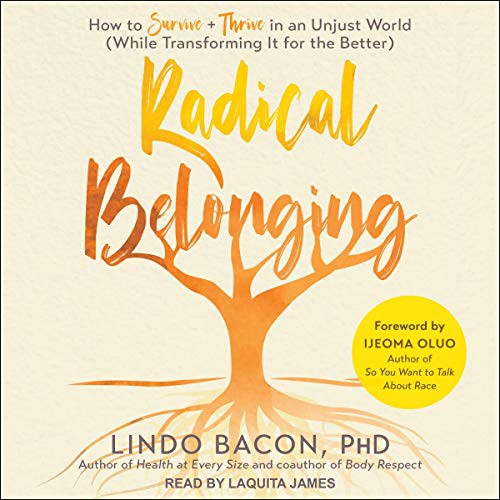
Radical Belonging
BenBella Books · 2020 · 305 pages
ISBN: 9781950665341
Review Editor
Sofia Reyes
Radical Belonging: How to Survive and Thrive in an Unjust World (While Transforming it for the Better) arrived in November 2020 from BenBella Books, and its timing was not incidental. The world was deep in a pandemic. Racial justice protests had reshaped national conversation about who gets to live safely and freely. The question of which bodies deserve comfort and care had moved from the margins to the center. Into this moment came Lindo Bacon, a researcher with graduate degrees in physiology, psychology, and exercise science, who had spent the previous two decades building the intellectual foundation for the body liberation movement through their earlier books, Health at Every Size and Body Respect. Radical Belonging synthesizes everything that came before it: part memoir, part scientific argument, part political manifesto. It asks a question that turns out to have a surprisingly precise answer: why do so many people feel like they don’t belong, and what would it actually take to fix that?
The answer Bacon offers is not the one the wellness industry usually provides. This is not a book about learning to love yourself. The distinction matters, and Bacon makes it early and returns to it often. Self-love places the burden of healing on the individual. Belonging is structural, relational, and collective. It requires not just that you feel differently about yourself, but that the people and institutions around you accept and include you as you are. For readers who have spent years trying to think their way into feeling better about their bodies, their identities, or their place in the world, this shift in framing is not a small thing.
Bacon weaves their own story through the book from the opening pages. They grew up feeling displaced in multiple directions: in their religious community, in their family, and in a body that didn’t map onto the cultural story of what a body should look like. The argument begins here, in the specific texture of that experience, and builds outward from personal history through science toward social analysis. The foreword is by Ijeoma Oluo, author of So You Want to Talk About Race, whose presence signals the kind of company this book intends to keep.
Character Arcs and Development
Radical Belonging is nonfiction, but Bacon’s personal narrative functions like the best character work in fiction: it gives the abstract argument a face and a history, and it tracks genuine development. The person who begins the book is someone who has spent their life navigating various forms of exile from the “mythical norm,” Bacon’s term for the white, male, cisgender, able-bodied, slender, Christian ideal that structures so much of American culture. By the book’s end, Bacon has not escaped that world (no one does), but they have built a framework for understanding it and, more practically, for surviving it with purpose and some grace.
Bacon handles the memoir material with discipline. They don’t use personal disclosure as performance or as a bid for sympathy. The revelations serve the argument. When Bacon writes about their experience of gender transition, about childhood religious alienation, or about the ongoing work of accepting a body the culture has consistently devalued, those passages carry weight. You learn things about Bacon’s life that genuinely sharpen the ideas that follow. The book doesn’t trade in sentimentality, which makes the moments of real vulnerability land harder.
Secondary figures appear mostly as case studies and composites: clients, research subjects, illustrative examples drawn from Bacon’s clinical experience. Bacon handles these carefully, but they are thinner than the author’s own account. Readers expecting the kind of fully drawn portraits found in the best narrative nonfiction will need to adjust those expectations. The book’s deepest characterization is Bacon themselves, and it turns out to be enough to carry the argument.
Pacing
The book divides into four sections: You, Your Body, Your People, and Your World. This structure reflects the core argument that belonging is not just a personal achievement but a political one, and it works as an organizing principle. The first two sections, covering Bacon’s personal history and the science of trauma and nervous system regulation, move with clarity and purpose. Bacon has a real gift for making physiological concepts accessible without reducing them to slogans. The passages on polyvagal theory, on how chronic social stress reshapes the nervous system, on co-regulation between individuals, connect the science directly to the personal stories Bacon has already put on the page.
The later sections, which turn toward community and institutional change, stretch the book’s scope in ways that occasionally strain its focus. The arguments are not wrong, but the writing becomes more associative and essay-like. A chapter might begin with an intimate discussion of how belonging registers in the body and arrive, several pages later, at a broad analysis of systemic racism. Both subjects deserve the space they receive. The transitions between them sometimes move too quickly. Readers who prefer a tightly constructed through-line will find the final third looser than the first two. Those comfortable with wide-ranging, idea-driven nonfiction will find it a natural progression.
Deeper Thematic Exploration
The self-love-versus-belonging distinction is the book’s most original and lasting contribution. The wellness industry has made self-love its central product. Bacon’s critique is precise: focusing on self-love within a system that targets certain bodies for devaluation treats a structural problem as a personal one. It can become, as Bacon writes, “a spoonful of sugar that makes the oppression go down” for marginalized people who are encouraged to feel better about a situation that has not changed.
Belonging, as Bacon defines it, is something you can only receive from other people. It requires being known, accepted, and wanted as you are. This definition opens the book’s deeper argument: that the suffering many people experience in their bodies and their social lives is not the product of their own inadequacies but of a culture that has systematically devalued certain kinds of people. The harm is measurable. Bacon draws on research in social psychology, neuroscience, and public health to show that marginalization and exclusion produce physiological consequences: dysregulation of the nervous system, elevated stress hormones, higher rates of chronic illness, reduced life expectancy. This is not a metaphor. It is a chain of biological cause and effect.
What gives this argument more than rhetorical force is the care Bacon takes in connecting the personal, the biological, and the political. When they argue that raising the minimum wage improves health outcomes, they follow an evidence chain from economic insecurity to chronic stress to disease. When they argue that the wellness industry’s focus on individual behavior ignores how privilege shapes health outcomes, they support it with research rather than assertion. The book earns its conclusions rather than simply asserting them.
The argument extends, importantly, to people who more closely resemble the mythical norm. Bacon makes the case that everyone suffers in a culture built on hierarchy, though not equally. The invitation is to build something different together: not through individual transformation alone, but through structural change, community investment, and the daily practice of genuine acceptance. This is where Radical Belonging becomes more ambitious than most wellness books, and also where it asks more of its readers than most wellness books do. Bacon is not satisfied with a book that helps individuals feel better. They want to change the conditions that made people feel bad in the first place.
Style and Voice
Bacon writes with the directness of someone who has spent years in both clinical practice and academic research and learned how to talk to people without condescending to them. The prose is clear and spare in the memoir sections, where restraint gives the writing its weight. Bacon handles the personal material carefully: frank without being self-indulgent, specific without oversharing. There is real skill in the voice, particularly in passages where science and personal narrative sit side by side, each making the other more legible. When Bacon explains polyvagal theory through the lens of their own nervous system’s response to social exclusion, you understand both the science and the experience more clearly than you would if they had appeared separately.
The register shifts noticeably in the more theory-heavy chapters, which can read more like a graduate seminar than a conversation. This is a minor issue for most readers, and Bacon generally returns to the personal before the abstraction grows too thick. At its best, the book’s voice sounds like someone who has both the research and the scars to back up what they’re saying, and who has no interest in making you comfortable if comfortable means avoiding the point.
Verdict
Radical Belonging is for readers who have found themselves unmoved, or even frustrated, by the mainstream self-help prescription to love yourself more. Bacon provides what that prescription lacks: an account of why individual approaches to structural problems fall short, backed by science and grounded in personal experience. If you have ever felt that your sense of not-belonging was your own failing rather than a rational response to a culture designed around a narrow norm, this book will reframe that feeling in a way that stays with you.
This is not a quick or tidy read. At 305 pages, it covers significant ground and sometimes follows its own threads further than strictly necessary. The later sections can feel looser than the tight, layered opening. But the core argument is solid, the personal narrative is honest, and the book offers something most titles in its category don’t: a clear-eyed account of why belonging is political, not just personal. If you are new to body liberation or Health at Every Size ideas, this is an excellent entry point. If you already know Bacon’s earlier work, what you will find here is more personal history and a broader framework that connects the body-focused work to a wider vision of social change. Either way, it is worth your time.
Frequently Asked Questions about Radical Belonging
What is Radical Belonging by Lindo Bacon about?
Radical Belonging is a combination of memoir, scientific research, and social critique published in November 2020 by BenBella Books. The book argues that the feelings of alienation and physical suffering many people experience are not personal failings but the direct result of a culture that has devalued certain bodies and identities. Bacon draws on their own life story as a genderqueer nutritionist and researcher alongside findings from physiology, psychology, and social science to make the case that belonging, rather than self-love, is the key to genuine healing.
What does Lindo Bacon mean by “radical belonging”?
Bacon defines radical belonging as the experience of being fully known and accepted by other people as you are, without needing to change to earn approval. The word “radical” refers both to the depth of that acceptance and to the political commitment required to create it. Bacon argues that belonging cannot be achieved individually; it requires dismantling the systems of oppression that exclude people in the first place.
What are the main themes in Radical Belonging by Lindo Bacon?
The book covers four central themes. First, it draws a sharp distinction between belonging and self-love, arguing that individual self-acceptance is insufficient when the problem is structural. Second, it traces the physiological consequences of marginalization, including how chronic social stress reshapes the nervous system and affects long-term health. Third, it examines how the “mythical norm” (the white, cisgender, slender, able-bodied ideal) defines who gets to belong and who doesn’t. Fourth, it argues for community care and structural change as the real antidote to the harms of exclusion.
How long is Radical Belonging and is it a difficult read?
The book is 305 pages. It covers complex territory in social psychology, physiology, and personal memoir, but Bacon writes for a general audience rather than an academic one. Most readers with an interest in social justice, wellness, or personal development will find the prose accessible. The first two-thirds of the book, which focus on personal narrative and neuroscience, read more smoothly than the later sections, which are more essay-like and wide-ranging.
What awards has Radical Belonging won?
Radical Belonging won the 2020 Foreword Indies Award Gold in the LGBTQ+ Category and the 2020 Foreword Indies Award Silver in the Self-Help Category. The Foreword Indies recognize independently published books, and the dual recognition reflects the book’s reach across audiences interested in queer identity and personal development.
Is Radical Belonging only for people with marginalized identities?
Bacon writes explicitly for all readers, including those who more closely resemble the “mythical norm.” The book argues that a culture built on exclusion harms everyone, not equally but pervasively, and that building genuine belonging requires people with privilege to examine the systems that grant it. Readers from dominant groups may find certain chapters more challenging, but Bacon’s argument is designed to include rather than exclude them from the project.
How does Radical Belonging compare to Health at Every Size by Lindo Bacon?
Health at Every Size focuses specifically on the science of weight and the harms of diet culture. Radical Belonging uses that body of work as one thread in a much broader argument about belonging, identity, and social justice. Readers who found Health at Every Size valuable will find Radical Belonging covers some familiar ground on weight and body image while expanding significantly into memoir, neuroscience, and political analysis. Of the two, Radical Belonging is the more personal and more ambitious book.
Should I read Radical Belonging and is it worth the time?
If you have ever felt that conventional self-help advice missed something important, or if you are interested in the connections between personal wellbeing and broader social structures, yes. The book is thoughtful, honest, and substantive in a genre that often isn’t any of those things. It is not a quick read and it does not promise easy answers. But for anyone who wants a book that takes both the science and the politics of belonging seriously, Radical Belonging is worth your attention.
Book Details
- Title
- Radical Belonging
- Author
- Lindo Bacon
- Genre
- Self-Help
- Publisher
- BenBella Books
- Year Published
- 2020
- Pages
- 305
- ISBN
- 9781950665341
- WritersReview Rating
- 4.1 / 5