
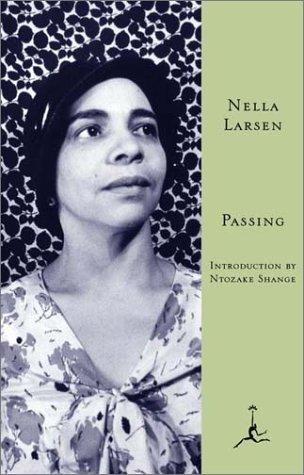
Passing
Penguin Classics · 1929 · 112 pages
ISBN: 9780140187250
Review Editor
admin
Nella Larsen’s Passing is one of the most compressed and psychologically dense novels of the Harlem Renaissance. At 96 pages, it is barely a novella, yet it contains more sustained ambiguity than most novels five times its length. Published in 1929 and largely forgotten until the 1970s, when Black feminist scholars began the work of recovering it, the novel has since been recognized as a masterpiece of American modernism – a book about race, desire, identity, and the terror of what is never quite said.
What Happens in Passing
Irene Redfield is a middle-class Black woman living in Harlem with her physician husband Brian and their two sons. One afternoon in Chicago, while passing as white herself to access a segregated tearoom, she encounters a childhood friend: Clare Kendry, who is also passing as white – but Clare has gone further. She has married a white man named John Bellew who does not know his wife is Black, and who, as Clare demonstrates in a chilling scene, is a virulent racist.
Clare wants back into the Black community. She is charming and reckless and beautiful, and she begins appearing in Harlem, attending parties, spending time with Irene’s husband Brian. Irene becomes increasingly disturbed by Clare’s presence – a disturbance she narrates as concern for safety, for propriety, for the danger that Clare represents to the community that has taken her in.
The novel ends with Clare’s death, which happens so suddenly and with such interpretive ambiguity that readers have argued for decades about what it means and who, if anyone, is responsible.
The Question of Desire
The novel’s surface subject is racial passing. Its deeper subject – and the source of its lasting fascination – is desire and what people do when they cannot acknowledge what they want. Irene’s narration is one of the most unreliable in American fiction. She describes her feelings for Clare in terms of anxiety and disapproval, but the prose is charged with something else: an intensity of attention, a physical awareness, a jealousy that her stated explanations do not fully account for.
Larsen does not explain this. She does not resolve it. She allows the reader to see what the narrator cannot or will not see, and she allows the narrator’s blindness to produce the novel’s catastrophe. Whether Irene desires Clare, fears her, envies her freedom, or some combination of all three is a question the novel holds open – and it is precisely this openness that has kept scholars and readers returning to it for a century.
Race and Performance
Both Irene and Clare pass in the novel’s opening scene, but their relationship to passing is different. Irene passes occasionally and instrumentally, to access spaces denied to her. Clare has made passing her entire life, surrendering her Black identity for the security and privilege that whiteness grants her husband and by extension her. The cost of this is her exclusion from the community she was born into and continues to desire.
Larsen is interested in what race requires people to perform – in the way that both Black and white identities in 1920s America are performances demanded by social structure – and in what happens to the people who can perform either and choose to perform only one.
Larsen’s Style
The prose is modernist in its indirection and its refusal of easy explanation. Larsen writes Irene’s consciousness with great precision, registering sensory details and emotional responses that her narrator cannot quite interpret. The novel is saturated with heat, color, and physical sensation in ways that suggest what Irene’s rational narration is suppressing. Reading it slowly and against the grain of Irene’s stated interpretations is the experience the novel is designed to produce.
Who This Book Is For
Readers interested in American modernism, in the Harlem Renaissance, in the literature of racial identity, or in novels that keep their secrets will find Passing essential. At 96 pages it is also an argument against length: this is everything it needs to be and nothing it doesn’t.
- What does “passing” mean in the novel’s context?
- Racial passing refers to the practice of a person with Black ancestry presenting as white in a society where whiteness granted legal rights, economic opportunity, and social access that Blackness did not. The term implies deception, but also the tragedy of a system that made the deception necessary.
- Is Irene in love with Clare?
- Larsen does not answer this question, and the novel’s power depends on the ambiguity. Many scholars and readers believe that Irene’s jealousy and fixation are consistent with desire. Others read Irene’s disturbance as class anxiety or fear for her domestic stability. The text supports both readings simultaneously.
- Did Irene kill Clare?
- The novel does not say. Clare falls or is pushed or jumps from a window at the novel’s climax. Irene is present. Whether her hand touched Clare is one of the most debated questions in American literary scholarship.
- Is there a film adaptation?
- Rebecca Hall directed a black-and-white film adaptation in 2021, starring Tessa Thompson and Ruth Negga, that received wide critical praise. Hall wrote about her own research into her family’s history of racial passing in the project’s promotional material.
- Why was the novel forgotten after 1929?
- Larsen published two novels (Quicksand and Passing) and then, following a plagiarism accusation from which she was cleared, largely stopped writing. The historical marginalization of Black women writers by the literary establishment ensured that her work was not widely taught or anthologized until the feminist recovery movements of the 1970s.
- How long does it take to read Passing?
- Most readers finish it in two to three hours. It rewards slow, careful reading; the prose is dense with implication that fast reading misses.
- What is the significance of the title?
- Passing refers to racial passing, but the word also suggests passing away (death), passing through (transience), and the passing of time. The novel’s ending activates all these meanings simultaneously.
- How does Passing relate to the Harlem Renaissance?
- Larsen is one of the central figures of the Harlem Renaissance, a period of extraordinary Black cultural production in 1920s New York. Passing engages the specific anxieties of the Black middle class of that period: the question of how to navigate a racist society, the temptation and cost of assimilation, the relationship between race and class.
Book Details
- Title
- Passing
- Author
- Nella Larsen
- Genre
- Literary Fiction
- Publisher
- Penguin Classics
- Year Published
- 1929
- Pages
- 112
- ISBN
- 9780140187250
- WritersReview Rating
- 4.0 / 5