
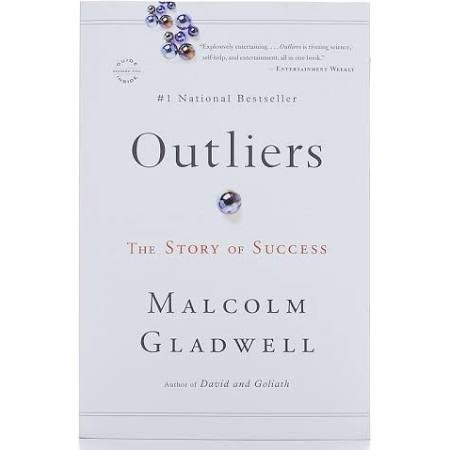
Outliers
Little, Brown and Company · 2008 · 336 pages
ISBN: 9780316017930
Review Editor
Daniel Okafor
Outliers: The Story of Success arrived in bookstores in November 2008 and went straight to the top of the New York Times bestseller list, where it stayed for eleven consecutive weeks. Malcolm Gladwell, already known for The Tipping Point and Blink, had trained his lens on a question that sounds straightforward: why do some people succeed so much more than others? Not a little more, but so far beyond their peers that the gap seems to imply a different kind of human being altogether. His answer is what makes the book worth arguing with: that we have built a mythology of the self-made individual that ignores almost everything that actually matters.
Gladwell’s argument is that the standard account of success (talent plus hard work equals achievement) leaves out timing, circumstance, cultural inheritance, and the specific opportunities a person encounters before anyone is watching. The hockey player born in January has the edge over the one born in December because youth leagues use calendar cutoffs, so older kids are mistaken for more talented ones and given better coaching. Bill Gates happened to be thirteen years old in 1968 in one of the few American schools with a time-sharing computer terminal. The Beatles happened to land a residency in Hamburg that required them to play eight hours a night, seven nights a week. Gladwell is not arguing that talent doesn’t exist. He is arguing that talent without opportunity stays invisible, and we consistently pretend otherwise.
The book divides into two parts. “Opportunity” opens with Canadian hockey and moves through Gates, the Beatles, and New York Jewish law firms. “Legacy” turns to cultural inheritance, tracing how Appalachian traditions, Chinese rice farming, and the communication norms of Korean cockpit crews all carry the marks of their origins into contexts that were never designed for them. The range is deliberately dizzying. The argument, once you see it, is coherent.
The Profiles at the Heart of the Argument
Gladwell builds Outliers around portraits of real people, and the best of them are genuinely arresting. Bill Gates is presented not as a lone visionary but as someone whose biography contains an almost implausible series of preparation-meets-opportunity moments: the Lakeside terminal, a job at a company in downtown Seattle that happened to need a programmer, a relationship with the University of Washington computer center that gave him free late-night machine time. Gladwell is careful to say he is not taking anything away from Gates. The point is that Gates saw each opportunity and had the preparation to use it. Most people with his intelligence never got the first door to open.
The most affecting figure in the book is Christopher Langan, a man with a measured IQ of 195 who spent most of his adult life working on a horse farm in Missouri. Gladwell uses Langan to show that practical intelligence, knowing how to read a room, how to negotiate with institutions, how to make authority figures take you seriously, matters as much as raw cognitive ability and is not distributed along the same lines. Langan grew up in brutal poverty with no one to show him how to advocate for himself. He was brilliant and he was stuck. His story sits next to Gates’s with uncomfortable deliberateness, and Gladwell means it to.
The epilogue is where the book becomes something more than an argument. Gladwell traces his own family history through his Jamaican great-great-great-grandmother and the chain of improbable circumstances, including the fact that a white plantation owner chose her as his mistress and so spared her from field labor, that led eventually to his own career as a writer. It is the moment in Outliers where Gladwell stops observing from the outside and puts himself in the frame. It changes what the book is.
Pacing
Outliers moves quickly. Gladwell’s chapters are short, his anecdotes well-chosen, and his prose strips out friction at every turn. The book works best read in long sittings rather than a chapter here and there, because the argument accumulates; the chapters talk to each other in ways that only pay off when you can hold multiple examples in mind simultaneously. Reading it across three evenings, the connections between the hockey chapter and the KIPP Academy chapter become visible in a way they wouldn’t across three weeks.
The book’s pacing problem is structural rather than stylistic. The 10,000-Hour Rule is introduced early as something close to a universal law of expertise, but by the time Gladwell reaches the Korean Air chapter, the rule is quietly doing less work, and he never fully revisits it. The Korean Air analysis, which interprets cockpit recordings from a 1997 crash as evidence of a cultural communication style that made pilots reluctant to correct a superior, drew the most sustained criticism from aviation experts and cultural critics, who argued that Gladwell oversimplified a complex safety failure into a story about Korean deference. Reading it now, the argument strains. The chapter on summer learning loss and the KIPP school program, where the claims are more modest, is also where Gladwell is most persuasive.
Deeper Thematic Exploration
The central idea of Outliers is that opportunity is not distributed randomly, and that success built on unacknowledged advantage is structurally different from success attributed entirely to individual merit. Gladwell keeps this argument empirical rather than prescriptive. He does not tell you what to do about it. He asks you to notice it, and notice it again, and consider what it means that we have organized entire societies around the assumption that achievement is a direct readout of ability.
Underneath the 10,000-hour framework is something more interesting: a theory of preparation and opportunity as a handshake. You need both, and they need to arrive in the right order. The Beatles were talented before Hamburg; Hamburg made them exceptional by forcing them to build their catalogue and their stamina in real time, night after night, for paying audiences in a city that did not know or care who they were. Gates was smart before the Lakeside terminal; the terminal gave him the hours he needed to become the person who could recognize what a personal computer could be when almost no one else could see it. The book is not saying these people were lucky and nothing more. It is saying they were prepared when the luck arrived, and that we rarely ask how many equally prepared people never got the knock at the door.
The “Legacy” section is more ambitious and less airtight. The argument that Chinese mathematical aptitude traces to rice agriculture, via the demanding work ethic that wet-rice farming required over centuries, is suggestive rather than proven. But the larger claim, that behaviors and attitudes embedded across generations shape outcomes in ways that individuals cannot easily override by effort alone, connects Outliers to a broader body of work in sociology and behavioral economics that has only grown since 2008. You do not have to accept every specific causal claim to take the underlying pattern seriously.
At its core, Outliers is about a particular kind of blindness: the tendency to look at the winners of any competitive system and conclude the system is working, when the right question is who the system never gave a chance. Gladwell does not answer that question. But he is patient and skillful at keeping you from looking away from it long enough to make the discomfort productive.
Style and Voice
Gladwell writes like a magazine journalist who knows his readers have a low tolerance for preamble. Every chapter opens with a specific scene or person, pulls back to reveal the larger argument, and drives to a conclusion that feels earned even when it is partly oversimplified. He knows exactly when to add detail and when to move on. The prose does not call attention to itself; what it does is make you feel, repeatedly, as though you have just been told something important that you almost already knew. That feeling is Gladwell’s signature, and it is a more sophisticated effect than it looks.
The epilogue is written in a different register from the chapters before it: quieter, more uncertain, less in command of its conclusions. Gladwell at his most reflective, writing about his Jamaican grandmother and the plantation-owner great-great-great-grandfather whose specific act of exploitation inadvertently created a chain of slightly better circumstances for his descendants across six generations, is doing something that popular nonfiction rarely attempts. He is turning the analytical lens on himself, and the result is the best writing in the book.
Verdict
Outliers works best when you read it as a provocation rather than a settled theory. Some of the specific causal claims have been substantially challenged since 2008: the 10,000-Hour Rule was qualified by the psychologists whose work Gladwell drew on, and the Korean Air chapter has faced serious criticism for the way it handled the evidence. These are real objections, and if you come to Outliers expecting a seamless argument with all the holes filled, you will find the holes. Gladwell is a journalist making a case, not a scientist reporting findings, and the book is more powerful when you read it that way.
But the question Outliers asks has not gone away. Not “how do I get there?” but “what does it mean to be there if luck and timing paved as much of the road as talent did?” If you work in education, talent development, organizational design, or anywhere that people make consequential decisions about who gets opportunities and why, this book is worth your time even now, seventeen years on. Read it alongside Carol Dweck’s Mindset for a more optimistic counterpoint on what deliberate effort can do, and see where the two arguments settle.
Frequently Asked Questions about Outliers by Malcolm Gladwell
What is Outliers: The Story of Success by Malcolm Gladwell about?
Outliers is a study of why some people achieve extraordinary success while others with similar ability do not. Gladwell argues that the standard story, which credits success to talent and hard work, ignores the critical role of timing, circumstances of birth, cultural inheritance, and specific opportunities. The book profiles Bill Gates, the Beatles, Christopher Langan, and others to build the case that the conditions surrounding a person’s development matter as much as the person’s individual qualities.
Is the 10,000-hour rule from Outliers still considered accurate?
Not in its original, universal form. A 2014 meta-analysis covering nine thousand research papers found that deliberate practice explained only a fraction of performance differences across music, sports, and other domains. Anders Ericsson, the psychologist whose research Gladwell cited, also noted that Gladwell had simplified his findings. The underlying insight, that sustained, deliberate practice matters enormously, still holds. The specific threshold of ten thousand hours as a universal rule does not.
What are the main themes in Outliers by Malcolm Gladwell?
The book explores four connected ideas: the way accumulated advantage (what Gladwell calls the Matthew Effect) compounds over time so that early, small advantages produce large later ones; the relationship between hours of deliberate practice and expert-level performance; the way cultural legacies from distant ancestors continue to shape behavior and outcomes in the present; and the gap between structural opportunity and individual merit in determining who rises and who does not.
How long is Outliers and is it a difficult read?
The paperback edition is 336 pages, and most readers finish it in three to five hours. Gladwell writes for a general audience: short chapters, clear sentences, and concrete anecdotes that do the conceptual heavy lifting. The ideas are sometimes challenging, but the writing is always accessible. It reads well on planes or in a weekend afternoon, and is frequently assigned in high school and university courses without much preparation required.
Is there a movie or TV adaptation of Outliers by Malcolm Gladwell?
As of 2026, no film or television adaptation of Outliers exists. The book has been cited in documentaries and discussed in countless podcast episodes, and Gladwell himself has a popular podcast called Revisionist History where he continues exploring similar themes. The book’s ideas have entered the broader culture in ways that exceed any single adaptation, but nothing has been produced directly from the text.
What age group or reading level is Outliers for?
Outliers is written for adult general readers but works well for intellectually curious readers in the upper years of high school. The language is clear and the stories are engaging; what requires maturity is willingness to sit with an argument that complicates comfortable beliefs about meritocracy. The book appears frequently on university syllabuses in business, education, and social science programs, which gives you a sense of the level it assumes.
How does Outliers compare to Gladwell’s other books like The Tipping Point and Blink?
Outliers is more personal and more contested than Gladwell’s earlier work. The Tipping Point examines how ideas and behaviors reach critical mass; Blink explores fast, intuitive decision-making. Outliers takes on a bigger question and makes bolder claims. Many readers consider it his best book because the epilogue, where Gladwell turns the argument onto his own family history, gives the whole thing an emotional resonance the earlier books lack. Critics who find his reasoning too loose often prefer The Tipping Point, where the evidence base is narrower and tighter.
Should I read Outliers by Malcolm Gladwell and is it worth it?
Yes, with clear expectations. Outliers is not a social science text, and some of its claims have been updated or challenged since publication. But as a provocation, a book that forces you to examine what we mean when we say someone deserved their success, it delivers. The questions it raises about talent, opportunity, and structural fairness feel more pressing now than they did in 2008. Go in skeptically, push back where the argument feels thin, and you will get more from it than readers who simply accept every claim.
Book Details
- Title
- Outliers
- Author
- Malcolm Gladwell
- Genre
- Business
- Publisher
- Little, Brown and Company
- Year Published
- 2008
- Pages
- 336
- ISBN
- 9780316017930
- WritersReview Rating
- 4.1 / 5