
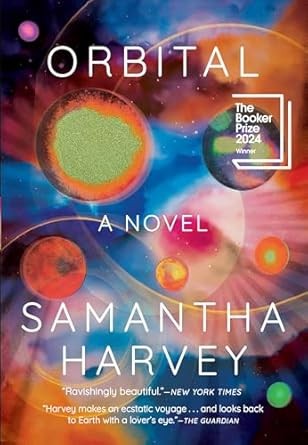
Orbital
Grove Atlantic · 2023 · 136 pages
ISBN: 9780802163622
Review Editor
Marcus Webb
Samantha Harvey’s Orbital begins somewhere above us. Six astronauts orbit Earth aboard a space station, completing sixteen circuits of the planet in the course of a single day, and the novel follows them through each pass: the dark side and the lit side, the weather systems and the coastlines, the slow political disasters visible from 250 miles up where they look like nothing, and the private sorrows that travel with every person into space.
Harvey published Orbital in November 2023, and it won the Booker Prize in November 2024, the first novel set in space to receive that award. At just 136 pages, it is a small book by any measure, but its ambitions are among the largest you will find in contemporary literary fiction. Harvey describes the project as a “space pastoral”: not a thriller, not a first-contact story, not a disaster narrative. The closest analogue is meditative prose poetry stretched into a novel’s shape. She spent years writing and abandoning early drafts, convinced she had no right to a subject she had never lived. She completed it during the 2020 pandemic lockdowns, watching a continuous live feed of Earth from the International Space Station to find her way back into the material.
The six crew members represent Japan, Britain, America, Italy, and Russia. Harvey introduces each one in quick, precise strokes: Chie, the Japanese astronaut who just learned her mother died on Earth while she was orbiting and could not return; Shaun, the American who turns to his faith for the orientation that gravity no longer provides; Pietro, all precision and professional devotion, an astronaut to his bones; Nell, who carries the quiet tension of the station in her breathing; and the two Russian cosmonauts, Anton and Roman, pragmatic and quieter than the others. They share a sealed capsule hurtling through silence, and they share a view of Earth that, Harvey argues, changes what it means to be human.
Character Arcs and Development
The most affecting storyline in the novel belongs to Chie. Her mother died while Chie was in orbit, and the news reached her the way most news does up there: through a terminal, in brief, without the touch of anyone who knew the woman. Harvey handles this with real care. Chie cannot go home. She cannot hold anything. She can only look down at Japan as the station passes over it every ninety minutes, watching the country that contains everything she has lost. The grief does not transform her; it floats alongside her, weightless, in the only way grief can float in a place where nothing has weight.
Shaun’s arc is quieter but equally honest. He is a man of faith conducting his faith in a place that offers both the strongest possible argument for design, the mathematical precision of orbits, the improbable conditions of life on Earth, and the strongest possible argument against it, the scale, the void, the total indifference of space. His questions do not resolve, and Harvey does not force them to. Pietro functions almost as a placeholder for pure competence and professional love: being in space is not an achievement for him but a vocation, and Harvey captures that distinction with real warmth. Anton’s dry humor becomes a kind of emotional gravity for the group.
Some readers will find the characterization frustrating, and the frustration is legitimate. Harvey is not interested in characters working through arcs in the conventional sense. She treats these six people as six refracted versions of the same human astonishment at being alive, rather than as individuals driving toward individual destinations. Whether that trade is worth it depends on how you read. What the novel asks of you is not the investment you give to a character you follow over years; it asks you to hold a person lightly and look at what they see.
Pacing
Each of the sixteen chapters covers a single orbit of roughly ninety minutes, and the structure is so clean it becomes a kind of clock. The novel does not move forward through plot: it turns. Things happen over the course of the day, a spacewalk, an equipment check, a meal, a video call home, a storm building across a continent, but the accumulation Harvey is after is emotional and philosophical rather than narrative. For readers who need a plot to pull them through, this will feel static at times. For readers who trust Harvey’s prose to be the event, the rhythm becomes hypnotic. The sections that work best are those where Harvey narrows to a single sensation, a handhold in open space, the sudden appearance of the Himalayas through the porthole, and stays there long enough to make you feel the altitude.
The book occasionally slips into repetition at its weakest moments. Certain meditations about humanity and the cosmos run through variations of the same thought in close succession, and a few of the more abstract passages read like ideas before they became images. But at 136 pages, the novel does not overstay its welcome. If a chapter loses you, the next orbit brings you back.
Deeper Thematic Exploration
The concept at the center of Orbital is what astronauts call the overview effect: the cognitive shift that happens when you see the entire Earth at once and the categories that organize human life, borders, nations, grievances, start to look provisional from above. Harvey takes this phenomenon seriously rather than sentimentally. She knows that “we’re all on the same planet” is a thought that sounds revelatory from orbit and obvious from the ground. What the novel asks is whether the feeling behind that thought, really felt rather than only understood, might change something in the person who carries it.
She connects this to climate change in a way that does not lecture. From the station, the crew can see the typhoon building in the Pacific, the bleached reefs, the cities producing their own weather. Harvey makes the overview effect environmental: the planet these characters orbit is already changing, and watching it from space gives the change a scale that news cycles cannot provide. The novel does not moralize about this. It positions the reader above the problem and lets the size of it land.
The cosmic time scale is Harvey’s other main instrument. She works in references to Carl Sagan’s cosmic calendar, which compresses the entire history of the universe into a single year, locating humanity somewhere in the last seconds of December 31st. This framing runs through the book as a counterweight to the urgency of any individual life. Chie’s grief over her mother, Shaun’s faith, Pietro’s professional devotion: all of it occupies the same brief moment on Sagan’s calendar. Harvey does not use this to dismiss individual meaning. She uses it to create a specific kind of tenderness. If we are this small, and we still care this much, then what we feel is extraordinary even at cosmic scale.
Style and Voice
Harvey’s prose is formal, deliberate, and often genuinely beautiful. She favors long sentences that accumulate observations the way an orbit accumulates distance, and she moves between close third-person interiority and something closer to second-person address, where the “you” is sometimes the reader and sometimes the Earth itself. The effect is disorienting in a productive way: you are not entirely sure whether you are watching the astronauts or the astronauts are watching you. Certain passages, particularly the spacewalk sequence and the descriptions of crossing the Pacific at night, achieve a prose altitude that fiction rarely reaches.
The style will not suit everyone. Harvey resists the compressed, maximally efficient prose that much contemporary literary fiction favors, and some of her more cosmic meditations can feel ornate. But the ornament is never empty: each digression returns to the station, to the six people sealed inside it, to the view from the window. The novel’s most sustained achievement is that the window never stops meaning something. By the sixteenth orbit, it has accumulated weight.
Verdict
Orbital is for readers who trust a novelist to build meaning without the scaffolding of plot, readers who can stay inside a single day and find that it keeps opening outward. It is ideal for fans of Jenny Offill’s Dept. of Speculation or Rachel Cusk’s Outline: books that seem thin on the page and turn out to be dense once you are inside them. It is not for readers who want a destination. You do not arrive at the end of Orbital so much as you return, as the astronauts do, having gone all the way around.
Harvey has made something genuinely new here. Space fiction almost always reaches for grandeur through scale, through the alien, through the threat of catastrophe. Orbital reaches for it through attention: paying very close attention to what it means to be human in a place built for machines, seeing your planet from outside it, and knowing you have to go home. Give it the reading pace it asks for rather than the pace you bring to other books, and it will stay with you longer than many novels three times its length.
Frequently Asked Questions about Orbital
What is Orbital by Samantha Harvey about?
Orbital follows six astronauts and cosmonauts aboard a space station during a single day, as they complete sixteen orbits of Earth. The novel covers their duties, their private thoughts, and their reflections on life, grief, faith, and the beauty of the planet below. There is no plot in the conventional sense; the book is a meditation on what it means to be human when seen from 250 miles up.
Is Orbital a science fiction novel?
Harvey describes Orbital as a “space pastoral” rather than science fiction in the genre sense. It takes place in a realistic, near-present setting aboard a station much like the International Space Station, with no speculative technology or alien contact. The Booker Prize committee categorized it as literary fiction; some science fiction prizes also recognized it. Whether you call it sci-fi depends on how broadly you define the term.
What are the main themes in Orbital by Samantha Harvey?
The book explores what astronomers call the overview effect, the cognitive shift that comes from seeing Earth whole from space. It also takes on grief and loss (through Chie’s storyline about her dying mother), faith and doubt (through the American astronaut Shaun), climate change as a visible reality from orbit, and the smallness of human life against cosmic time. Harvey uses Carl Sagan’s cosmic calendar as a recurring framework throughout.
How long is Orbital and is it a difficult read?
Orbital is 136 pages, making it one of the shortest Booker Prize winners on record. It reads in two to three hours for most people. The difficulty is not complexity but attention: the novel asks you to slow down and stay inside its observations rather than push forward through events. Readers accustomed to plot-driven fiction may find the stillness challenging; readers who enjoy lyrical literary prose will move through it comfortably.
Did Orbital win the Booker Prize?
Yes. Orbital won the 2024 Booker Prize for fiction, making it the first novel set in space to win the award and the second-shortest winner in the prize’s history. It also won the Hawthornden Prize and the InWords Literary Award in 2024, and it was shortlisted for the Orwell Prize for Political Fiction and the Ursula K. Le Guin Prize. Harvey had previously been longlisted for the Booker for her debut novel The Wilderness in 2009.
Who are the main characters in Orbital?
There are six crew members: Chie, a Japanese astronaut grieving her mother’s death on Earth; Shaun, an American astronaut whose faith is tested and sustained by the scale of space; Pietro, an Italian who is entirely at home in orbit; Nell, a British astronaut described as the breath of the craft; and Anton and Roman, two Russian cosmonauts, with Roman serving as commander. Harvey gives each character a distinct quality without building elaborate backstories for any of them.
How does Orbital compare to Samantha Harvey’s other novels?
Harvey’s previous novels include The Wilderness (2009), about a man losing his memory to Alzheimer’s, and The Western Wind (2018), a medieval mystery told in reverse. All three books share Harvey’s interest in time, perception, and the limits of what any individual consciousness can hold. Orbital is her most formally unusual work and the most direct in its engagement with beauty as a subject. Readers who loved The Western Wind’s compressed, precise prose will feel at home in Orbital; readers new to Harvey might find The Western Wind a useful next step after this one.
Should I read Orbital and is it worth it?
If you are willing to let a novel be an experience rather than an event, yes. Orbital does not give you a story to follow; it gives you a vantage point, and what you see from it is worth the short time it takes to get there. You will finish it in an afternoon and think about it for much longer. If you need narrative momentum to carry you through a book, this one will test your patience. But for readers drawn to meditative literary fiction, it delivers something that almost nothing else in recent years has attempted.
Book Details
- Title
- Orbital
- Author
- Samantha Harvey
- Genre
- Science Fiction
- Publisher
- Grove Atlantic
- Year Published
- 2023
- Pages
- 136
- ISBN
- 9780802163622
- WritersReview Rating
- 4.3 / 5