
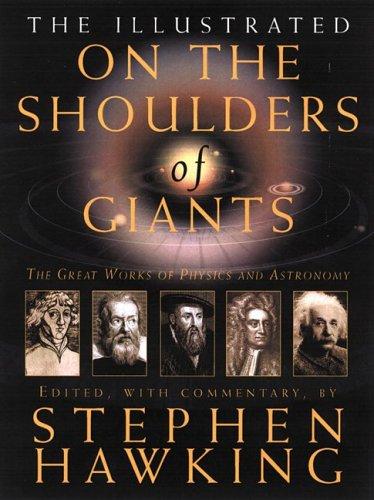
On the Shoulders of Giants
Running Press · 2002 · 1264 pages
ISBN: 9780762427321
Review Editor
Lena Park
Isaac Newton wrote to Robert Hooke in 1675 that if he had seen further, it was by standing on the shoulders of giants. Stephen Hawking borrowed that phrase as the title for this anthology, published by Running Press in 2002, which brings together five landmark texts in the history of astronomy and physics: excerpts from Copernicus’s On the Revolutions of the Celestial Spheres (1543), selections from Galileo’s Dialogues Concerning Two New Sciences (1638), excerpts from Kepler’s Harmonies of the World (1619), substantial selections from Newton’s Principia Mathematica (1687), and the complete text of Einstein’s Relativity: The Special and General Theory (1920). Hawking precedes each section with a biographical introduction to the author. The book runs to 1,264 pages and is, taken as a whole, a record of the revolution in scientific understanding that began with Copernicus and culminated, at least provisionally, with Einstein.
The project is both modest and ambitious. It is modest because Hawking’s editorial contribution consists primarily of selection and brief introduction: he is not analyzing these texts in any depth, not attempting a synthetic history of science, not offering a rival interpretation of what happened between Copernicus and Einstein. The introductions, typically ten to twenty pages each, give the biographical and historical context needed to understand who these writers were and why their work mattered, and then stand aside. The ambition lies in the selection itself and in what it implies: that these five thinkers were the essential architects of modern physical science, that reading their actual words rather than summaries or secondhand accounts matters, and that a general reader with patience and curiosity can still profit from direct engagement with texts that are now three hundred to five hundred years old.
The framing conceit of the volume, gathering the giants in one place so that a reader can appreciate both the individual achievements and the cumulative arc they describe, is more pedagogically useful than it might sound. Most popular science accounts of the Scientific Revolution describe what Copernicus did and what Galileo did and what Newton did, but reading the actual texts in sequence shows something that description cannot easily convey: the difference in how these thinkers write, what they assume their readers already know, what they feel compelled to argue against, and how the specific intellectual problems they were solving shaped the form of their answers.
The Thinkers in Their Time
Copernicus presents the most difficulty for a modern reader. His On the Revolutions is mathematically dense, written in a style that assumes familiarity with Ptolemaic astronomy, and not organized to tell a narrative that a modern reader will find intuitive. The excerpt Hawking selects, focusing on the cosmological argument rather than the full mathematical treatment, makes it manageable, but this is still challenging reading. Hawking’s introduction is useful here, explaining what the Ptolemaic model was, why its accumulation of epicycles and deferents had become unwieldy, and what Copernicus was actually claiming when he placed the sun at the center of the system. The claim, it turns out, was more conservative and more contested than the popular account suggests: Copernicus was not claiming that the Earth moved in any deep physical sense, only that the mathematics of planetary motions was simpler if you put the sun at the center.
Galileo is the most readable of the five for a modern audience. His dialogues are genuinely dramatic, with named interlocutors who disagree with each other in ways that feel like real arguments rather than set-piece confrontations. The sections on motion and mechanics are among the clearest demonstrations available of how careful observation and mathematical reasoning can overturn conclusions that seemed obvious on philosophical grounds. Galileo shows that heavier objects do not fall faster than lighter ones (a result that contradicts Aristotle) not by appealing to authority or abstract argument but by describing what you actually see when you drop things from heights. This methodological lesson, that the world is more authoritative than the books written about it, is exactly the revolution Galileo’s work represents.
Newton’s Principia is the most technically demanding material in the book. The selected excerpts cover the definitions and laws of motion, the law of universal gravitation, and the proofs of Kepler’s laws from gravitational theory. Reading even the excerpts requires following geometric proofs that are rigorous but not organized the way modern mathematics is organized; Newton wrote in the style of classical geometry rather than algebra, which means results that would now be presented as two lines of calculus appear as multi-page geometric constructions. Hawking’s introduction is again valuable here, providing the context of what Newton was trying to show and why the Principia represented such a decisive break from everything that preceded it.
Pacing
The book is not designed to be read straight through at the pace of a novel, and reading it that way would be both exhausting and counterproductive. The right approach is to use Hawking’s introductions to orient yourself in each section, read as much of the primary text as your patience and mathematical background allows, and then read the next introduction before moving on. Some sections reward extended engagement: Galileo’s dialogues read better if you commit to following the argument over multiple sessions. Others, particularly the Kepler and Newton excerpts, are best treated as a sample of a larger work rather than a complete reading experience.
The volume as a whole has a genuine arc. Starting with Copernicus and ending with Einstein, a reader who works through the selections in order watches a coherent project develop across four centuries: the gradual replacement of a cosmology centered on philosophical categories with one built from mathematical description of observed motions. Einstein’s text, accessible and written specifically for a general audience, serves as an effective conclusion to this arc; unlike the earlier selections, it is possible to read all the way through without specialized knowledge and come away with a real understanding of what the theory of relativity claims.
Deeper Thematic Exploration
The most interesting theme this collection makes visible is not any particular scientific result but the changing relationship between observation and theory across these five thinkers. Copernicus works primarily with mathematical convenience: his heliocentric model is better, he argues, because it is simpler and more elegant, not because he has observational evidence that the Earth moves. Galileo insists on observation as the arbiter of physical questions but still works within a broadly mathematical framework that he inherited from classical sources. Kepler combines extraordinary observational data, borrowed from Tycho Brahe, with an almost mystical belief that the structure of the solar system must reflect mathematical harmony. Newton creates a mathematical framework powerful enough to connect Galileo’s terrestrial mechanics with Kepler’s planetary motions in a single set of laws. Einstein extends and revises that framework when observational anomalies, specifically the precession of Mercury’s orbit and the behavior of light in gravitational fields, indicate that Newton’s laws are not quite right.
Reading the texts in sequence, you can see that each thinker is solving a problem that the previous one created. Copernicus’s simpler geometry raised the question of what actually caused the planets to move in the way they did, a question Ptolemy’s model had never needed to answer. Kepler’s careful description of planetary orbits as ellipses raised the question of what force could produce exactly that pattern. Newton’s answer to Kepler’s question, universal gravitation with an inverse-square law, raised the question of what gravity actually was and how it acted at a distance. Einstein’s answer to Newton’s question reorganized the framework again. This is what scientific progress actually looks like from inside, not a steady accumulation of facts but a sequence of problems each of which is generated by the resolution of the previous one.
Hawking is too restrained in his introductions to draw this theme out explicitly, which is both a limitation and a deliberate choice. He is presenting rather than interpreting, and the interpretation is left to the reader. For readers willing to do that work, the experience of following the argument across four centuries in original sources is more convincing than any summary could be.
Style and Voice
Hawking’s introductions are clear and economical. They do not attempt to be comprehensive biographies: they cover enough biographical detail to understand the thinker’s context and motivations, explain the intellectual problem each was addressing, and describe the reception of the work. The tone is engaged but not breathless. Hawking occasionally allows himself a dry joke at an appropriate moment, particularly in the biographical sections where human foibles and institutional resistance to new ideas make for good material. The introductions are effective at what they are designed to do: lowering the barrier to reading texts that are unfamiliar and, in some cases, genuinely difficult.
The translations of the primary texts vary in quality. The translations of Copernicus and Kepler are adequate without being distinguished; the Galileo and Newton selections use translations that have become standard and are generally respected. The Einstein is the author’s own simplified exposition, written in English, so translation is not a factor. For a reader interested in the history of science rather than philological scholarship, the translation quality is sufficient.
Verdict
This is a book for a specific kind of reader: someone who is genuinely curious about where modern physics came from and who wants to engage with primary sources rather than being told about them. It is not a quick or easy read, and it is not designed to be. It rewards the reader who is willing to read slowly, follow arguments rather than just note conclusions, and tolerate the difficulty of texts written for different audiences in different eras. That reader will come away with something that popular science writing cannot provide: a direct encounter with how these thinkers actually thought, in their own words, rather than the streamlined and sometimes mythologized version that textbooks and biographies provide.
Readers who want the narrative story of the Scientific Revolution without this level of engagement with primary sources should start with a history of science rather than this anthology. James Gleick’s Isaac Newton, or Dava Sobel’s Galileo’s Daughter, will give the story more efficiently. But for readers who want to know what Galileo actually said when he described his experiments with inclined planes, or what Einstein’s own explanation of why time slows at high velocities looks like, this is the most accessible single-volume source.
Frequently Asked Questions about On the Shoulders of Giants
What is On the Shoulders of Giants by Stephen Hawking?
It is an anthology edited by Stephen Hawking that collects excerpts from five landmark texts in the history of physics and astronomy: Copernicus’s On the Revolutions of the Celestial Spheres, selections from Galileo’s Dialogues Concerning Two New Sciences, excerpts from Kepler’s Harmonies of the World, selections from Newton’s Principia Mathematica, and Einstein’s Relativity: The Special and General Theory in full. Hawking wrote a biographical introduction to each section. The book covers approximately four centuries of physics and astronomy, from the heliocentric revolution to general relativity.
Is On the Shoulders of Giants accessible to general readers?
It depends on the section. Einstein’s text, written specifically for a general audience, is accessible without a scientific background. Galileo’s dialogues require patience but are readable without advanced mathematics. The Kepler and Newton excerpts are more demanding, particularly for readers unfamiliar with classical geometry. Hawking’s introductions help with all five sections and should be read before attempting the primary texts. A general reader willing to read slowly and consult supplementary sources when confused will manage the book; a reader expecting a smooth, flowing experience may be frustrated by the more technical passages.
How long does it take to read On the Shoulders of Giants?
At 1,264 pages, this is a commitment. Hawking’s introductions total roughly 80 pages and can be read in a few hours. The primary texts vary in difficulty; Einstein’s contribution of about 180 pages can be read in several sessions by a general reader. The Newton and Copernicus excerpts require much more time per page. Readers who engage seriously with all five sections should expect to spend several weeks on the book, reading actively rather than straight through.
What does Hawking’s introduction add to each section?
Hawking provides biographical context, explains the intellectual problem each thinker was addressing, describes the reception of the work, and points to the key results the reader should watch for in the primary text. He is not attempting comprehensive historical or scientific analysis; the introductions are orientation rather than interpretation. For readers unfamiliar with the history of science, they are essential for making the primary texts comprehensible. For readers who know the history well, they serve mainly as a reminder of context before diving into the original source.
Why does Hawking include Einstein alongside the earlier figures?
Hawking argues that Einstein belongs in this sequence because relativity represents the same kind of conceptual revolution that Copernicus, Galileo, Kepler, and Newton each produced: a fundamental reorganization of the framework for understanding motion and space and time, forced by the failure of the previous framework to account for new observations. Einstein’s special relativity resolved the incompatibility between Newton’s mechanics and Maxwell’s electromagnetism; his general relativity replaced Newton’s theory of gravitation with a geometrical description of curved spacetime. Including Einstein completes the arc from the heliocentric revolution to the relativistic revolution.
What is the most interesting thing to read in On the Shoulders of Giants?
Most readers find Galileo’s dialogues and Einstein’s explanation of relativity the most engaging sections. The Galileo selection shows the experimental method being developed in real time, with the kind of dramatic clarity that is rare in primary scientific sources. Einstein’s text is a model of accessible scientific writing: he starts from simple, verifiable observations and builds the theory step by step in a way that a careful reader without physics training can follow. The Newton selection is the most historically significant but also the most difficult; readers who manage to follow even part of the argument will come away with genuine respect for Newton’s achievement.
Is On the Shoulders of Giants suitable for students studying the history of science?
Yes, as a primary source collection supplemented by a proper history of science course or textbook. The texts themselves are the standard primary sources for the Scientific Revolution and relativity. Hawking’s introductions provide context but are not a substitute for scholarly historical analysis. Students who want to engage with what these thinkers actually wrote, rather than what textbooks say they wrote, will find this anthology useful as a companion to more analytical historical works.
How does On the Shoulders of Giants relate to Hawking’s other popular science books?
This is an editorial and curatorial project rather than an original work of popular science. Hawking’s own ideas appear primarily in the introductions rather than in the book’s main content. Readers who want Hawking’s thinking about cosmology and physics should read A Brief History of Time or The Universe in a Nutshell. Readers who want to understand the history of physics through primary sources, with Hawking as a guide, will find this anthology the most direct route available.
Book Details
- Title
- On the Shoulders of Giants
- Author
- Stephen Hawking
- Genre
- Science & Nature
- Publisher
- Running Press
- Year Published
- 2002
- Pages
- 1264
- ISBN
- 9780762427321
- WritersReview Rating
- 3.9 / 5