
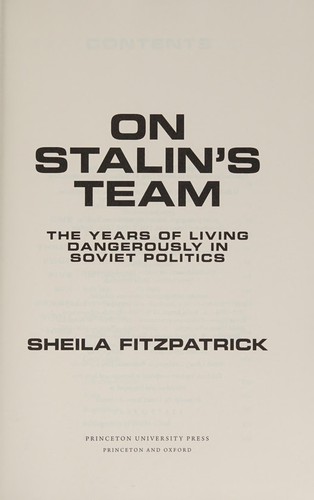
Sheila Fitzpatrick’s On Stalin’s Team is one of the most illuminating works on Soviet political history in years — a study of the men who surrounded Stalin from the 1920s through his death in 1953, the inner circle that ran the Soviet state and survived, most of them, while millions did not. Fitzpatrick, one of the preeminent Western historians of the Soviet period, brings to this project decades of archival work and an uncommon ability to resist the simplifications that so often distort writing about Stalinism.
The book’s central argument is worth stating plainly: Stalin’s rule was not simply a one-man dictatorship but a collective leadership, a team, with its own dynamics of loyalty, rivalry, succession anxiety, and shared complicity. Molotov, Kaganovich, Mikoyan, Voroshilov, Beria, Khrushchev, Malenkov — these figures are rendered here not as interchangeable villains but as distinct personalities whose individual trajectories illuminate the larger system. They were, Fitzpatrick writes, neither purely cynical nor simply terrorized. They believed, or came to believe, in what they were doing, even as what they were doing included the deaths of colleagues and the terror of an entire society.
Fitzpatrick is particularly good on the dynamic of the team itself — the camaraderie and the fear, the collective decision-making that allowed individual members to both share responsibility and evade it. The famous dinners at Stalin’s dacha, the late-night film screenings, the hunting trips: these details are not window dressing but evidence of a political culture that bound men together in ways that made defection or resistance almost unimaginable.
The archival depth here is formidable. Fitzpatrick draws on diaries, memoirs, letters, and newly accessible Soviet materials to construct portraits that feel psychologically true — not the cardboard monsters of Cold War mythology but real political actors whose choices, made across decades, produced consequences of staggering scale.
Essential reading for anyone who wants to understand how totalitarian systems actually function from the inside.
Book Details
- Title
- On Stalin’s Team
- Genre
- History
- WritersReview Rating
- 5.0 / 5