
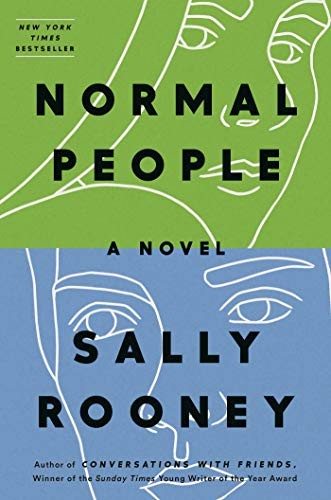
Normal People
Hogarth Press · 2018 · 288 pages
ISBN: 9781984822178
🏆 Irish Novel of the Year, Irish Book Awards (2018)
Waterstones Book of the Year (2018)
Costa Book Award, Novel category (2019)
Encore Award (2019)
Book of the Year, British Book Awards (2019)
Longlisted, Man Booker Prize (2018)
Longlisted, Women's Prize for Fiction (2019)
Review Editor
Eleanor Marsh
Sally Rooney’s second novel, Normal People, published in 2018 by Faber & Faber and released in the US by Hogarth in 2019, follows two young Irish people from their final year of secondary school in County Sligo through their years at Trinity College Dublin. Connell Waldron and Marianne Sheridan orbit each other across a decade of false starts, breakups, and quiet reconciliations, never quite managing to stay together but never able to fully let go.
Connell is a popular athlete whose mother, Lorraine, cleans Marianne’s family home. Marianne is wealthy, sharp-tongued, and socially isolated at school. What begins as a secret relationship in Sligo inverts when they reach Dublin: Connell becomes the uncertain outsider while Marianne finds the intellectual circles that suit her. The novel tracks their connection through shifting power dynamics, class friction, and the painful process of figuring out who you are when the person who knows you best keeps slipping away.
Rooney is writing about intimacy in its most specific and unsentimental form. This is not a love story in the traditional sense. It is an examination of what happens when two people understand each other down to the bone, yet keep failing to say the one honest thing that would keep them from hurting each other.
Character Arcs and Development
Connell starts the novel as someone who hides behind the opinions of his peers. He keeps his relationship with Marianne secret because he cannot bear the social cost of being seen with her. This cowardice, and his eventual reckoning with it, forms the spine of his arc. By the time he reaches Dublin, Connell’s popularity means nothing, and he discovers that without the framework of small-town social approval, he has very little sense of self. His slow movement toward genuine confidence, filtered through a depressive episode that Rooney handles with precision rather than melodrama, is one of the most convincing portrayals of a young man finding his footing in recent fiction.
Marianne’s trajectory runs in the opposite direction. She begins the novel as someone who has already decided she does not need other people. The reader gradually learns this is not strength but a survival response to an abusive family. Her brother, Alan, is physically violent, and her mother responds to this violence with indifference. Marianne’s willingness to enter relationships where partners dominate or demean her never reads as kink for its own sake; Rooney connects it clearly to a young woman who has learned to expect pain from people who are supposed to care for her. Her arc is about learning that she deserves something gentler.
The secondary characters are drawn lightly but effectively. Lorraine, Connell’s mother, is one of the novel’s quiet anchors, a woman who respects her son enough to let him make mistakes. Niall and Joanna at Trinity serve as mirrors for Connell and Marianne’s respective social lives, but Rooney wisely keeps the spotlight tight on her two leads.
Pacing
The novel moves in time jumps between chapters, sometimes leaping months in a single white space. This works brilliantly in the first half, where each chapter opens on a new arrangement of the relationship: together, apart, circling. The pacing does soften in the middle stretch set during their second and third years at Trinity. A period in Sweden where Connell studies abroad and Marianne enters a relationship with a man named Lukas sags slightly because the reader has by now internalized the pattern of separation and reunion. Rooney needs these chapters to deepen the stakes, but a few could have been compressed without losing emotional ground.
The final third tightens again beautifully. The scenes following Connell’s friend’s death and his subsequent depression carry real weight, and the closing pages move with a quiet urgency that earns its emotional payoff.
Deeper Thematic Exploration
Class is the engine running beneath every scene. Connell grows up in a house his mother rents; Marianne grows up in a house large enough to employ Connell’s mother. At school in Sligo, this gap is invisible because Connell holds the social capital of likeability. At Trinity, the equation flips. Marianne’s ease in the world of wine receptions and dinner parties, a world Connell finds suffocating, reveals how much of social confidence is simply knowing the codes. Rooney never lectures about this. She lets you feel it in Connell’s silence at a party where everyone else seems to know what to say.
Communication, or the failure of it, is the novel’s other central preoccupation. Connell and Marianne are both intelligent people who read literature for a living, yet they cannot bring themselves to say “I need you” or “please stay.” Their silences are not romantic. They are costly. The novel builds its tension from the gap between what these two characters feel and what they are willing to articulate, and Rooney makes you understand that this gap is not a failure of love but a failure of courage shaped by class, gender, and family history.
There is also a quiet argument about what it means to be “normal.” Both characters want to be ordinary. Connell wants the comfort of fitting in; Marianne wants proof that someone could love her without conditions. The title is ironic because neither of them is normal in the way they imagine, and the novel suggests that the desire for normalcy is itself a kind of trap, a way of avoiding the harder work of accepting yourself as you actually are.
Style and Voice
Rooney’s prose is stripped to the bone. She does not use quotation marks for dialogue, a choice that blurs the line between speech and thought and gives the novel a continuous, almost stream-of-consciousness quality. Sentences are short. Descriptions are precise and unadorned. This minimalism is not affectation; it mirrors the emotional restraint of her characters, who feel everything intensely but express almost nothing directly.
The narration alternates between Connell’s and Marianne’s perspectives, and Rooney is skilled at modulating voice so that you always know whose head you are in, even without section headings. Connell’s chapters tend toward anxious self-monitoring, while Marianne’s carry a cooler, more detached register. The effect is of watching two people look at each other through frosted glass, each seeing a slightly distorted version of the other.
Verdict
Normal People is a book for anyone who has ever known exactly what another person needed to hear and still could not say it. It is also for readers who are tired of novels where class is either invisible or treated as a lecture topic. Rooney weaves economic reality into the texture of her characters’ lives so naturally that you absorb it the way you absorb weather.
The novel is not perfect. The middle section repeats its structural pattern one too many times, and readers who want plot will find the book’s interest in interiority frustrating. But for those who care about how people actually talk and think and fail each other, this is one of the sharpest novels of the last decade. Rooney writes about young love with the precision of someone who understands that love at twenty is not simple or sweet; it is a negotiation conducted mostly in silence, and the stakes are nothing less than who you become.
Frequently Asked Questions about Normal People
What is Normal People by Sally Rooney about?
Normal People follows Connell Waldron and Marianne Sheridan from their final year of secondary school in a small Irish town through their time at Trinity College Dublin. The novel tracks their on-and-off romantic relationship as they navigate class differences, family trauma, and the difficulty of honest communication. It is less a traditional love story than an examination of how two people who understand each other deeply keep failing to stay together.
Is Normal People based on a true story?
Normal People is a work of fiction. Sally Rooney has said in interviews that the characters are not based on specific real people, though she drew on her own experience growing up in County Mayo in western Ireland and studying at Trinity College Dublin. The novel’s setting and social dynamics reflect real aspects of Irish life, but the plot and characters are invented.
What are the main themes in Normal People by Sally Rooney?
The novel explores four central themes: class and economic inequality (Connell comes from a working-class background while Marianne is wealthy), communication and emotional vulnerability (the characters repeatedly fail to say what they mean), identity and the desire for normalcy (both characters struggle with who they are versus who they want to be), and the lasting effects of family dysfunction (Marianne’s abusive home life shapes her adult relationships).
How long is Normal People and is it a difficult read?
Normal People is 288 pages and reads quickly. Rooney’s prose is spare and direct, with short sentences and no quotation marks around dialogue. Most readers finish it in two or three sittings. It is not a difficult read in terms of language or structure, but the emotional content can be intense, particularly the sections dealing with depression and domestic abuse.
Is there a TV adaptation of Normal People?
Yes. Normal People was adapted into a 12-episode television series in 2020, co-produced by BBC Three and Hulu. Daisy Edgar-Jones plays Marianne and Paul Mescal plays Connell. The series was widely praised and launched both actors into international recognition. It follows the novel closely and was co-written by Rooney herself.
What age group is Normal People appropriate for?
Normal People is written for adult readers and contains explicit sexual content, depictions of domestic abuse, and a storyline involving depression and self-harm. It is best suited for readers aged 17 and older. The novel is widely read by people in their twenties and thirties, though readers of any adult age who enjoy character-driven literary fiction will find it rewarding.
How does Normal People compare to Sally Rooney’s other novels?
Normal People is Rooney’s second novel, after Conversations with Friends (2017) and before Beautiful World, Where Are You (2021) and Intermezzo (2024). It shares Rooney’s characteristic style of unadorned prose and absent quotation marks, but it is more emotionally concentrated than her debut. Many readers consider it her strongest work because of its tight focus on two characters. Intermezzo marks a departure toward a more varied prose style, while Beautiful World expands to four central characters.
Should I read Normal People by Sally Rooney and is it worth it?
If you care about character-driven fiction that takes relationships seriously without being sentimental, Normal People is absolutely worth your time. Readers who love Ottessa Moshfegh, Rachel Cusk, or Sheila Heti will find a kindred sensibility here. If you prefer plot-heavy novels with strong forward momentum, you may find the pacing frustrating. The book rewards readers who are willing to sit with small, painful moments of miscommunication and watch two people slowly learn how to be honest with each other.
Book Details
- Title
- Normal People
- Author
- Sally Rooney
- Genre
- Literary Fiction
- Publisher
- Hogarth Press
- Year Published
- 2018
- Pages
- 288
- ISBN
- 9781984822178
- Awards
- 🏆 Irish Novel of the Year, Irish Book Awards (2018) Waterstones Book of the Year (2018) Costa Book Award, Novel category (2019) Encore Award (2019) Book of the Year, British Book Awards (2019) Longlisted, Man Booker Prize (2018) Longlisted, Women's Prize for Fiction (2019)
- WritersReview Rating
- 4.9 / 5