
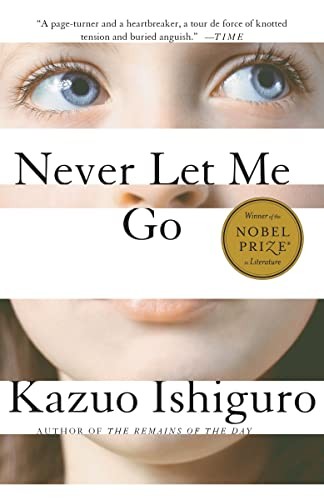
Never Let Me Go
Vintage International · 2005 · 288 pages
ISBN: 9781400078776
🏆 Shortlisted for 2005 Man Booker Prize
Shortlisted for 2006 Arthur C. Clarke Award
Shortlisted for 2005 National Book Critics Circle Award
TIME Magazine Best Novel 2005
ALA Alex Award 2006
Review Editor
Marcus Webb
Kazuo Ishiguro’s Never Let Me Go, published in 2005, is a novel that disguises itself as a quiet English boarding school story before slowly revealing something far more unsettling. Set in an alternate version of late-twentieth-century England, it follows Kathy H., a thirty-one-year-old “carer” who looks back on her years at Hailsham, a seemingly idyllic school in the countryside. Alongside her closest friends, Tommy and Ruth, Kathy recalls a childhood that was at once sheltered and subtly menacing, defined by cryptic rules, odd silences from the adults in charge, and a creeping awareness that their lives were never entirely their own.
The novel unfolds through Kathy’s measured, conversational narration as she pieces together memories of Hailsham, the Cottages where she and her friends moved as young adults, and her present work as a carer tending to organ donors. Ishiguro parcels out the central revelation of the story with extraordinary restraint. There is no dramatic twist; instead, the truth about what Kathy and her friends are, and what they were made for, arrives in fragments, like something you already suspected but refused to name. The result is a book that is less about surprise and more about the slow, devastating weight of understanding.
For readers unfamiliar with the premise: the students of Hailsham are clones, raised to donate their vital organs once they reach adulthood, after which they will “complete,” which is the novel’s antiseptic word for death. Ishiguro gives away this premise early enough that the novel’s power rests not in the revelation itself but in how the characters absorb and accommodate it.
Character Arcs and Development
Kathy H. is one of the most quietly affecting narrators in contemporary fiction. She is careful, observant, and prone to understatement, a quality that makes the horrors of her situation land with greater force. She watches, she remembers, she qualifies. She will say things like “I don’t know how it was where you were” or “maybe I’m remembering it wrong,” inviting you into a shared intimacy while also revealing how deeply she has internalized the limits placed on her life. Her arc is not about rebellion or transformation; it is about understanding. By the novel’s end, Kathy has not changed the world or even her own fate, but she has come to see it clearly, and that clarity is both her tragedy and her dignity.
Tommy is the emotional center of the book, even when he is offstage. As a boy at Hailsham, he is the kid who throws tantrums in the playing field while the others watch and laugh. He is sensitive, earnest, and easily wounded. His later attempts to create art, laboriously drawing small imaginary animals in the hope that creativity might prove he has a soul, form one of the novel’s most heartbreaking threads. Tommy’s belief that art could save them is both naive and profoundly human, and the scene where that hope is finally extinguished ranks among the most devastating passages Ishiguro has ever written.
Ruth is the most complex of the three. She is manipulative, insecure, status-conscious, and often cruel, particularly in the way she positions herself between Kathy and Tommy. She is also, in her way, the most desperate. Ruth’s need to perform normalcy, to pretend she might have come from a life like anyone else’s, makes her both frustrating and deeply pitiable. Her late-novel apology, when she finally acknowledges what she took from Kathy and Tommy, is earned precisely because Ishiguro never softens her earlier behavior. Ruth is difficult to like and impossible to dismiss, which is exactly the point.
Pacing
Never Let Me Go moves at a deliberate, unhurried pace that mirrors Kathy’s own tendency to circle around difficult truths. Some readers will find this slow, and they are not entirely wrong. The middle sections at the Cottages, where Kathy, Tommy, and Ruth live as young adults, can feel like the novel is treading water. The plot, such as it is, takes a back seat to small social dramas: who is dating whom, how the Hailsham students measure themselves against the others, what Ruth saw in a magazine.
But this pacing is deliberate and, ultimately, essential. Ishiguro is building a world in which extraordinary cruelty has been made ordinary, and ordinary life proceeds in its ordinary rhythms even under the shadow of an early, predetermined death. The Cottages sections also do crucial emotional work: they show us what happens when the structure of Hailsham falls away and the characters must face the outside world with nothing but each other and the growing knowledge of what awaits them. The slow accumulation of detail, the way a conversation about a lost pencil case can carry the weight of an entire life’s worth of longing, is what gives the final act its devastating power. If the novel moved faster, it would be a different and lesser book.
Deeper Thematic Exploration
On its surface, Never Let Me Go is about cloning and organ harvesting. Beneath that, it is about what it means to be human when the world has decided you are not. The students of Hailsham are raised with art, music, and literature specifically so that their guardians can prove to a skeptical public that clones have souls. But the experiment fails. Not because the students lack inner lives, but because the public does not want to know. The parallel to how societies treat marginalized people, those whose suffering is visible but inconvenient, is unmistakable, and Ishiguro draws it without ever stating it outright.
The novel also wrestles with the human capacity for acceptance. Kathy, Tommy, and Ruth never try to escape. They never revolt. They do not run. This passivity troubles many readers, but it is the novel’s most pointed observation. We are all, Ishiguro suggests, more compliant than we like to believe. We accept the terms we are given. We follow the schedules laid out for us. We console ourselves with small pleasures and the company of the people we love, and we try not to think too hard about the end. The students’ acceptance of their fate is not a failure of imagination; it is a mirror held up to everyone who has ever said, “That is just the way things are.”
There is also a thread about memory and nostalgia that runs through the entire book. Kathy narrates from a position of looking back, and her memories of Hailsham are tinged with a warmth that sits uncomfortably alongside what we know about the institution’s purpose. Hailsham was, in the end, a farm. But it was also the place where Kathy learned to love, to think, to feel. The tension between those two truths is never resolved, and Ishiguro is wise enough not to try. Nostalgia, the novel implies, is not a lie, but it is never the whole story.
Style and Voice
Ishiguro’s prose in Never Let Me Go is deceptively plain. The sentences are short, the vocabulary simple, the tone conversational. Kathy speaks the way a real person remembers: circling back, correcting herself, pausing to wonder whether a detail matters. This plainness is the novel’s secret weapon. There are no pyrotechnics, no passages of conspicuous beauty. Instead, there is a steady, almost hypnotic accumulation of small observations that, taken together, produce an emotional effect far greater than any individual sentence could achieve.
The narrative point of view, Kathy’s first person retrospective, is perfectly chosen. Her voice is intimate without being confessional, restrained without being cold. She tells you things and then tells you she is not sure she should have, which creates a constant undertow of anxiety beneath the calm surface. The effect is something like listening to a friend recount a memory that they have told themselves so many times it has worn smooth, all the sharp edges filed down, but not quite gone. Ishiguro resists the temptation to let the science fiction premise generate its own drama. There are no chase scenes, no laboratories, no villainous scientists. The horror is domestic, bureaucratic, polite, and that restraint makes it land with far more force than any genre spectacle could.
Verdict
Never Let Me Go is a novel that works on you slowly and then stays. It is not a book that delivers immediate thrills or tidy catharsis. If you need a fast plot or a protagonist who fights back, you will be frustrated. But if you are willing to sit with discomfort, to let a quiet story build its case through accumulation rather than spectacle, this is one of the most emotionally powerful novels of the twenty-first century.
It is a book for readers who love Ishiguro’s The Remains of the Day and want to see him push those same themes of repression, duty, and wasted time into stranger territory. It is for anyone who has ever wondered why we accept the unacceptable, and for anyone who has looked back on a place they loved and realized, too late, what it really was. The novel’s final image, Kathy standing alone in a Norfolk field, imagining everything she has lost blowing toward her on the wind, is one you will carry for a long time.
Frequently Asked Questions about Never Let Me Go
What is Never Let Me Go by Kazuo Ishiguro about?
Never Let Me Go follows Kathy H., a young woman looking back on her childhood at Hailsham, an English boarding school. She and her friends Tommy and Ruth gradually discover that they are clones raised to donate their organs. The novel traces their relationships from school through young adulthood as they come to terms with a fate they cannot escape.
Is Never Let Me Go based on a true story?
No, Never Let Me Go is entirely fictional. It is set in an alternate version of late-twentieth-century England where human cloning for organ harvesting became a widespread medical practice. While the science is invented, Ishiguro has said the novel draws on real questions about how societies justify exploiting certain groups of people for the benefit of others.
What are the main themes in Never Let Me Go?
The novel explores several interconnected themes: the ethics of using human beings as means to an end, the nature of memory and nostalgia, the human tendency to accept unjust systems rather than resist them, and the question of what makes a person truly human. It also examines love, loss, and the way people negotiate power and vulnerability within intimate relationships.
How long is Never Let Me Go and is it a difficult read?
The novel is 288 pages in the standard paperback edition, making it a moderate-length read that most readers can finish in a few days. The prose is accessible and conversational, with no experimental structure or difficult vocabulary. The emotional content, however, is heavy, and the deliberately slow pacing requires patience. It rewards careful, attentive reading.
Is there a movie or TV adaptation of Never Let Me Go?
Yes, a film adaptation was released in 2010, directed by Mark Romanek with a screenplay by Alex Garland. It stars Carey Mulligan as Kathy, Andrew Garfield as Tommy, and Keira Knightley as Ruth. The film was well received by critics and captures the novel’s melancholy tone, though many readers feel the book’s interior quality is difficult to translate fully to screen.
What age group or reading level is Never Let Me Go for?
Never Let Me Go is written for adult readers, though it is widely taught in high school AP and college literature courses. There is no graphic violence or explicit sexual content. The American Library Association awarded it the Alex Award in 2006, recognizing it as an adult book with strong appeal for young adult readers aged sixteen and up.
How does Never Let Me Go compare to Kazuo Ishiguro’s other novels?
Never Let Me Go shares DNA with The Remains of the Day in its use of a restrained, retrospective narrator who gradually reveals painful truths. Both novels are about characters who accept their circumstances with quiet resignation. Where The Remains of the Day examines class and duty in postwar England, Never Let Me Go pushes those themes into speculative territory. Readers who loved one will almost certainly appreciate the other, though the emotional register of Never Let Me Go tends to hit harder.
Should I read Never Let Me Go and is it worth it?
If you appreciate literary fiction that prioritizes character and atmosphere over plot mechanics, Never Let Me Go is essential reading. It is one of the defining novels of the early twenty-first century and was shortlisted for the Man Booker Prize. Readers who prefer fast-paced stories or clear-cut resolutions may find it frustrating, but anyone willing to sit with its quiet, accumulating sadness will find a book that stays in memory long after the last page.
Book Details
- Title
- Never Let Me Go
- Author
- Kazuo Ishiguro
- Genre
- Science Fiction
- Publisher
- Vintage International
- Year Published
- 2005
- Pages
- 288
- ISBN
- 9781400078776
- Awards
- 🏆 Shortlisted for 2005 Man Booker Prize Shortlisted for 2006 Arthur C. Clarke Award Shortlisted for 2005 National Book Critics Circle Award TIME Magazine Best Novel 2005 ALA Alex Award 2006
- WritersReview Rating
- 5.0 / 5