
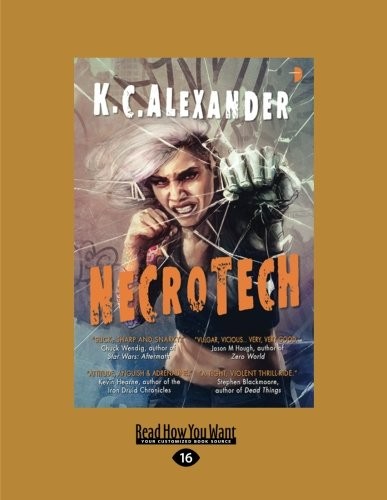
Necrotech
Angry Robot · 2016 · 400 pages
ISBN: 9780857666239
Review Editor
Marcus Webb
K.C. Alexander’s debut novel Necrotech arrived in 2016 from Angry Robot, the first entry in the SINless series. It drops you into a near-future cityscape where corporations own everything worth owning, where the government issues a SIN (Security Identification Number) to every citizen, and where people who refuse that system become SINless: off the grid, off the books, surviving by whatever means the street allows. The city itself registers in impressionistic fragments: bare electrical cables, humidity that never relents, chrome-enhanced teenagers trying to look dangerous on corners where the neon has mostly burned out. It is a world that has kept going past the point at which it should have collapsed, and everyone in it has made their peace with that in their own way.
The protagonist is Riko, a mercenary and self-described splatter specialist who wakes up at the novel’s opening in a laboratory, months of memory gone. Her girlfriend, Nanji, has been converted into a necrotech: a person whose cybernetic implants have been hijacked by a devastating virus that turns the body into something like a zombie, aggressive and relentless and no longer recognizably the person they were. Riko’s crew believes she sold them out. The only people with answers are the ones who want her dead first. So she has to fight through the corporate underworld, recover her memories, and figure out what she did and what was done to her before the people chasing her finish the job.
Alexander builds the world with the raw materials of vintage cyberpunk: the logic of bodies as hardware, of corporations as governments, of poverty as a design feature rather than a flaw. The necrotech virus fits this setting with a specific kind of elegance. In a society where technology lives inside people, the most effective weapon is one that converts the body against its owner. People do not merely die from necrotech; they become something useful to whoever deployed it. Alexander keeps that implication in the texture of the world rather than underlining it, but it is there throughout.
Character Arcs and Development
Riko is a character built for confrontation. She is violent, profane, and comfortable in her own skin in a way that few science fiction protagonists manage without announcing it. She knows exactly who she is, or thought she did before her memories were taken, and the tension between that settled self-knowledge and the destabilizing reality of what she can no longer verify drives the novel’s emotional engine. Most memory-loss plots treat the missing past as something to recover on the way to becoming a better or fuller version of the protagonist. Alexander is not interested in that. Riko wants her memories back not for redemption but for clarity. She refuses to live in a version of herself she cannot confirm.
The relationship between Riko and Nanji gets less page time than the action sequences, but Alexander builds it with enough specific detail that its loss carries real weight. Riko’s grief runs entirely through anger, which is the only language she has for strong feeling, and the novel takes this seriously rather than treating it as a character flaw waiting for correction. She does not cry. She breaks things, and the story respects that as a genuine emotional response rather than a symptom to be treated. This is rarer than it sounds; fiction is full of violent characters whose emotions eventually get softened into something more conventionally sympathetic. Riko’s do not.
Digo, Nanji’s brother and a member of the crew that suspects Riko, is the supporting character who comes closest to full dimensionality. His loyalty to his sister and his distrust of Riko pull in opposite directions throughout the narrative, and the friction this produces feels genuine rather than mechanical. Other crew members are drawn more economically, sometimes more economically than the story needs. But the decision to concentrate the novel’s emotional investment in Riko and her immediate relationships, rather than distributing it across a large ensemble, pays off in the clarity of the protagonist’s experience.
Pacing
Necrotech moves fast. Alexander writes close-quarters violence with real kinetic confidence, and the novel rarely pauses long enough for you to settle into any single scene before the next complication arrives. If your tolerance for sustained, graphic action sequences is low, this book will exhaust you. If you find momentum rewarding regardless of what drives it, you will get through it quickly and want the sequel.
The pace works against the novel in places. The middle section, where the rhythm of fight-discover-fight-discover begins to feel predictable, is where some readers will start to notice a sameness in the beats. The worldbuilding is rich enough to support slower passages; the moments when Alexander pauses to show you how the city actually operates, who controls which streets, how the SINless economy functions, are often the most interesting in the book. There is a version of this story that gives those moments more room. The published version chooses speed instead, and both choices carry real costs.
Deeper Thematic Exploration
The necrotech virus is the novel’s most effective metaphor for what late-stage corporate control actually does to people. In a world where corporations have extended themselves into the body through implants and chipsets, the idea that the same technology can be weaponized to turn a person into something useful to whoever holds the trigger becomes a precise horror. It is not abstract. It is physical, it happens to someone Riko loved, and it places the novel’s central violence in a specific political context without ever becoming a lecture about it. Alexander trusts readers to make the connection.
The SINless framework is where the novel’s political thinking gets most interesting. To be SINless is to be outside the apparatus of surveillance and identification that the corporations use to manage their population. It is a form of resistance, and also a form of profound precarity. The SINless gain autonomy and lose safety in the same transaction. Corporate power does not need the law to reach them; it has private security, hired mercs, and enforcers for that. Riko inhabits this contradictory space without evident discomfort, but the story keeps showing you how fragile the position is, how the freedoms it offers depend entirely on your ability to keep outrunning the forces aligned against you.
Memory loss as a plot device usually serves suspense, and it does that here. But it also does something more specific to Riko as a character. She was most certain of herself, and that certainty has been taken. The novel refuses to let this arc resolve into a simple recovery narrative. Riko does not learn from her ordeal and emerge improved. She fights her way toward the truth, and what she finds does not settle the question of who she is in any comfortable way. The book’s willingness to sit with that ambiguity rather than resolve it into redemption is one of its more honest qualities.
Identity and the body are themes that cyberpunk has always circled, but Alexander brings a specific focus to what it means to be a woman who augments her body not for appearance but for function, and whose sexuality is active and unapologetic in a genre that has not always known what to do with female characters who simply are rather than perform. Riko is not the first protagonist of this kind, but she is drawn with enough particularity that she does not read as a type.
Style and Voice
Alexander writes in close first person, and Riko’s voice stays consistent through interrogations, street fights, and the few quiet moments the novel allows. The prose is direct and unsentimental, heavy on profanity that belongs to the register the character inhabits rather than serving as decoration. The humor is dry and usually arrives at the moment after something violent enough to warrant a darker response, which produces a tonal quality that treats horror and absurdity as inseparable. This is one of the things that distinguishes the book from standard-issue cyberpunk action. Not many novels in this mode manage genuine wit alongside their body counts.
Some readers will find the voice relentless in a way that works against them. The prose is calibrated for pace and energy, and that calibration sometimes leaves less room for reflection than the ideas being explored would warrant. The best sentences in the book have real precision: a city detail rendered in a clause, a character observation that arrives sideways and lands accurately. Others push harder than they need to. But the voice is genuinely distinctive, and in a genre with a surplus of novels that read interchangeably, that matters more than the inconsistencies.
Verdict
Necrotech is a book for readers who want their science fiction fast, loud, and committed to its own aesthetic without apology. If you came up on classic cyberpunk and have spent years looking for something that carries that energy forward without smoothing off the parts that were never supposed to be comfortable, this delivers. If you read primarily for psychological complexity or thematic depth, you will find things here worth your attention, but you will have to work around the relentlessness to get to them.
The SINless series continues with Nanoshock (2018), which picks up Riko’s story without softening anything. Readers who find Riko’s voice compelling by page fifty will likely read through to the end of this volume in a sitting and immediately want the next one. Readers who find her alienating by that same page should trust that instinct. This is not a book that accommodates reluctance. It asks for full engagement, and for readers who can give it that, Necrotech delivers something genuinely its own.
Frequently Asked Questions about Necrotech
What is Necrotech by K.C. Alexander about?
Necrotech follows Riko, a cybernetically augmented mercenary who wakes up with months of her memory erased and her girlfriend converted into a necrotech: a person whose implants have been hijacked by a virus that transforms them into a violent, uncontrollable creature. With her crew convinced she betrayed them and corporate enforcers on her tail, Riko has to fight through a dystopian near-future cityscape to recover her memories and find out who is responsible. It is the first book in K.C. Alexander’s SINless cyberpunk series.
What does “SINless” mean in Necrotech?
In the world of Necrotech, a SIN (Security Identification Number) is the government-issued identifier that tracks every citizen within the corporate-controlled society. People who opt out of the system and go off the grid are called SINless. Being SINless means operating outside corporate surveillance and control, but also without the legal protections and infrastructure that the system provides. Most of the main characters, including Riko, are SINless.
What is necrotech, and how does it work in the novel?
In the novel, necrotech is a computer virus that infiltrates a person’s cybernetic implants and hijacks the body, turning the host into something like a cyberpunk zombie: fast, aggressive, and no longer recognizably themselves. Because the near-future society in the book has normalized body modification and tech integration, the necrotech threat is not supernatural but technological, which makes it both more plausible and more disturbing. The infected retain physical capability while losing their identity entirely.
Is Necrotech the first book in a series?
Yes. Necrotech is the first book in the SINless series by K.C. Alexander. The second novel, Nanoshock, was published in 2018 and continues Riko’s story. The series is set in the same cyberpunk world with the same protagonist and picks up without significantly recapping the first volume, so reading them in order is recommended.
What are the main themes in Necrotech?
The novel explores corporate control as an extension into the body itself, the precarious freedom of those who refuse to participate in systems of surveillance and identification, and the question of what identity means when memory can be erased or overwritten. It also engages with transhumanism through the lens of survival rather than aspiration: the characters augment their bodies not for enhancement but because the environment demands it.
How long is Necrotech and is it a difficult read?
The novel runs to approximately 400 pages. It is not a difficult read in terms of prose complexity; Alexander writes in a direct, fast-moving style with a consistent first-person voice. The challenge, for some readers, is sustaining engagement through a narrative that maintains a very high intensity level throughout. The content is graphic in its violence and frank in its language, which will be a feature for some readers and a barrier for others.
How does Necrotech compare to other cyberpunk novels?
Alexander herself described Necrotech as “the bastard hate-child of Warren Ellis’s Transmetropolitan and vintage cyberpunk,” which is a reasonably accurate self-assessment. The novel shares DNA with the gritty, corporate-dystopia strain of cyberpunk associated with writers like Richard Kadrey and Stephen Blackmoore, and it received blurbs from both. It is less cerebral than William Gibson’s work and more relentless than most of the genre’s literary wing, sitting closer to the action-thriller end of the cyberpunk spectrum while maintaining genuine thematic interest.
Should I read Necrotech, and who is it for?
Necrotech is best suited for readers who enjoy fast-paced, high-intensity action fiction with a protagonist who is genuinely different from the genre’s defaults, and who are comfortable with explicit violence and language. If you like cyberpunk, appreciate a female lead who is neither softened nor morally clarified for reader comfort, and want a book you can finish in a weekend, this is worth your time. If you prefer literary pacing, emotional subtlety, or a clear moral framework, it will be a harder fit.
Book Details
- Title
- Necrotech
- Author
- K.C. Alexander
- Genre
- Science Fiction
- Publisher
- Angry Robot
- Year Published
- 2016
- Pages
- 400
- ISBN
- 9780857666239
- WritersReview Rating
- 3.8 / 5