
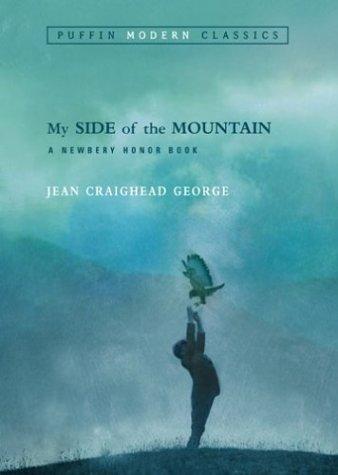
My Side of the Mountain
Puffin Books · 1959 · 177 pages
ISBN: 9780142401118
Review Editor
Hannah Bright
Jean Craighead George published My Side of the Mountain in 1959, and it arrived at a particular moment. The postwar suburban expansion was pushing American families further from the natural world, and anxieties about what that meant for children were beginning to surface in the culture. George’s response was direct. She wrote a book about a thirteen-year-old boy who walks away from a crowded New York City apartment, travels to a patch of wilderness in the Catskill Mountains of upstate New York, and spends a full year living alone off the land. The book won a Newbery Honor in 1960 and has never gone out of print. Sixty-five years later, it still reads like something urgent.
Sam Gribley is the hero, and his plan has more substance than most boyhood escape fantasies. His family owns land in the Catskills that belonged to his great-grandfather, and that fact gives him a destination. He arrives with a penknife, a ball of cord, an ax, some flint and steel, a few dollars, and a library card’s worth of reading on wilderness survival. What he builds from those materials over the following year is remarkable: a home carved inside a hollow hemlock tree, a system of food preservation using clay pots and pine smoke, a trained peregrine falcon named Frightful who hunts alongside him, and a working knowledge of a specific patch of Catskill ecosystem that reads more like ecology than adventure fiction.
The novel unfolds as journal entries addressed directly to the reader. George keeps the tone personal and unguarded, as though Sam is talking to a friend who might actually want to follow him into the woods. That casualness is one of the book’s most useful achievements. The technical detail is substantial (George was a trained naturalist, and every plant, animal, and food source she names is accurate), but it arrives with the enthusiasm of a kid who has figured something out, not the solemnity of an instruction manual. You can read this as a survival guide, as a character study, or as a love letter to a specific landscape, and it holds up on all three readings.
Character Arcs and Development
Sam is an unusual protagonist for children’s literature because his central problem is not conflict with a villain or a family drama but rather the gap between his vision of himself and the reality of living alone. He imagines, before he leaves New York, that he wants solitude. What he discovers is that he wants competence, and those are not the same thing. The arc is subtle: Sam does not become less capable over the course of the year, but he becomes less certain that capability alone is enough.
George brings a small cast of characters into Sam’s orbit, and each one complicates his self-sufficient project in useful ways. Bando, a college professor who stumbles onto the hemlock home during a summer hike, becomes a quiet friend who visits several times across the year. He is pleased by Sam’s experiment rather than alarmed by it, which is one of the novel’s convenient fictions, but George uses him well. Bando brings news of the outside world, leaves books behind, and implicitly asks the question Sam is not yet ready to answer: what does all this prove, and for whom? Matt, a journalist on the trail of the “wild boy” rumored to be living in the Catskills, adds a note of tension in the later pages and forces Sam to think seriously about the life he is building.
Frightful deserves its own attention. Sam traps her as a young bird and spends months training her using traditional falconry techniques, and George’s treatment of this relationship is one of the book’s genuine accomplishments. Frightful is not anthropomorphized. She does not develop human feelings for Sam. But the specificity with which George describes the training, the hunting partnership, and the daily rhythms of a life shared with a wild raptor creates a bond that feels entirely real. George trained birds herself, and it shows on every page. The falcon is not a symbol or a prop; she is a specific animal with specific behaviors, and watching Sam learn to work with her rather than against her carries a satisfaction that stays with you long after you finish the book.
Pacing
My Side of the Mountain covers a full year, structured by season. Spring arrival, summer learning, autumn harvest, winter survival, and the slow return of warmth: the natural shape of the year gives the book its arc without relying on the usual machinery of escalating crisis. For readers who came looking for action-driven adventure fiction, the pacing may feel loose. The novel is observational rather than tense, and the middle section covering Sam’s long productive autumn is the book’s densest stretch. The pages on food preservation, shelter improvement, and falcon training are genuinely interesting, but they slow the momentum that the opening chapters established.
This is not quite a weakness; it reflects George’s priorities. She cares more about showing what the life actually feels like than manufacturing incidents to keep pages turning. But it is worth knowing before you pick it up. Young readers who need constant plot movement may find their attention drifting in the middle third. The reward for staying with it is a final section, as winter tightens and spring approaches, that feels completely earned.
Deeper Thematic Exploration
The surface story is about survival skills, but the deeper argument is about what independence actually costs. Sam believes, when he leaves New York, that living alone in the wilderness is a purer form of freedom than the crowded apartment life his family knows. The Catskills give him something real: competence, quiet, a specific satisfaction that comes from mastering a difficult skill. But George is careful not to let that vision stand unchallenged. Sam craves conversation. He values Bando’s visits more than he admits. He keeps a journal partly for company. The novel is quietly honest that human beings are social animals, and that choosing solitude is choosing to go without something necessary, not just something comfortable.
There is also an environmental thread running through the book that was genuinely ahead of its moment. Sam is a careful steward of his patch of mountain: he takes only what he needs, returns waste to the soil, and studies the forest’s patterns rather than imposing his will on them. He is not a romantic who believes nature is purely benign (he watches an owl take prey; he nearly freezes; he knows the Catskills are not Eden), but he operates from a premise that the natural world has its own logic worth respecting. For a book published in 1959, that is a more sophisticated ecological position than most nature writing was offering at the time, and it reads less like a period artifact and more like a value the book is actively arguing for.
The novel’s sharpest idea is one it leaves mostly implicit: Sam’s romantic vision of self-sufficiency is real, but it is also structurally dependent on things he did not build from nothing. He carries library knowledge. He has legal claim to the land because of his family’s history. He lives in a society that produced falconry traditions he can borrow and refine. The independence Sam achieves is genuine, but it is not pure, and the book builds that complexity into the details of his daily life rather than stating it. That layering is unusual in children’s literature and gives the novel a weight that pure adventure stories rarely carry.
Style and Voice
George’s prose is clear, exact, and unshowy. She has the naturalist’s habit of specificity: she names the species, describes the technique, notes the season and the hour. But the voice is Sam’s, and Sam is eager and direct rather than pedantic. The journal format keeps the register informal and the pages moving. You never feel lectured to, even when the book is teaching you something about hemlock bark tannins or the patience required to train a bird of prey.
The most impressive quality of the writing, given that this is nominally a children’s book, is the emotional restraint. George does not explain what Sam feels. She shows him doing things: building, hunting, lying awake in his tree home listening to snow fall, watching Frightful make her first clean kill. The emotional content accumulates through action rather than declaration. That is a harder skill than it looks, and George executes it consistently through the novel’s best pages. Some children’s books talk down to their audience; this one trusts them to feel what is on the page without being told what to feel.
Verdict
My Side of the Mountain earns its place among the essential American children’s novels. It is the kind of book that gives you something different at every age: as a child you want to be Sam, hollowing out your hemlock and flying your falcon; as an adult you notice how carefully George built the ideas about independence and community into the daily texture of the story. That doubling is rare, and it is what keeps the book alive across generations of readers rather than dating it as a product of its moment.
The ideal reader is a child between roughly eight and twelve who cares about animals, the outdoors, or the idea of doing things for themselves, but adults who missed it growing up will find it holds up with surprising strength. Its weaknesses are small: the pacing softens in the autumn section, and the adults Sam encounters are a shade too understanding to be entirely plausible. Neither flaw diminishes what the book accomplishes. If you have been meaning to read it, or read it as a child and want to return, it will not disappoint you.
Frequently Asked Questions about My Side of the Mountain
What is My Side of the Mountain by Jean Craighead George about?
My Side of the Mountain is a 1959 adventure novel about Sam Gribley, a thirteen-year-old boy who runs away from his large family’s New York City apartment to live alone in the Catskill Mountains of upstate New York. Over the course of one year, Sam carves a home inside a hollow hemlock tree, learns to find food from the forest, and trains a peregrine falcon named Frightful as a hunting partner. The novel is structured as Sam’s journal, addressed directly to the reader, and it follows him through all four seasons as he builds a functioning wilderness life from scratch.
Is My Side of the Mountain based on a true story?
The novel is fiction, not a memoir, but Jean Craighead George drew heavily on her own deep knowledge of the natural world and outdoor skills. George was a trained naturalist who spent significant time in wild places, and she trained raptors herself. The survival techniques Sam uses, the plants he eats, the falconry methods he employs, and the ecological observations he makes are all accurate and based on real knowledge. The emotional truth of the book, that longing for self-sufficiency balanced against the need for human connection, also reflects themes George explored throughout her career as a writer.
What are the main themes in My Side of the Mountain?
The most important themes are self-reliance and its limits, the relationship between human beings and the natural world, and the tension between independence and community. Sam spends the year learning that genuine competence is achievable but that choosing to be alone is always a choice to give something up, not just to gain freedom. The book also explores environmental stewardship, presenting a model of living lightly on the land that was ahead of its cultural moment in 1959. Coming-of-age is a quieter but persistent theme: Sam leaves a boy and the year transforms him in ways he did not plan for.
How long is My Side of the Mountain and is it a difficult read?
The novel is 177 pages in the standard Puffin Modern Classics edition. It reads quickly because the journal format keeps the prose informal and the chapters short. The vocabulary and sentence structure are accessible to readers around age eight and up, though the subject matter, a year of genuine solitude punctuated by careful observation of the natural world, appeals most strongly to children who already have some patience for detail. The technical passages about food preservation and falconry add density without adding difficulty. Most middle-grade readers can finish it in two or three sittings.
Is there a movie or TV adaptation of My Side of the Mountain?
Yes. A film adaptation was released in 1969, directed by James B. Clark and starring Ted Eccles as Sam Gribley. The film follows the general arc of the novel, with Sam leaving his family in New York to live in the Catskill Mountains and befriending a peregrine falcon. The adaptation is relatively faithful to the spirit of the book, though it makes some changes to the secondary characters. There is no major streaming adaptation as of this writing; the 1969 film remains the primary screen version of the story.
What age group is My Side of the Mountain recommended for?
The novel is typically recommended for readers aged eight to twelve, which places it in the middle-grade category. Children who love animals, survival stories, or outdoor adventure tend to connect with it most strongly. The reading level is approximately fifth grade, but the ideas in the book carry weight beyond that age; many adult readers who return to it after childhood find it more interesting, not less. Teachers and librarians frequently recommend it for classroom use in grades four through seven, where its themes of independence and environmental awareness pair well with nature writing and social studies units.
How does My Side of the Mountain compare to Jean Craighead George’s other books?
George wrote more than a hundred books over her career, and My Side of the Mountain is the most celebrated. It was followed by two sequels: On the Far Side of the Mountain (1990), which continues Sam’s story and focuses on his sister Alice, and Frightful’s Mountain (1999), which retells events from the original novel from the falcon’s perspective. Readers who love the wilderness setting and the naturalist precision of My Side of the Mountain will find both sequels rewarding. George’s Julie of the Wolves (1972), which won the Newbery Medal, covers similar thematic territory, this time following a young Alaska Native girl living alone on the tundra, and is worth reading alongside or after My Side of the Mountain.
Should I read My Side of the Mountain and is it worth it in 2025?
Yes, without reservation. The book is sixty-five years old and shows almost none of its age. The survival skills Sam learns are still accurate, the ecological thinking still feels current, and the emotional core of the story, a child discovering the gap between the freedom they imagined and the freedom they actually want, speaks to something that does not expire. If you read it as a child and want to revisit it as an adult, you will find it has more in it than you remembered. If you are coming to it for the first time, give yourself a quiet afternoon and start from the beginning.
Book Details
- Title
- My Side of the Mountain
- Author
- Jean Craighead George
- Genre
- Children's
- Publisher
- Puffin Books
- Year Published
- 1959
- Pages
- 177
- ISBN
- 9780142401118
- WritersReview Rating
- 4.6 / 5