
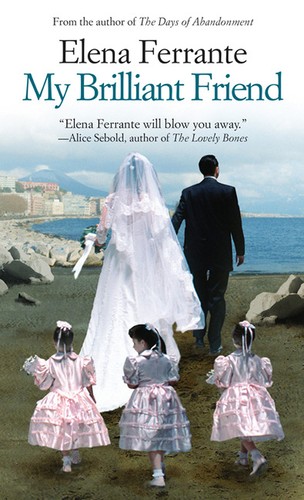
My Brilliant Friend
Europa Editions · 2012 · 336 pages
ISBN: 9781609450786
Review Editor
admin
Elena Ferrante published My Brilliant Friend in Italian in 2011, the first volume of what would become known as the Neapolitan Quartet. The English translation by Ann Goldstein appeared in 2012 and set off a reading phenomenon that is still ongoing. Ferrante – a pseudonym; the author’s true identity remains undisclosed – had been publishing novels for two decades, but the Quartet reached a scale of readership that none of her previous work had approached. My Brilliant Friend is the story of how a friendship forms, what it costs to sustain it, and what it means for two girls to want something from a world that does not expect them to want anything at all.
The Neighborhood
Elena Greco – called Lenu – grows up in a poor neighborhood in Naples in the 1950s. The neighborhood is its own world, with its own hierarchies, its own violence, its own social rules that govern who can want what and who can become what. Lenu narrates from old age, looking back at a friendship that began in childhood and shaped everything that came after.
Ferrante renders the neighborhood with the specificity of someone who has either lived in it or imagined it so completely that the distinction does not matter. The buildings, the streets, the courtyards, the smells, the sounds – the physical world is so present that it functions almost as a character, shaping the lives of everyone who grows up in it and constraining the possibilities of escape.
Lila
Lenu’s brilliant friend is Lila Cerullo, the daughter of a shoemaker, a girl of ferocious intelligence who teaches herself to read before school, who competes with Lenu in everything and exceeds her at most of it, and who will not be allowed – by economics, by family, by the neighborhood’s expectations of girls – to continue her education past elementary school. Lila’s trajectory diverges from Lenu’s not because she is less capable but because she has less freedom, and the divergence drives the novel and its sequels.
Lila is one of the great characters in contemporary fiction. She is difficult, brilliant, funny, frightening, and impossible to reduce to a type. Ferrante gives her an interiority that is both more intense and more opaque than Lenu’s – we see Lila through Lenu’s eyes, which means we see her with the distortion of love and competition and jealousy that characterizes the friendship throughout.
The Friendship
The novel is fundamentally about what it feels like to be close to someone more brilliant than you, and to build your life partly in response to that person’s existence. Lenu wants to be like Lila, to keep up with Lila, to be worthy of Lila’s attention. She also wants to surpass Lila, to prove to herself and the neighborhood that she is the one who succeeded. These two impulses are not contradictory; they drive each other.
Ferrante refuses to make the friendship simply warm or simply toxic. It is both, and often simultaneously. The intensity between the two girls is the novel’s primary source of energy, and Ferrante channels it with a precision that makes the book feel more like reading someone’s honest private diary than reading a novel.
Class and Escape
The question of escape runs through the novel like a current. Lenu escapes – she continues her education, she reads, she eventually writes. Lila does not, or cannot, or refuses to in ways that are not entirely clear. The neighborhood exerts a gravity that not everyone escapes, and the cost of escape – what you become when you leave, what you lose, who you are to the people who stayed – is one of the Quartet’s central preoccupations.
Ferrante’s Style
The prose, in Goldstein’s translation, is direct and fast-moving in a way that conceals its complexity. Ferrante thinks on the sentence level – each sentence advances something – while building paragraphs and chapters that accumulate emotional weight without announcing it. The narration is retrospective but rendered with the urgency of the present, so that adult Lenu’s knowledge of how things turned out sits just behind the child Lenu’s experience of living through them.
A Quartet That Rewards Commitment
My Brilliant Friend is the opening of a work that runs to four volumes and covers roughly sixty years of its characters’ lives. Readers who commit to all four books will find a project that is among the most ambitious and fully realized in contemporary fiction.
Frequently Asked Questions
- Who is Elena Ferrante?
- Elena Ferrante is a pseudonym. The author’s true identity has been the subject of considerable journalistic investigation but has not been confirmed. Ferrante has given interviews in writing and protects her anonymity as a matter of principle, arguing that the author’s biography should not mediate the reader’s relationship to the work.
- Do I need to read all four volumes?
- The four novels form a single work, and the full arc of Lenu and Lila’s friendship only emerges across all four. Most readers who begin the Quartet find it difficult to stop after the first volume.
- Is the novel autobiographical?
- Ferrante has distinguished between the emotional truth of the work – which she describes as deeply personal – and autobiographical fact. The experience of female friendship and class aspiration draws on genuine experience, while specific characters and events are invented.
- Why is Lila so compelling?
- Lila is compelling partly because we see her through Lenu’s eyes – through the distorting lens of love and competition – which makes her simultaneously more vivid and more mysterious than a character we observed directly. Ferrante also gives Lila qualities – ferocity, indifference to social approval, a willingness to speak uncomfortable truths – that are rare in literary female characters.
- How does the novel handle Naples?
- Naples is not a backdrop; it is an active presence. The poverty of the neighborhood, its violence, its particular social hierarchies – all rendered with the specificity of deep knowledge. Ferrante’s Naples is the city as experienced by people who have no exit from it.
- What is the novel’s relationship to feminism?
- The novel is profoundly engaged with questions of female ambition and the structures that constrain women’s lives without being a polemic. Ferrante shows how the neighborhood, family, and Italian society of the 1950s distribute possibility differently to boys and girls, and what the consequences of that distribution are.
- How does the translation affect the reading experience?
- Ann Goldstein’s translation is widely praised for its fidelity and readability. Ferrante’s Italian prose has a directness that Goldstein renders without loss.
- What other books should I read alongside the Quartet?
- For the Italian novel tradition, readers might consider Natalia Ginzburg and Elsa Morante. For the literature of female friendship and ambition, Doris Lessing’s The Golden Notebook offers useful comparison.
Book Details
- Title
- My Brilliant Friend
- Author
- Elena Ferrante
- Genre
- Literary Fiction
- Publisher
- Europa Editions
- Year Published
- 2012
- Pages
- 336
- ISBN
- 9781609450786
- WritersReview Rating
- 5.0 / 5