
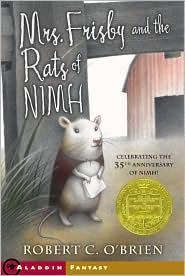
Mrs. Frisby and the Rats of NIMH
Atheneum Books · 1971 · 240 pages
ISBN: 9780689710681
Review Editor
Hannah Bright
Robert C. O’Brien published Mrs. Frisby and the Rats of NIMH in 1971 to relatively little fanfare, and then it won the Newbery Medal the following year and became one of the most widely loved children’s books ever written. O’Brien, whose real name was Robert Leslie Conly, died in 1973 and never saw how far the book would travel. It has stayed in print continuously for more than fifty years, spawned an animated film adaptation, and introduced generations of young readers to the idea that animals in stories can grapple with genuinely big questions without sacrificing the adventure that keeps pages turning.
The story centers on Mrs. Frisby, a widowed field mouse living with her four children near a vegetable garden on a farm owned by the Fitzgibbon family. When spring arrives, the family faces a crisis: the farmer will soon plow the fields, destroying their winter home, but Mrs. Frisby’s youngest son Timothy is bedridden with pneumonia and cannot survive the move. In her desperation, she seeks help from an owl who directs her to the rats living beneath the rosebush near the farmhouse, and the novel opens into something far stranger and larger than a simple rescue story. The rats, it turns out, are not ordinary rats. They were captured years earlier by scientists at a place called NIMH, the National Institute of Mental Health, and subjected to experiments that dramatically accelerated their intelligence. They can read. They can reason. They have built an underground civilization of remarkable sophistication beneath that rosebush, and they are in the middle of their own moral crisis when Mrs. Frisby arrives.
O’Brien wrote the book as a blend of domestic adventure and speculative fiction, a combination that makes it unusual among children’s novels of its era. The kitchen-table stakes of a mother protecting her children sit alongside questions about consciousness, obligation, and what it means to build something worth keeping.
Character Arcs and Development
Mrs. Frisby is one of the more quietly compelling protagonists in children’s literature because she is not particularly remarkable. She is small, careful, and used to surviving by staying unnoticed. She is not clever in any showy way, not gifted by accident or birthright, and she has no special powers beyond the kind of practical resourcefulness that comes from raising four children alone in a world full of things that want to eat you. What changes over the course of the novel is her understanding of who she is in relation to the larger story around her, specifically the connection between her late husband, Dr. Frisby, and the extraordinary rats she has come to for help. When she learns that her husband was part of the NIMH experiments and played a crucial role in the rats’ escape, she stops being a supplicant and becomes, in her own way, a participant in a history she didn’t know she belonged to. That shift, handled without melodrama, is what gives the novel its emotional weight.
The rats themselves are drawn with real care. Nicodemus, the rat leader, is thoughtful and a little melancholy, carrying the burden of knowing that his community’s gift came at a cost they didn’t choose and can’t undo. His journal entries, which take up a substantial section of the middle of the book, read as a kind of firsthand witness account of the NIMH years, and they work because O’Brien gives Nicodemus a voice that is precise without being cold. Justin, by contrast, is younger and warmer, quick to trust Mrs. Frisby and quick to act, and he functions as the novel’s moral pulse in moments where caution might otherwise stall the plot. The clearest antagonist among the rats is Jenner, who broke from the group before the story begins, choosing a life of comfortable theft over the harder project of self-sufficiency. O’Brien keeps Jenner largely off the page, but his shadow falls over every argument about what the rats owe themselves and each other.
Pacing
The novel moves in two distinct rhythms. The outer story, Mrs. Frisby’s race against the plow and against Timothy’s illness, runs as a continuous low-grade urgency that keeps the reader grounded in immediate stakes. The inner story, Nicodemus’s account of the laboratory and the escape from NIMH, deliberately slows that momentum in exchange for depth. Some younger readers find the shift disorienting, and it is worth acknowledging that the middle section of the book asks for a kind of patience that pure adventure stories do not. O’Brien earns that patience by making the NIMH chapters genuinely suspenseful in their own right, even though the outcome is already known: the rats did escape, because they are here. The question that sustains the flashback is not what happened but how it felt and what it cost.
The final act pulls both threads back together with real efficiency. Once Mrs. Frisby knows the truth about her husband and the rats commit to helping her, the story moves quickly and the payoff feels proportional to the setup. There are no wasted scenes in the last third of the book, and O’Brien resists the urge to resolve every thread neatly, leaving the fate of some characters genuinely uncertain. That willingness to let ambiguity stand is part of what makes the ending land as it does.
Deeper Thematic Exploration
The central tension in Mrs. Frisby and the Rats of NIMH is not between Mrs. Frisby and any external threat. It is the argument the rats are having among themselves about what their intelligence obligates them to do. They have been living by stealing from the farmer: electricity tapped from his supply lines, food taken from his stores, tools borrowed and returned. Nicodemus and his faction believe this is untenable. True intelligence, he argues, means building something of your own. The rats’ Plan, their long-term project to establish a self-sufficient colony in a remote valley, is the novel’s moral horizon, the thing the story is working toward even when it is not happening on the page. Jenner’s counter-position is that comfort is its own justification, that intelligence is wasted if it only creates harder problems to solve. It is not a caricature argument, and O’Brien does not present it as one. The novel respects Jenner’s logic enough to let it be genuinely tempting.
Underneath this ethical debate runs a quieter question about the relationship between intelligence and identity. The rats know that what they are was given to them, that they did not evolve into sapience but were made into it by scientists with their own agendas. This leaves them in an uncomfortable position: they are too aware for the world they came from and not human enough for the world they want to enter. The book was published in 1971, when animal experimentation was coming under serious public scrutiny for the first time, and O’Brien does not take sides explicitly, but he does not need to. The NIMH chapters are written with enough specificity about the mechanics of the experiments, the injections, the maze tests, the careful progress of the rats’ growing awareness, to make the reader feel the weight of what was done to them without anything in the text demanding outrage.
Mrs. Frisby herself carries a separate thematic burden. She is ordinary in a story full of extraordinary beings, and her presence asks what courage means when it comes without enhancement. She takes risks the rats would not, not because she is more capable but because her love for her children overrides her fear in a way that no amount of intelligence can replicate or replace. The novel treats this as its own form of power, and it does so without sentimentality. The book’s deepest argument is that the qualities of a good life, courage, loyalty, the willingness to build rather than take, belong to the ordinary as much as to the exceptional.
Style and Voice
O’Brien wrote in a third-person omniscient voice that suits the book’s fable-like quality without ever becoming formal or remote. The prose is clear and precise, the kind of writing that seems simple on the surface because it has been carefully built, not because it is actually simple. He is particularly good at scale: the world he creates feels genuinely mouse-sized, with doors that are mouse-sized problems, distances that are mouse-sized distances, and dangers that are as real as cats, owls, and farmers with plows tend to be. The effect is immersive in a way that more self-conscious world-building often is not.
The shift in voice during the Nicodemus chapters is handled well. The journal reads as a slightly more formal, retrospective account, which is exactly what it should be, and the change in register signals to the reader that they are in different narrative territory without any explicit announcement. O’Brien trusted his readers, young and adult alike, to follow that shift without a guide, and that trust is part of what makes the book feel serious in the best sense: it asks something of you.
Verdict
Mrs. Frisby and the Rats of NIMH belongs on the short list of children’s novels that adults should read or return to without apology. It is not a nostalgia piece. It holds up because O’Brien was writing about something real, the ethics of intelligence, the cost of comfortable dependency, the particular courage of ordinary love, and he never talked down to his audience about any of it. The book has genuine weaknesses: the Jenner subplot resolves more abruptly than it deserves, and several of the supporting characters (Mrs. Frisby’s children other than Timothy chief among them) remain underdeveloped. These are real limitations, but they are not reasons to skip the book.
If you read it as a child and remember it fondly, you will find it has held up better than most of what you remember fondly. If you haven’t read it, this is the right time. Readers who love character-driven speculative fiction, who appreciate novels that trust their audience to sit with moral complexity, and who want a story that earns its emotional ending will find exactly what they are looking for.
Frequently Asked Questions about Mrs. Frisby and the Rats of NIMH
What is Mrs. Frisby and the Rats of NIMH about?
Mrs. Frisby and the Rats of NIMH follows a widowed field mouse named Mrs. Frisby who must find a way to save her sick son when the family’s winter home is threatened by spring plowing. Her quest leads her to a hidden colony of superintelligent rats who escaped from a government research lab called NIMH (National Institute of Mental Health), where experiments gave them the ability to read and reason far beyond ordinary animals. The novel weaves together a rescue story and a philosophical debate about what intelligence and freedom actually require of those who possess them.
What does NIMH stand for in Mrs. Frisby and the Rats of NIMH?
NIMH stands for the National Institute of Mental Health, a real U.S. government research agency. In the novel, scientists at NIMH conduct experiments on rats and mice using injections that dramatically accelerate the animals’ ability to learn and reason. O’Brien used this real institution as a springboard for his fictional premise, lending the story a layer of plausibility that contributed to its impact. The actual NIMH does conduct animal research, though the specific experiments described in the book are science fiction.
What are the main themes in Mrs. Frisby and the Rats of NIMH?
The book works through four overlapping themes: the ethics of intelligence and what it obligates those who possess it to do; the tension between comfortable dependency and the harder work of self-sufficiency; what genuine courage looks like for those who are not exceptional; and the moral questions surrounding scientific experimentation on animals. O’Brien builds all four into the story’s central conflict, the ongoing debate among the rats about whether to keep stealing from the farmer or to build a life of their own, rather than stating them as lessons.
How long is Mrs. Frisby and the Rats of NIMH and what reading level is it?
The book runs to 240 pages in its standard edition and is typically placed at grades 4 through 7, though confident readers in grade 3 will have no difficulty with the language. Adults reading it for the first time will likely finish in two or three sittings. The vocabulary is accessible, but the ideas are sophisticated enough to reward discussion, which is why the novel has remained a staple of elementary and middle school curricula for decades. It reads far faster than its length suggests because the pacing rarely lets up once established.
Is there a movie or TV adaptation of Mrs. Frisby and the Rats of NIMH?
Yes. Don Bluth directed an animated film adaptation titled The Secret of NIMH, released in 1982. The film keeps the core premise but makes significant changes, adding more overt magic and action while reducing the philosophical content. The main character is renamed Mrs. Brisby. The film developed its own following and is worth watching on its own terms, though readers who love the book tend to find it a lesser experience for its greater reliance on spectacle. A direct-to-video sequel, The Secret of NIMH 2: Timmy to the Rescue, was released in 1998 without Bluth’s involvement and is generally considered inessential.
Did Mrs. Frisby and the Rats of NIMH win any awards?
The book won the 1972 Newbery Medal, the most prestigious award in American children’s literature, given annually by the American Library Association to the most distinguished contribution to children’s literature published the previous year. It also received an ALA Notable Book designation and has appeared on recommended reading lists continuously since publication. Robert C. O’Brien, whose real name was Robert Leslie Conly, died in 1973 at age 54 and did not live to see the full extent of the book’s lasting influence on children’s fiction.
How does Mrs. Frisby and the Rats of NIMH compare to Charlotte’s Web and Watership Down?
All three are animal stories that treat their subjects with genuine seriousness rather than as talking-animal entertainment, and readers who love one tend to love the others. Compared to Charlotte’s Web, Mrs. Frisby is less pastoral and more driven by ideas about community and self-determination. Compared to Watership Down, it is considerably shorter and more accessible to younger readers while covering similar territory around freedom, society, and what a good life requires. Of the three, Mrs. Frisby is the one most willing to put a moral argument at the center of its plot and let the story be the argument.
Should I read Mrs. Frisby and the Rats of NIMH as an adult?
Yes, without reservation. The book holds up because O’Brien solved real narrative and moral problems rather than writing down to his audience. Adult readers will notice the ethical architecture of the novel more clearly than they likely did as children, and the NIMH chapters carry a different weight when read with adult knowledge of how research institutions and animal experimentation actually work. If you read it as a child and haven’t returned to it, this is a good moment to do that. If you haven’t read it at all, start sooner rather than later.
Book Details
- Title
- Mrs. Frisby and the Rats of NIMH
- Author
- Robert C. O'Brien
- Genre
- Children's
- Publisher
- Atheneum Books
- Year Published
- 1971
- Pages
- 240
- ISBN
- 9780689710681
- WritersReview Rating
- 4.7 / 5