
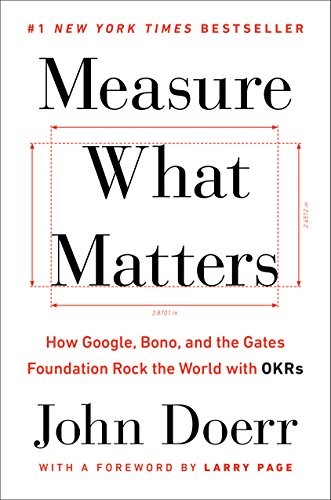
Measure What Matters
Portfolio · 2018 · 320 pages
ISBN: 9780525536222
Review Editor
Daniel Okafor
In the spring of 1999, John Doerr walked into a conference room at Google’s Mountain View office carrying a PowerPoint deck of thirteen slides. The company had just closed $11.8 million in funding, had fewer than forty employees, and had been operating for less than a year. Larry Page and Sergey Brin were brilliant engineers still learning what it meant to run a company. Doerr, a partner at Kleiner Perkins who had backed Amazon and Netscape, had something to show them: a goal-setting system he had learned more than two decades earlier from Andy Grove at Intel. He called it OKRs, short for Objectives and Key Results.
The idea is simpler than the name suggests. An Objective is what you want to achieve, stated in clear, ambitious language. Key Results are how you will know you got there, expressed as specific, time-bound numbers. You set them quarterly. You score them honestly at the end of each cycle. You move on and set new ones. Doerr had watched this system reshape Intel in the 1970s under Grove’s relentless management, and he believed it could do the same for the next wave of technology companies. Google adopted OKRs in that first meeting and has never stopped using them.
“Measure What Matters,” published in 2018 by Portfolio/Penguin, is Doerr’s attempt to share what he has observed across decades of investing: why some organizations make focused, cumulative progress while others work hard and arrive nowhere in particular. The book draws on his own experience, on interviews with executives at Google, the Bill and Melinda Gates Foundation, Bono’s ONE Campaign, YouTube, Adobe, and a dozen other organizations, and on the foundational ideas of Grove, who died in 2016 before the book was completed. It is practical, readable, and genuinely useful, though it asks readers to do some work to separate the operational insight from the promotional tone that creeps in around the edges.
Character Arcs and Development
The central figure of the book is not Doerr but Andy Grove, the Intel CEO who developed OKRs and who comes alive in the opening pages as a demanding, precise, and intellectually unsparing manager. Grove believed that management could be approached with the same rigor as engineering. He had no patience for ambiguity in objectives and no tolerance for the kind of performance review that rewarded busyness over results. Doerr writes about Grove with evident admiration, and this early portrait is the book’s most vivid: you get a sense of a specific person with a specific worldview, someone who would find most modern goal-setting exercises both vague and dishonest.
Page and Brin appear more briefly, mostly to confirm that OKRs worked without fully revealing their own skepticism about them. The book quotes Page saying Google “never drank the Kool-Aid” on OKRs but came to rely on them anyway, which is an interesting admission that gets less examination than it deserves. Bill Gates is given a longer chapter to reflect on how the Gates Foundation uses OKRs to focus on specific health outcomes in developing countries, and his contribution is substantive: he describes the discipline of choosing a measurable target in global health, where an organization can feel constantly busy while making no actual progress on the things that reduce suffering. Bono’s chapter on the ONE Campaign advocacy organization is shorter but interesting for showing how a framework built for product companies can translate to political and humanitarian work.
Doerr himself is an honest presence throughout. He writes about his failures alongside his successes: companies he backed that did not work out, moments when OKRs were in place and the leadership was still wrong, cases where measuring the wrong things drove organizations sideways. This self-awareness keeps the book from tipping into something unreadable. A management framework presented as a cure-all earns no credibility. Doerr’s consistent argument that OKRs are necessary but not sufficient for organizational health is one of the things that gives the book its staying power.
The secondary characters who appear in the case study chapters are thinner. They tend to arrive with a problem, encounter OKRs, and succeed. This pattern repeats often enough to feel like testimony rather than analysis. A deeper look at one or two OKR implementations that failed, or that succeeded by the metrics while creating other problems, would have made the book significantly more valuable.
Pacing
The book divides into two halves, and they move at different speeds. The first half covers OKRs directly, organized around what Doerr calls their four superpowers: focus, alignment, tracking accountability, and stretching for ambitious targets. This section is tight. The chapters are short. The examples are concrete. You can read the first hundred pages in a couple of hours and arrive with a clear picture of what OKRs are, where they came from, and why an organization would benefit from using them.
The second half introduces CFRs (Conversations, Feedback, Recognition), a companion management practice that Doerr argues should accompany OKRs as a replacement for traditional annual performance reviews. Adobe’s overhaul of its review process gets extended treatment, as does the broader case for continuous coaching over yearly judgment. This material is genuinely useful, but it reads like a second book that needed more development. The connection between OKRs and CFRs is logical, but the CFR section never achieves the same clarity as the OKR framework, and by the midpoint of the case studies a pattern has established itself: organization struggles with focus, organization adopts OKRs, organization succeeds. Readers who want the book to linger on cases where OKRs were implemented well and still failed to fix the underlying problem will not find that here.
Deeper Thematic Exploration
The real argument underneath “Measure What Matters” is not about a specific management tool. It is about the cost of misaligned effort. Doerr’s foundational observation, drawing on Grove, is that most people in most organizations work hard while pointing in slightly different directions. Priorities conflict silently. Strategy lives in presentations that most employees have never seen. The result is not laziness but waste: energy spent on tasks that do not add up to anything coherent at the organizational level. A hundred people working full days, slightly out of sync, can accomplish less than twenty people who share a clear, specific, public understanding of what success looks like this quarter.
OKRs are Doerr’s proposed solution, but the problem he is diagnosing is deeper and older than any management framework. What the book does well is show how explicit, measurable, public goals create the conditions for alignment at scale. The emphasis on making OKRs visible across an organization, so that an individual contributor can see how their work connects to a company-level objective, addresses a real failure mode that most large organizations share: the gap between what leaders say they care about and what employees understand they are being asked to do.
The stretch goal concept is one of the book’s more interesting ideas. Doerr distinguishes between “committed” OKRs, where full completion is expected, and “aspirational” OKRs (sometimes called moonshots), where achieving 60 to 70 percent is considered a genuine success. The logic behind moonshots is that ambitious targets motivate people differently than achievable ones. When employees know they will not be penalized for falling short of a stretch goal, they attempt things they otherwise would not. This creates a different relationship between people and their work, one that is more experimental and less fearful. The book makes this case clearly and gives it room to breathe, which is one of the reasons readers who encounter OKRs in practice often point to this section as the most useful.
There is a tension in the framework that Doerr never fully resolves, and it is worth naming directly. OKRs work best when you already know what to measure. A Key Result is almost always a number: active users, revenue, error rates reduced by some percentage, new partnerships signed. But some of the most consequential organizational work resists clean quantification. How do you write a Key Result for improving team trust? For building institutional knowledge that will matter in three years? For reducing the kind of slow-burning technical debt that will not show up in any quarterly metric? The book acknowledges this problem but suggests that better metrics are always available if you look carefully enough. That is sometimes true and sometimes optimistic. Organizations working in fields where outcomes are long-delayed or inherently qualitative will need to adapt the framework carefully rather than adopt it wholesale.
The Gates Foundation chapter offers the book’s most honest engagement with this limitation. Gates describes how OKRs helped focus philanthropic resources on health interventions with measurable, near-term outcomes. This is a genuine achievement. But the same chapter reveals how the discipline of OKRs can push organizations toward goals that are easy to measure at the expense of goals that matter more but measure poorly. Doerr does not fully grapple with this tradeoff, and that is a missed opportunity.
Style and Voice
Doerr writes in a clear, unpretentious voice. He is not reaching for literary effect, and the book benefits from this restraint: it reads the way a thoughtful investor talks, directly, with examples close at hand and a preference for making the point and moving on. The prose has almost no wasted sentences, which is a real virtue in a genre where padding is common and jargon serves as a substitute for thinking. Individual chapters are short enough to finish in a single sitting, which makes the book easy to read in pieces over several days without losing the thread.
The opening anecdote about walking into Google’s conference room in 1999 is the book’s best piece of writing: specific, cinematic, and genuinely interesting as a piece of business history. The portrait of Grove in the early chapters reaches a similar quality. These sections show what the book could have been throughout if it had invested more in the specific texture of particular people and moments, rather than alternating between framework explanation and case study testimonials. The structure works in the first half and becomes mechanical in the second. Readers who prefer to scan business books before committing to close reading will find the bolded key terms, numbered lists, and short chapters very helpful.
Verdict
If you work in or lead any organization that struggles with focus, or where strategy feels like it belongs to the executive team rather than to the people doing the work, or where smart people consistently spend their energy on the wrong things, this book will give you a practical framework and a vocabulary for addressing that. John Doerr is an honest and experienced guide, and the OKR system he describes has been tested across thousands of organizations over fifty years. The case for OKRs does not rest on theory; it rests on practice, and Doerr presents that practice with clarity and appropriate humility.
Read the first half carefully, engage with the case studies that feel relevant to your context, and treat the CFR section as a separate conversation to return to when you are thinking about performance management. Some readers will finish this book and implement OKRs the following Monday. Others will take the core ideas and adapt them heavily for their particular situation. Both approaches are valid. The book does not ask for total adoption, and it should not. What it asks for is that you take the problem of organizational alignment seriously enough to measure it. That is a reasonable ask, and for most organizations it is long overdue.
Frequently Asked Questions about Measure What Matters
What is Measure What Matters by John Doerr about?
Measure What Matters explains OKRs (Objectives and Key Results), a goal-setting framework used by Google, Intel, the Gates Foundation, and many other organizations. Doerr, a venture capitalist at Kleiner Perkins, traces the history of OKRs from Andy Grove’s work at Intel in the 1970s through their adoption across some of the world’s most successful companies. The book combines framework explanation with extended case studies from leaders who have used OKRs in practice at scale.
What are OKRs and how do they work?
OKRs stands for Objectives and Key Results. An Objective is a clear, inspiring statement of what you want to achieve. Key Results are specific, measurable milestones that tell you whether you achieved it. Doerr recommends setting OKRs quarterly at the company, team, and individual level, making them public across the organization, and scoring them honestly at the end of each cycle. The goal is to create shared clarity about priorities and to separate the effort of setting goals from the judgment of whether people are worth keeping on the team.
Who invented OKRs and what companies use them?
OKRs are credited to Andy Grove, the CEO of Intel, who developed the framework in the 1970s drawing on earlier management-by-objectives thinking from Peter Drucker. John Doerr learned the system while working at Intel and introduced it to Google in 1999. Today, OKRs are used by organizations including Google, LinkedIn, Spotify, Twitter, Adobe, Salesforce, and many others across technology, nonprofit, and government sectors around the world.
What are the main themes in Measure What Matters?
The book’s central themes are organizational focus, alignment across teams, accountability for outcomes rather than activity, and the value of ambitious goals. Doerr argues that most organizational failure comes from misalignment: people working hard without a shared understanding of what matters most. A secondary theme is the problem with traditional annual performance reviews, which Doerr argues reward the wrong things and should be replaced with ongoing feedback conversations. The book also examines when OKRs are most useful and where they require adaptation.
How long is Measure What Matters and is it a difficult read?
The book is 320 pages and is not a difficult read. Doerr writes in a clear, direct style with short chapters and concrete examples throughout. Most readers can finish it in four to six hours. The first half is particularly tight and focused. The second half, which covers continuous performance conversations alongside the OKR framework, is somewhat less even but still accessible. You do not need a business or management background to follow the arguments or to apply them.
Is there a film or documentary about Measure What Matters?
Doerr worked with a documentary team to create a companion film with the same title, featuring several of the executives and leaders who appear in the book. The documentary covers OKRs at Google, the Gates Foundation, and Bono’s ONE Campaign and serves as a shorter introduction to the framework for those who prefer watching to reading. There is no fictional film or television adaptation of the book.
How does Measure What Matters compare to other business books on leadership and strategy?
Compared to broad leadership books like “Good to Great” by Jim Collins, Measure What Matters is more narrowly focused on a specific operational tool rather than on identifying what distinguishes exceptional companies overall. It shares territory with “The Lean Startup” by Eric Ries in its emphasis on measurable outcomes and iterative progress, but Doerr’s focus is on how leadership teams set and communicate priorities rather than on product development. Readers who want to understand the philosophy behind OKRs in more depth might also read Grove’s “High Output Management,” which remains the foundational text on the management thinking that produced OKRs.
Should I read Measure What Matters and is it worth my time?
If you manage a team or lead any part of an organization, yes. The OKR framework Doerr describes is practical, proven, and genuinely useful even when you adapt it significantly to your context. The book is worth reading in full at least once, with particular attention to the first half. Some of the case study chapters in the second half are more relevant to specific industries than others. If you work entirely independently with no organizational responsibilities, the book is less directly applicable, but it remains a clear and readable account of how some of the world’s most successful organizations set goals and hold themselves accountable for reaching them.
Book Details
- Title
- Measure What Matters
- Author
- John Doerr
- Genre
- Business
- Publisher
- Portfolio
- Year Published
- 2018
- Pages
- 320
- ISBN
- 9780525536222
- WritersReview Rating
- 4.0 / 5