
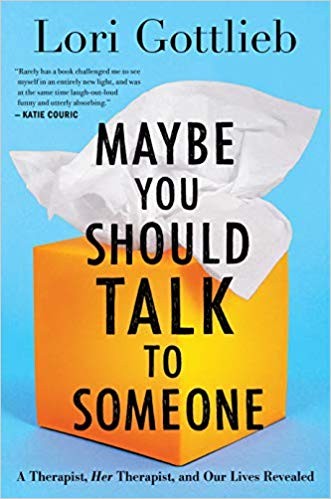
Maybe You Should Talk to Someone
HMH Books · 432 pages
ISBN: 9781328662057
Review Editor
admin
Summary
Lori Gottlieb is a therapist who one day finds herself devastated by a sudden breakup and, on the advice of a colleague, sits down on the other side of the couch. Maybe You Should Talk to Someone tracks what happens next: her sessions with a therapist named Wendell unfold alongside the stories of four patients she is treating simultaneously. The patient roster includes a pompous Hollywood producer convinced the world is against him, a young newlywed facing a terminal cancer diagnosis, a thirty-something woman addicted to toxic relationships, and an elderly woman weighing whether her life has meant anything. Gottlieb moves between her own vulnerability and her clinical role with candor and precision, producing a memoir that functions equally well as a primer on what therapy actually does and as a story about being human in a world that does not always cooperate.
Core Argument
Gottlieb’s central argument is that the examined life is not a luxury but a necessity, and that most of us avoid self-examination because the truth we might find there frightens us. She rejects the popular idea that therapy is for people in crisis, arguing instead that it is the place where ordinary people confront the stories they have been telling themselves and decide whether those stories still serve them. She also pushes back against the cultural narrative that discomfort is a problem to be solved: in her framing, discomfort is the signal that growth is available.
Key Frameworks
Three intellectual scaffolds hold the book together. The first is the idea of the presenting problem versus the underlying problem. Almost every patient in the book arrives with a surface complaint that, over time, reveals itself to be a proxy for something deeper and more difficult. The second framework is attachment theory, deployed not as jargon but as lived experience. The third framework is existential psychology, particularly the work of Irvin Yalom, whose four ultimate concerns provide a loose organizing principle for the book’s emotional arc.
Practical Application
Readers who have never been in therapy will finish this book with a realistic picture of what happens in those fifty minutes: the false starts, the silences, the sessions that seem to go nowhere and then, weeks later, reveal their importance. Readers already in therapy will find language for experiences they have had trouble articulating. The book models the skill of self-inquiry in ways that transfer outside the consulting room.
Style and Voice
Gottlieb writes with warmth and wit, and she refuses the self-seriousness that can make therapy memoirs feel like testimonials. She is funny about her own defenses, clear-eyed about her blind spots, and willing to let her patients be complicated rather than instructive. The narrative structure, alternating between her sessions and theirs, creates a natural rhythm that sustains momentum across nearly four hundred pages.
Verdict
Maybe You Should Talk to Someone is the rare book that expands a reader’s understanding of what it means to be a person. Gottlieb earned the 2019 Meridian Award not by writing the most technically sophisticated psychology book of the year but by writing the most honest one. The book holds a 5.0 rating because it accomplishes what it sets out to do with complete conviction and leaves the reader not feeling managed, but feeling seen.
FAQ
Is this book only for people currently in therapy?
No. The book works for anyone curious about psychology, human behavior, or the mechanics of change.
How much does Gottlieb reveal about her own therapy sessions?
A great deal. Her sessions with Wendell are central to the book rather than a sidebar, disclosed with the same candor she brings to her patients’ stories.
Is the patient material fictionalized?
Yes. Patient details have been altered to protect confidentiality, and in some cases composite characters were created. The emotional and psychological truth of the cases is preserved.
How does this book compare to other therapy memoirs?
Most therapy memoirs are written by patients. This one is written by a therapist who becomes a patient, which gives it a structural and emotional complexity that sets it apart.
About the Author
Lori Gottlieb is a psychotherapist and contributing editor at The Atlantic, where her advice column “Dear Therapist” has built a substantial following. Maybe You Should Talk to Someone became a New York Times bestseller and is currently in development as a television series.
Book Details
- Title
- Maybe You Should Talk to Someone
- Author
- Lori Gottlieb
- Genre
- Self-Help
- Publisher
- HMH Books
- Pages
- 432
- ISBN
- 9781328662057
- WritersReview Rating
- 5.0 / 5