
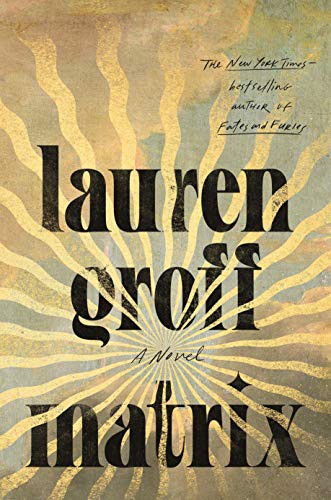
Matrix
🏆 Joyce Carol Oates Prize (2022, winner)
National Book Award for Fiction (2021, finalist)
Andrew Carnegie Medal for Excellence in Fiction (2022, shortlisted)
Lammy Award for Lesbian Fiction (finalist)
IMPAC Dublin Literary Award (longlisted)
Obama's Favorite Books of 2021
Review Editor
Eleanor Marsh
Lauren Groff’s Matrix, published by Riverhead Books in September 2021, reimagines the life of Marie de France, the twelfth-century poet whose identity remains one of medieval literature’s most tantalizing mysteries. In Groff’s telling, Marie is a seventeen-year-old half-royal, tall and ungainly and fierce, who has spent her youth at the court of Eleanor of Aquitaine. When Eleanor tires of her, she ships Marie off to England to run a small, failing abbey in the countryside. The nuns there are starving. The buildings are crumbling. The fields yield almost nothing. Marie, who has never wanted a religious life, who burns with love for the queen who discarded her, must now figure out how to keep these women alive.
What follows spans decades. Marie does not merely survive the abbey; she transforms it. Through sheer force of will, cunning land deals, agricultural innovation, and a gift for reading people, she turns a community on the edge of collapse into something prosperous and powerful. She builds a labyrinth around the abbey grounds, a physical boundary that keeps the male-dominated world at bay. The novel traces this arc from destitution to abundance, from exile to empire, while Marie’s inner life grows more complex with each passing year.
The title carries a double meaning. “Matrix” is Latin for womb, and Groff uses it to point toward the enclosed, fertile, exclusively female world Marie creates. But it also suggests a web, a system, a structure of power that Marie constructs as deliberately as any king building a castle.
Character Arcs and Development
Marie is one of the most commanding protagonists in recent literary fiction. She arrives at the abbey as a creature of appetite and fury, someone whose body and desires mark her as an outsider in every space she enters. She loves Eleanor with a consuming, unrequited passion that never fully releases its grip on her. She is not naturally pious; her relationship with God is more like a negotiation between rivals than a surrender of the self. Over the decades, she channels all of that appetite into building. She becomes a visionary leader, a shrewd political operator, and, in her own complicated way, a spiritual figure to the nuns who depend on her.
The secondary characters are drawn with economy but real precision. Subprioress Tilde, who resents Marie’s arrival and schemes against her, eventually becomes an uneasy ally. Sister Wevua, the one nun who can match Marie’s intellect, serves as both conscience and confidante. Young Nest, the child oblate, grows up entirely within the abbey’s walls and represents a generation that knows no other world. Goda, fierce and loyal, becomes Marie’s enforcer. None of these women are simple. They gossip, compete, love each other, and occasionally betray each other. Groff gives them enough specificity that the community feels lived in rather than symbolic.
What makes Marie’s arc so compelling is that Groff refuses to simplify her. She is simultaneously a liberator and an autocrat. She frees these women from want, but she also controls them. Her visions, which arrive as ecstatic episodes throughout the book, blur the line between genuine mysticism and self-serving delusion. By the novel’s final pages, you are left wondering whether Marie built a paradise or a prison, and the answer is probably both.
Pacing
Matrix covers roughly fifty years in under three hundred pages, and the compression is both its great strength and its occasional weakness. Groff moves through time in leaps, sometimes skipping years in a paragraph. The effect can feel exhilarating, like watching a time-lapse of a garden growing from bare soil to wild abundance. But there are stretches in the middle section where the accumulation of achievements (another land purchase, another building project, another clever scheme) starts to blur together. You want the camera to slow down and linger on a single afternoon, a single conversation, and Groff does not always let you have that.
The final third accelerates in a different way, turning darker as Marie ages and the outside world presses in. The Crusades ripple through even this cloistered space, and political shifts in the English church threaten everything Marie has built. Here the pacing works beautifully, carrying a sense of time running out that matches the physical decline Groff tracks with unsentimental clarity. The closing pages, which bring Marie face to face with her own mortality and the question of what her legacy will mean without her to protect it, land with real emotional force.
Deeper Thematic Exploration
At its core, Matrix is a novel about what women build when men are not watching. The abbey becomes a functioning society, complete with its own economy, its own art, its own political structures, and its own internal tensions. Groff is not interested in presenting this as simple utopia. The community thrives, but it also develops hierarchies, resentments, and blind spots. Marie’s leadership is effective precisely because it borrows from the same toolkit as the patriarchal world she has walled off: strategic marriage of resources, control of information, cultivation of loyalty through both generosity and fear.
The novel also grapples with the relationship between desire and creation. Marie’s love for Eleanor never fades, but it changes shape over the years, eventually becoming the fuel for everything she builds. The abbey is, in some sense, an elaborate monument to an unrequited passion. Groff suggests that the energy of thwarted desire can be redirected but never fully extinguished, and that the things we build to compensate for what we cannot have can take on a life of their own.
There is also a persistent tension between the spiritual and the material. Marie’s visions give her authority among the nuns, but Groff leaves their origin ambiguous. Are they divine communications or symptoms of a mind under extraordinary pressure? The novel seems to suggest that the distinction may not matter as much as we think. What matters is what Marie does with the certainty they provide, and whether the community she builds justifies the methods she uses to build it.
Running beneath all of this is a quiet meditation on time and legacy. Marie builds something remarkable, but the novel never lets you forget that medieval institutions, however powerful, exist at the mercy of forces beyond any single leader’s control. The church can revoke what it granted. A new king can rewrite the rules. And death comes for even the most formidable abbess. Groff handles this tension between permanence and fragility with real subtlety, refusing to offer the easy comfort of a legacy that outlasts its creator without complication.
Style and Voice
Groff makes a bold formal choice: Matrix contains almost no direct dialogue. Characters speak, but their words arrive filtered through narration, reported rather than quoted. The effect is strange at first, almost disorienting, but it quickly becomes a source of the novel’s power. You experience the abbey the way Marie does, from a position of authority and slight distance, always watching, always calculating. The absence of dialogue also gives the prose a rhythmic, almost incantatory quality that suits the medieval setting without resorting to pastiche.
The sentences are dense and muscular, packed with physical detail. Groff writes about bodies, weather, food, and labor with the same intensity she brings to Marie’s inner life. There is a passage describing the nuns harvesting in autumn that makes you feel the cold in your fingers. Another sequence, tracking Marie’s aging body through a series of winters, achieves a quiet devastation without a single sentimental word. The prose never feels ornate for its own sake; it is always in service of the story’s relentless forward momentum.
The novel’s structure, divided into three parts without conventional chapters, reinforces its themes. Time does not pause for neat chapter breaks any more than it pauses for Marie. The narrative voice sits close to Marie’s consciousness but occasionally pulls back to survey the community as a whole, and these shifts give the book an almost choral quality. You feel the weight of collective experience, not just one woman’s story but the story of a whole community shaped by her will.
Verdict
Matrix is a novel for readers who want to be challenged and transported in equal measure. If you love historical fiction that refuses to treat the past as costume drama, if you are drawn to complicated female protagonists who are allowed to be ambitious and flawed and powerful, this book will reward you. It is also a genuine pleasure for anyone who cares about prose style; Groff’s sentences repay close attention in ways that few contemporary novels manage.
The novel’s compressed timeline and lack of dialogue will not suit every reader. If you prefer deep immersion in moment-to-moment scene work, or if you rely on dialogue to feel connected to characters, the formal choices here may feel like barriers rather than invitations. And the middle section, with its accumulative rhythm, asks for patience. But the payoff is a portrait of female ambition and community that feels genuinely original, a book that trusts you to sit with its contradictions rather than resolving them into easy lessons. Matrix deserves a place on any serious reader’s shelf, and it belongs in the conversation about the best American fiction of the 2020s.
Frequently Asked Questions about Matrix by Lauren Groff
What is Matrix by Lauren Groff about?
Matrix tells the story of Marie de France, a seventeen-year-old half-royal woman who is exiled from the court of Eleanor of Aquitaine and sent to lead a failing English abbey in the twelfth century. Over several decades, Marie transforms the impoverished convent into a thriving, self-sufficient community of women, building walls, expanding land holdings, and creating an enclosed world apart from the male-dominated society around them.
Is Matrix by Lauren Groff based on a true story?
The novel is inspired by the real Marie de France, a twelfth-century poet who wrote lais (short narrative poems) and fables. However, very little is known about the historical Marie’s actual life. Groff takes the few biographical details that scholars have debated and builds an entirely fictional narrative around them, imagining Marie as a nun and abbey leader rather than strictly following any historical record.
What are the main themes in Matrix by Lauren Groff?
The novel explores female power and autonomy within patriarchal structures, the tension between spiritual devotion and worldly ambition, queer desire and unrequited love, and the dynamics of community building. It also examines how isolation can be both liberating and confining, and whether the structures women create to protect themselves inevitably mirror the hierarchies they sought to escape.
How long is Matrix and is it a difficult read?
Matrix is approximately 260 pages in the hardcover edition. The prose is dense and literary, and Groff uses an unconventional style with no direct dialogue and large time jumps between sections. Most readers can finish it in a few days, but it requires attentive reading. It is best suited for readers comfortable with literary fiction that prioritizes voice and theme over conventional plot structure.
Is there a movie or TV adaptation of Matrix by Lauren Groff?
As of 2026, there is no confirmed movie or television adaptation of Matrix. The novel’s unconventional narrative style, with its lack of dialogue and compressed timeline spanning decades, would present interesting challenges for screen adaptation. However, no public announcements have been made regarding film or television rights.
What age group or reading level is Matrix by Lauren Groff appropriate for?
Matrix is written for adult readers. It contains frank depictions of sexuality, physical suffering, childbirth, and death. The prose style and thematic complexity make it best suited for readers aged eighteen and older who enjoy literary fiction. Advanced high school readers studying medieval history or women’s literature could engage with it, but it is not a young adult novel.
How does Matrix compare to Lauren Groff’s other novels like Fates and Furies?
Matrix shares Groff’s signature interest in power dynamics and the inner lives of ambitious people, but it departs significantly in setting and form. Fates and Furies (2015) is a contemporary novel told in two halves from a husband’s and wife’s perspectives. Matrix abandons the modern world entirely, embraces a collective rather than a couple, and drops direct dialogue. Readers who loved Groff’s prose in Fates and Furies will find it even more concentrated here, though the medieval setting and formal choices make Matrix a more demanding and experimental reading experience.
Should I read Matrix by Lauren Groff and is it worth it?
If you are drawn to literary fiction that takes risks with form, if you enjoy historical settings that feel alive rather than museum-like, and if you want to spend time with a protagonist who is brilliant and deeply flawed, Matrix is absolutely worth your time. Readers who prefer fast-paced plots, extensive dialogue, or straightforward storytelling may find it less satisfying. But for those willing to meet the book on its own terms, it offers one of the most original and rewarding reading experiences in recent American fiction.
Book Details
- Title
- Matrix
- Awards
- 🏆 Joyce Carol Oates Prize (2022, winner) National Book Award for Fiction (2021, finalist) Andrew Carnegie Medal for Excellence in Fiction (2022, shortlisted) Lammy Award for Lesbian Fiction (finalist) IMPAC Dublin Literary Award (longlisted) Obama's Favorite Books of 2021
- WritersReview Rating
- 4.9 / 5