
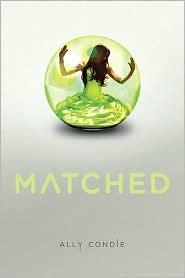
Cassia Reyes lives in a Society that has solved the problem of choosing: officials called Matched select your career, your diet, your activities, and ultimately your spouse — the person with whom you are statistically most compatible. On the night of the Matching banquet, Cassia is Matched to her best friend Xander, a reassuring outcome that becomes complicated when she inserts the microcard containing his information and a different face appears first. Ky Markham — a boy she knows, an Aberration, someone who should be incapable of being Matched — looks at her from the screen before the card corrects itself. Ally Condie’s 2010 novel is a competent and often touching example of dystopian YA romance, stronger in its emotional precision than in its worldbuilding and plot construction.
Character Arcs
Cassia is a protagonist defined by her dawning awareness that the Society’s gift of certainty is also the removal of her agency. Her arc is internally consistent: she moves from compliance to question to resistance, and each step is grounded in specific experience rather than arbitrary rebellion. Her feelings for both Xander and Ky are rendered with enough specificity that the triangle doesn’t feel entirely mechanical. Ky is constructed with deliberate mystery — his Aberration status and his hidden history with the Society make him the novel’s central unknown — and Condie sustains that mystery effectively without making him opaque to the reader. Xander is the novel’s most underused character; his genuine good qualities make the triangle more complicated than most YA examples.
Pacing
Matched moves slowly, which suits its material but will frustrate readers who came for plot. The novel is primarily about Cassia’s interior experience — her growing awareness, her feelings, her relationship to the poetry the Society has preserved and the poetry it has banned. The romance develops at a credible pace. The dystopian plot machinery (what the Society is hiding, what Ky’s background means, what the Aberration designation entails) is established in this volume without being resolved, which is the appropriate approach for a series opener but leaves the novel’s conflict somewhat diffuse. The ending is satisfying as emotional closure while leaving the larger story unresolved.
Thematic Depth
The novel’s most interesting thematic material involves poetry — specifically the Society’s decision to preserve exactly one hundred poems, one hundred songs, one hundred paintings, and so forth. Dylan Thomas’s “Do not go gentle into that good night,” which a grandfather passes to Cassia illegally, becomes the novel’s recurring symbol: the insistence on raging against what extinguishes. The connection between artistic expression and individual freedom, between choice and selfhood, is the novel’s genuine argument, and Condie makes it with more care than the romance-heavy surface suggests. The dystopian setting is less developed as a critique than as a context for the personal story.
Style and Voice
Condie writes in first-person present tense with a lyrical quality that distinguishes Matched from more action-oriented YA dystopia. The prose is sometimes too careful, reaching for beauty in a way that can feel strained, but at its best it captures the texture of a life lived under observation — the constant awareness of being watched and evaluated, the way compliance becomes involuntary before it becomes chosen. The poetry embedded in the narrative (Thomas, Tennyson, and original verse attributed to Ky) is handled with a care that reflects genuine interest in what poems do rather than what they symbolize.
Verdict
Matched is a thoughtful, emotionally earnest YA dystopia that prioritizes interiority and romance over action and worldbuilding. Readers who want the former will find it more satisfying than the genre’s more plot-driven examples; readers who want the latter will find it slow. Cassia is a convincing protagonist, Ky is an effective romantic lead, and the novel’s engagement with poetry as resistance gives it a thematic dimension that most series-launching dystopias don’t reach for. It’s a gentler book than the genre sometimes promises, and that gentleness is both its limitation and its strength.
Rating: 3.7 out of 5
Book Details
- Title
- Matched
- Author
- Ally Condie
- Genre
- Young Adult
- Publisher
- Dutton Books
- Year Published
- 2010
- Pages
- 366
- ISBN
- 9780525423645
- WritersReview Rating
- 3.7 / 5