
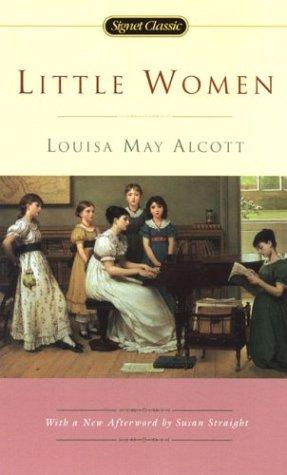
Little Women
Roberts Brothers · 1868 · 456 pages
ISBN: 9780451529305
Review Editor
Hannah Bright
Louisa May Alcott wrote Little Women quickly, reluctantly, and under pressure from her publisher. She didn’t think much of the idea at first: a novel for girls, following the domestic lives of sisters in New England. She submitted the first part in 1868, the book sold immediately and enthusiastically, and she produced the second part the following year to meet demand. The result is one of the most beloved novels in American literature, read by millions of children and just as many adults who return to it long after their own girlhood is behind them.
The story follows the four March sisters across roughly two years during and after the Civil War. Their father is away serving as a chaplain with the Union Army, leaving Marmee, their mother, to manage the household and the girls’ moral education on a very modest income. Meg is the eldest: sensible, pretty, and drawn to the comforts and conventions she can’t quite afford. Jo is the second daughter and the novel’s restless, argumentative heart: she wants to be a writer, hates the limitations placed on women, and cuts her hair off and sells it when the family needs money for train fare to see their ailing father. Beth is gentle, deeply musical, and almost entirely selfless in a way that makes her both the family’s emotional center and its most vulnerable member. Amy, the youngest, is artistic and socially ambitious, prone to vanity in ways Jo finds infuriating but that the reader gradually comes to understand as reasonable responses to her circumstances. Rounding out the household is Marmee herself, who manages to be patient and wise without ever feeling like a cardboard saint, and Laurie, the wealthy boy next door who becomes Jo’s closest friend and something like the fifth March sibling.
The book opened to readers who were hungry for exactly this kind of story: warm, domestic, morally serious without being preachy, full of humor and real sadness. Thomas Niles, the publisher at Roberts Brothers, had doubted the project’s commercial prospects. He was wrong. Little Women has never been out of print.
Character Arcs and Development
Jo March is the reason most people pick up this book, and she’s worth every page. She is a person at war with herself: she wants freedom and artistic achievement, but she also wants the warmth and belonging of family. She refuses Laurie’s marriage proposal in a scene that is still startling, still true, and still controversial. She is not always likeable; she can be selfish and impulsive. When Amy destroys the manuscript of Jo’s stories in a fit of revenge for being excluded from a trip, Jo refuses to forgive her for days, and her vindictiveness leads directly to a catastrophe on the ice. The reader understands both girls completely, which is Alcott’s real achievement: the sisters are not types but people.
Beth’s arc is the book’s most affecting. She contracts scarlet fever after visiting a sick family in the slums, and her first illness takes up a terrifying stretch of the novel’s middle section. Even after she recovers, she never quite returns to her full strength. Beth is the kind of character who could easily become maudlin, but Alcott writes her with precision: her love for the old piano the Laurences give her, her close relationship with Jo, the quiet way she fades. Amy’s development is more divisive. In Part 1 she is a comic figure, a vain child with pretensions. In Part 2 she becomes something more complex: a young woman who has thought seriously about what she can accomplish and accepted, with more clarity than Jo, what the world is willing to offer her. Whether this acceptance reads as wisdom or defeat depends on which sister you identify with.
Marmee is worth talking about separately from the girls. She has a famous scene where she tells Jo that she has been angry every day of her life but has learned to control it. That moment does more for her characterization than any amount of description could. She is not a finished person; she is someone who has been working on herself for decades. That makes her feel real in a way that literary mothers often don’t.
Pacing
The first half of the novel moves with genuine charm. The episodes feel organic: the Christmas morning when the girls give away their breakfast to a poor family, the Pickwick Society meetings where they read from the club’s home-produced newspaper, Jo’s theatrical productions in the attic, the skating scenes where she and Laurie become friends. These scenes don’t push hard toward plot; they accumulate into a full and convincing picture of a household.
Part 2, which Alcott wrote under more pressure and with less affection for the material, covers more ground more quickly. The romantic resolutions in particular feel rushed, and some readers have always felt that Alcott’s handling of Jo’s eventual romance represents the book’s weakest choice, a capitulation to reader expectations over the logic of the character. That’s a legitimate criticism. The book is not perfectly shaped. But even the second half contains the Beth material, which is devastating, and the European chapters following Amy that transform her from a minor character into a fully realized person. The unevenness is real, but the best parts remain among the best things in nineteenth-century American fiction.
Deeper Thematic Exploration
Alcott had complicated feelings about her own book, and those complications run through every chapter. She drew heavily on her own life: like Jo, she was the family’s main breadwinner, she wrote sensation fiction under a pseudonym to pay the bills, and she never wanted to marry. The tension in the novel between what women are expected to want and what they actually want is not resolved by the ending; it’s just absorbed into the narrative. Jo finds a version of the life she wanted. But readers who pay attention notice that she gets it through domesticity after all, through a relationship that gives her the school and the large household she was always drawn to. Alcott knew exactly what she was doing.
The book is also fundamentally about the work of being good. Marmee’s moral framework is Transcendentalist, Bronson-Alcott-adjacent: character is built through deliberate effort, virtue is a practice not a gift, and self-examination is the highest obligation. The girls are constantly measuring themselves against their own ideals and usually falling short. Amy’s vanity, Jo’s temper, Meg’s weakness for luxury, Beth’s excessive self-abnegation: all four sisters are working on themselves throughout. This gives the book a different texture from the moralizing children’s literature of its era. The tone is warm but not complacent. Alcott respects her characters enough to show them failing.
Class runs quietly through everything. The Marches are genteel poor: educated, cultured, connected to the wealthy Laurences next door, but genuinely worried about money in ways they try not to show. Alcott captures what it feels like to be poor among people who are not, to want things you can’t afford, to manage the gap between aspiration and reality with as much grace as you can manage. The Hummel family, the extremely poor German immigrants the Marches help throughout the book, provide a counterpoint that keeps the girls’ struggles in proportion without minimizing them.
Style and Voice
Alcott’s prose is friendly and direct. She writes with the confidence of someone who is good at conversation, and the novel has the quality of a very long, very enjoyable one. The narrator addresses the reader directly at times, a convention of the period that Alcott handles with more warmth than most of her contemporaries. She is never stiff. Her descriptions of the March home have a specificity that accumulates into genuine atmosphere: the cold New England winters, the shabby parlor, the heat of the kitchen, the garret where Jo writes.
What she doesn’t do is sentimentalize. The Beth scenes could easily collapse into the worst kind of Victorian weeping, but Alcott keeps them grounded in physical detail and in the responses of the other characters. Jo’s grief is rendered through action and through the specific texture of their relationship. The novel allows sadness without wallowing in it, which is a harder thing to achieve than it sounds.
Verdict
This is not a simple book disguised as one. The pleasures are real and immediate: the warm household, the specific sisters, the humor of the Pickwick Society and the disasters of the failed pickle-making and the burnt cooking. But underneath those pleasures is a novel that takes seriously what it costs a woman to want things, to have talent, to live in a world that has already decided what she should want instead. That tension never fully resolves, and that’s what keeps the book alive after a century and a half.
If you haven’t read it since childhood, it will feel different now: smaller in some ways, larger in others. If you’ve never read it at all, go in without assumptions about what kind of book it is. It will surprise you. Readers who love domestic fiction, character-driven stories, and books that take their female characters seriously will find this essential. Those expecting something lighter might find the Beth sections more emotionally demanding than they expected. That’s not a flaw. That’s the book doing exactly what it means to do.
Frequently Asked Questions about Little Women
What is Little Women by Louisa May Alcott about?
Little Women follows four sisters, Meg, Jo, Beth, and Amy March, through their adolescence and early adulthood in Civil War-era Massachusetts while their father serves as a Union Army chaplain. The book traces their friendships, romantic lives, ambitions, and losses over roughly two years, with particular focus on Jo, an aspiring writer determined to make her own way in the world.
Is Little Women based on a true story?
Largely, yes. Alcott based the March family closely on her own family: she was the model for Jo, her sisters inspired Meg, Beth, and Amy, and her father Bronson Alcott influenced Marmee’s philosophical outlook. The family’s genteel poverty and the strong moral framework of the household were drawn from Alcott’s own Concord, Massachusetts childhood. She changed names and some circumstances but kept the emotional core very close to her experience.
What are the main themes in Little Women?
The book works through several overlapping ideas: female ambition and the constraints placed on it, the tension between domesticity and individual achievement, the work required to build good character, class anxiety and the gap between aspiration and resources, and the specific losses that come with growing up. Alcott was also thinking seriously about what it means to want things you’re told you shouldn’t want, and the novel never completely resolves that question.
How long is Little Women and is it a difficult read?
Most modern editions of the complete novel run between 400 and 550 pages, depending on the edition, since they combine the original 1868 “Little Women” with the 1869 “Good Wives.” The prose is accessible and conversational, written for a general audience rather than a literary one. Most adult readers find it moves quickly, especially the first half. Some readers find the second half slower and more uneven, but even those sections contain some of the book’s finest writing.
Is there a movie or TV adaptation of Little Women?
Several. The best-known are the 1994 film directed by Gillian Armstrong, starring Winona Ryder as Jo and Susan Sarandon as Marmee, which remains a strong adaptation, and Greta Gerwig’s 2019 version with Saoirse Ronan, Florence Pugh, Emma Watson, and Eliza Scanlen, which reorganizes the narrative chronology to put Jo’s ambition more explicitly at the center. There have also been earlier film versions from 1933 and 1949, as well as stage productions and television adaptations. The 2019 Gerwig version is the place to start if you want to pair the film with the book.
What age group or reading level is Little Women for?
The book is typically introduced to readers between 10 and 14, and it works well at that age. It was written for girls in that range, and the four sisters are at various points in early adolescence and young adulthood throughout the story. Adult readers find it holds up very well and often read it differently the second time, with more patience for Amy and more complicated feelings about Jo’s arc. There is nothing in the content that is inappropriate for younger readers.
How does Little Women compare to Louisa May Alcott’s other books?
Little Women is by far Alcott’s best-known work, and it set her up for a career of sequels and follow-up novels. Little Men (1871) and Jo’s Boys (1886) continue the story of the March family into the next generation, though neither has the narrative energy or character depth of the original. Alcott also wrote sensation fiction under the pen name A.M. Barnard, stories that are much darker and more melodramatic than the domestic novels, and readers curious about the full range of what she could do should look up those stories.
Should I read Little Women and is it worth it?
Yes, and you should go in expecting a more complex book than its reputation sometimes suggests. If you love character-driven fiction that takes its people seriously, follows them through real difficulty, and doesn’t flatten their contradictions into easy lessons, this will reward you. It’s also very funny in places, which surprises some readers. The readers most likely to bounce off it are those expecting a purely cheerful, unchallenging domestic story; the book is warm, but it doesn’t flinch from the hard parts.
Book Details
- Title
- Little Women
- Author
- Louisa May Alcott
- Genre
- Children's
- Publisher
- Roberts Brothers
- Year Published
- 1868
- Pages
- 456
- ISBN
- 9780451529305
- WritersReview Rating
- 4.3 / 5