
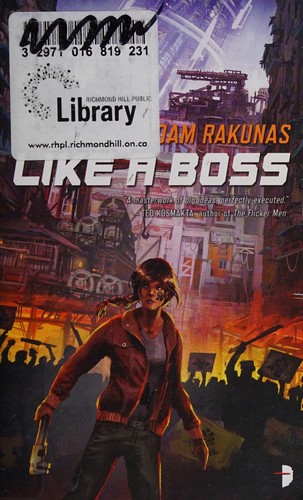
Like a Boss
Angry Robot · 2016 · 382 pages
ISBN: 9780857664815
Review Editor
Marcus Webb
Like a Boss is the second novel in Adam Rakunas’s Windswept series, published by Angry Robot in June 2016. Set on Santee Anchorage, a sugarcane colony planet at the edge of human-occupied space, it follows Padma Mehta, a former labor organizer who has finally bought the rum distillery she spent the first book dreaming about. She was supposed to be retired. She is not.
The world of the Windswept series feels fully inhabited from the first page. Santee Anchorage runs on cane, which feeds a biofuel industry that keeps Occupied Space moving, and the rum it produces has become the planet’s cultural lifeblood. The colony operates under the shadow of the Big Three, three mega-corporations whose indenture contracts cover most of humanity from birth. The Union is the counterweight, the institution that can pull people out of corporate service and give them something like a free life. When Like a Boss opens, Padma is scrubbing sewage systems to pay off the property damage she caused at the end of the first book. The work is unglamorous. She accepts it without complaint, which tells you quite a lot about the character.
Then Evanrute Saarien, her former nemesis and the man who tried to kill her, walks out of prison and promptly founds a religion. His congregation’s first act is planning a planet-wide strike. The Union president, Letty, summons Padma to stop it. Padma goes, reluctantly, and finds that the situation is considerably more complicated than she was told. The novel picks up from there and barely pauses.
Character Arcs and Development
Padma Mehta is one of the more compelling protagonists in recent science fiction because she is not exceptional in the ways the genre usually demands. She is not brilliantly gifted, not secretly chosen, not the repository of any special power. What she has is anger and ethics and a hard-won knowledge of how labor organizing actually works. She punches people when she runs out of better options. She drinks Old Windswept rum at six o’clock as a kind of secular ritual, a small insistence on pleasure in a life that keeps handing her crises. She argues with herself about every decision and frequently loses those arguments.
In Like a Boss, the character development that began in Windswept continues in ways that feel earned rather than imposed. Padma has grown more self-aware since the first novel. She is less prone to blundering forward and more capable of sitting with discomfort before acting. The reflexes are still there, but there is a layer of reflection underneath them now. Rakunas also portrays Padma’s mental health with more honesty than most SF attempts: her anxiety is not a plot device or a dramatic flourish but a condition she manages day by day, with coping strategies she has developed over years. He does not fix her, and he does not punish her for it. She carries it and keeps working.
The supporting cast presents a more uneven picture. Letty, the Union president, functions as a foil but never quite becomes three-dimensional. Saarien is more interesting in this book than the last, his villainy given deeper motivation than simple malice, though his willingness to let Padma confront him physically while flanked by bodyguards strains credibility. The deeper pleasure is in the background: the cane workers, the kampong dwellers, the distillery staff whose lives form the texture of Santee Anchorage. These characters are not plot devices. They are the point. The way they organize, argue, and occasionally surprise each other is what the book is actually about.
Pacing
Like a Boss moves quickly. Rakunas has a real talent for comic momentum, carrying readers through scenes on the energy of a well-timed line or a sharp reversal. The first two-thirds of the novel are genuinely propulsive: each chapter ends in a way that makes the next one feel necessary, and the political intrigue accumulates with enough patience to reward attention. The humor is consistent without undercutting the stakes, which is harder to manage than it sounds.
The pacing dips in the final third. Several threads that had been building toward resolution turn out to have simpler explanations than expected. Padma’s arc in these chapters tips into something closer to self-sacrifice set pieces than the organic character behavior that defined earlier sections. The novel’s careful attention to unglamorous, institutional-level politics briefly gives way to something more conventional. These are genuine weaknesses, worth noting. They do not undo what works in the preceding 250 pages, but readers expecting the tight plotting of Windswept will notice the change in gears.
Deeper Thematic Exploration
The Windswept series is a sustained argument about labor. Specifically, it asks what labor organizing looks like when the stakes are interplanetary and the corporate antagonists are structurally omnipresent rather than individually malevolent. This is not a story about a bad CEO. It is a story about systems, and about what happens to people who try to operate inside them without being consumed by them.
Like a Boss extends this argument by turning the camera onto the Union itself. By the second novel, the Union has developed its own institutional pathologies: it protects its own status rather than its members, and the president prioritizes stability over justice. When Padma is pulled back into service, she is navigating not just corporate manipulation but the corruption that has grown closer to home. Rakunas does not present the Union as simply good and the corporations as simply bad. He presents both as institutions, which means both are capable of betraying the people they claim to serve. This is a more sophisticated position than most genre fiction takes.
Running beneath this is a thread about the politics of anger: who gets to be angry, whose anger is taken seriously, and what happens when someone channels collective grievance for personal ends. Saarien’s fake religion is not merely a villain’s scheme. It works because real discontent is there to be exploited. The novel’s sharpest observation is that demagogues do not create anger. They inherit it. The workers following Saarien have genuine reasons for their frustration. That the reasons are being manipulated does not make them less real.
The book also engages seriously with class division, specifically the gap between those inside the corporate enclave and those outside it, and between the kampong cane workers who harvest the crop and the town dwellers who process it. These divisions shape behavior throughout the novel. Rakunas trusts readers to track them without annotation, which is part of what makes the worldbuilding feel adult rather than instructional. You are not being told what to think about any of this. You are watching it play out.
Style and Voice
Rakunas writes in a tight first-person voice that fits Padma’s character precisely. The prose is brisk and economical, with moments of genuine wit buried inside the forward motion. Padma’s narration carries a specific kind of wry exhaustion: the voice of someone who has seen enough organizational dysfunction to be past surprise but not past caring. The comic timing is one of the series’ real pleasures. Rakunas can defuse a tense scene with a single well-placed observation and rebuild the tension within the same paragraph, a trick that requires confidence in both your character and your readers.
The world-building continues to feel organic rather than assembled, the result of a writer who knows exactly what his world runs on and why that matters. Santee’s cane culture, its rum rituals, the slang and geography of the kampong accumulate detail without becoming a burden on the narrative. You believe in Santee Anchorage as a place with a history that extends well beyond what you are shown. For readers who like their science fiction grounded in the concrete textures of labor, economy, and community rather than the abstract sweep of galactic politics, this is a book that delivers on its premise from beginning to end, with the exception of those last few chapters.
Verdict
If you read Windswept and loved Padma Mehta, read Like a Boss. Rakunas gives her more room to grow, more complicated obstacles, and a sharper, more honest inner life. The politics are specific without being preachy. The humor is consistent without undercutting the stakes. Santee Anchorage remains one of the more original settings in contemporary science fiction, a planet where sugarcane and rum and labor rights are genuinely consequential things, not window dressing for a more familiar story.
The caveats are real. The final third loses momentum, the supporting cast is thinner than it could be, and the scope of the plot occasionally outpaces the resolution it earns. Readers who want their science fiction free of explicit labor politics will find this a challenging read from the first page. But for anyone interested in SF that takes working people seriously as protagonists rather than backdrop, that treats class and collective action as genuine dramatic material, Like a Boss is worth your time. Padma Mehta is the kind of hero who gets her hands dirty, pays her debts, and keeps showing up. Not because she is chosen. Because someone has to.
Frequently Asked Questions about Like a Boss
What is Like a Boss by Adam Rakunas about?
Like a Boss is a science fiction novel set on Santee Anchorage, a sugarcane colony planet in a future controlled by three mega-corporations. Former labor organizer Padma Mehta, now the reluctant owner of a rum distillery, is pulled back into union politics when her old nemesis Evanrute Saarien starts a fake religion and threatens to trigger a planet-wide strike. The novel follows her investigation into who is really behind the crisis and why.
Do I need to read Windswept before reading Like a Boss?
Like a Boss is the second book in the Windswept series and follows directly from the events of the first novel. Rakunas provides enough context to make it readable on its own, but reading Windswept first gives you the full character history and makes Padma’s development in this book considerably more meaningful. Starting with book one is strongly recommended.
What are the main themes in Like a Boss by Adam Rakunas?
The main themes are labor organizing and institutional corruption (specifically what happens when unions begin protecting themselves instead of their members), class division between corporate workers and free settlers, the way demagogues exploit genuine collective grievances, and mental illness as a routine part of working life. Rakunas treats all of these with more specificity than most science fiction attempts.
How long is Like a Boss and is it a difficult read?
Like a Boss is 382 pages and reads quickly. The prose is first-person and conversational, paced more like a thriller than literary fiction. Readers unfamiliar with the first book may need a few chapters to orient in the world, but the learning curve is not steep. Most readers report finishing it in two or three sittings.
Is there a movie or TV adaptation of the Windswept series?
As of 2024, there is no film or television adaptation of the Windswept series. Both Windswept and Like a Boss were produced as full-cast audio dramas by GraphicAudio, with multiple voice actors, sound effects, and original music. These productions have received strong reviews from readers who prefer an immersive audio format.
What age group is Like a Boss written for?
Like a Boss is written for adult readers. The content includes workplace violence, political corruption, and Padma’s candid experience with anxiety and psychological stress. The reading level is accessible rather than demanding, and the humor keeps the tone from becoming heavy, but the book is marketed as adult science fiction. Mature teens interested in politically engaged SF would likely find it engaging.
How does Like a Boss compare to the first Windswept novel?
Reader opinions are genuinely split on this question. Many find Like a Boss emotionally sharper and more developed than Windswept, particularly in how it handles Padma’s inner life and the political complexity of the Union. Others feel the first book had more energy and tighter plotting. Both novels are fast, funny, and politically engaged. The safe answer is that Like a Boss is at least as good as its predecessor, and for some readers it is considerably better.
Should I read Like a Boss by Adam Rakunas?
If you enjoy science fiction with a working-class protagonist, explicit engagement with labor politics, a comedy-noir voice, and a world built around cane farming and rum, yes. Like a Boss is not a perfect novel: the final third loses momentum and the villain’s logic has gaps. But Padma Mehta is a character worth spending time with, and Santee Anchorage is a world that rewards the attention you give it.
Book Details
- Title
- Like a Boss
- Author
- Adam Rakunas
- Genre
- Science Fiction
- Publisher
- Angry Robot
- Year Published
- 2016
- Pages
- 382
- ISBN
- 9780857664815
- WritersReview Rating
- 3.9 / 5