
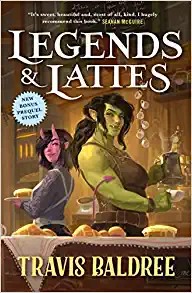
Legends & Lattes
Tor Books · 2022 · 296 pages
ISBN: 9781250888280
Review Editor
Marcus Webb
Viv has been an adventurer for most of her life, and she is tired. At the start of Legends & Lattes: A Novel of High Fantasy and Low Stakes, Travis Baldree’s debut novel, this orc warrior arrives in Thune, a mid-sized city that doesn’t know her name or owe her anything, and sets about doing something no one in her old life would have predicted: she opens a coffee shop. She has a lead on a building, a single coffee bean she found on a long-ago job, and the conviction that she is done with swords. That is the entire premise. There is no dragon threatening the city, no ancient prophecy requiring her particular skills. She just wants to make coffee.
What Baldree does with this deliberately small premise is the most interesting thing about the book. The author spent years as a professional narrator of fantasy audiobooks before writing his own fiction, and it shows in the confidence with which he handles tone. He knows exactly what register he’s working in. Legends & Lattes is cozy fantasy: a genre that borrows the trappings of epic fantasy (the orc protagonist, the tavern-district setting, the halfling musician who plays for tips) while deliberately abandoning the high stakes. No one’s going to die for a plot reason. The world will still be here tomorrow. The central conflict is whether Viv can make her shop work and whether she’ll let herself be happy. That’s it, and Baldree commits to it completely without ever winking at the reader about how small it all is.
The shop takes shape over the novel’s first act: a run-down building rented by Viv, gradually hammered into something habitable with help from a wry contractor and eventually staffed by a rotating cast of characters who wander in and become, more or less by accident, a found family. Chief among them is Tandri, a succubus who shows up looking for work and turns out to be far better at running a cafe than Viv is. Where Viv is blunt and competent and constitutionally bad at small talk, Tandri is observant, warm, and fast with customers. The romance between them develops at a pace that would be described as glacial in most novels. Here it feels right.
Character Arcs and Development
Viv is the kind of protagonist fantasy readers rarely get to spend time with: she’s past the part of her life that would usually be the story. Her adventuring years are backstory. What the reader encounters is a person trying to figure out who she is when she isn’t fighting, and that is a genuinely uncommon subject for the genre. She is competent in the way that people who have survived hard things are competent, but she keeps running into the limits of that competence: she can handle a mugger, but she can’t charm a skeptical regular into ordering from the new menu. Watching her learn to ask for help, and to accept it when it arrives, is the book’s emotional core.
Tandri arrives as a mystery and slowly becomes legible. The book hints at a difficult history without detailing it, and that restraint is mostly earned. What matters more than her past is her present: she notices things, she manages people, she quietly becomes indispensable. The romance between Viv and Tandri is slow in a way that might frustrate readers looking for heat but will satisfy anyone who has been rewarded by patience. Baldree is interested in two people learning to trust each other, and the physical relationship, when it finally develops, lands because you’ve spent the whole book watching them look out for each other in small ways.
The supporting cast is drawn with a lighter hand but still leaves impressions. There’s a rattkin who works behind the scenes and says very little but gradually becomes the shop’s mascot. A gnome who bakes pastries and treats the project with the seriousness of a professional. A halfling musician who starts playing evenings and brings in the regulars who turn the Lattes from a coffee house into a community. These characters don’t get arcs of their own so much as they get textures, small details that accumulate into people you’re glad to check in on. None of them are thin exactly, but they serve the novel’s project, which is less about individual transformation than about collective flourishing.
Pacing
The pacing is as unhurried as the genre advertises. Chapters are short. Days pass. The shop opens, gains regulars, faces a supply problem, attracts a threat from a local criminal operation. None of these developments arrive with urgency. Baldree writes scenes about making coffee and talking to customers with the same attentiveness he gives to the one scene of genuine physical danger, and this either works for you or it doesn’t. If you come to the book wanting momentum, the first third will feel padded. If you come wanting to feel like you’re spending an afternoon in a pleasant place, those same chapters feel generous.
The antagonist, a local enforcer who demands protection money and doesn’t take no for an answer, arrives in the book’s second half and gives the narrative a shape it wouldn’t otherwise have. The threat is real enough to create stakes without ever feeling like it might derail the book’s fundamental warmth. If anything, it clarifies what the novel is: this is a story about what it takes to make something, to hold onto it when people want to take it from you, and to build community in the process. The villain is the least interesting thing in the book, which is probably the point. The point is the coffee shop.
Deeper Thematic Exploration
The subtitle, “A Novel of High Fantasy and Low Stakes,” is playful, but it points at something real. Baldree is interested in what the fantasy genre leaves out when it only tells stories about world-saving and chosen ones. Viv’s retirement is not a failure; it is a choice, and the novel takes that choice seriously. She is a person who is good at violence and has decided to stop using that skill, which is harder than it sounds in a genre that consistently treats combat ability as the most valuable thing a character can possess. The fact that her martial competence occasionally surfaces (she can still intimidate people when she needs to) is handled without celebration. It’s a tool she has, not an identity she’s happy about.
The novel is also, without making a big deal of it, a queer love story. Viv and Tandri’s relationship is same-sex and treated as entirely unremarkable within the story’s world. No one comments on it. There’s no prejudice to overcome on that front. Baldree’s fantasy world is quietly inclusive in a way that serves the book’s broader argument: that rest, love, and belonging are available to people who have historically been told to stay on the margins. The found family that forms around the Lattes includes characters from several fantasy species who would not share a table in a more traditional adventure story. Here they share a coffee counter and argue about pastry recipes.
There’s a subtler argument beneath the domestic warmth, one about what happens after the standard hero’s journey ends. Most fantasy novels end when the protagonist succeeds. This one starts there. Viv has already won. She just doesn’t know what to do with herself in the aftermath. That framing resonates differently depending on where you are in your own life; readers in transition, between jobs, between relationships, figuring out what comes after the chapter they thought defined them, tend to find the book lands hard. The coffee shop is a metaphor without being an allegory. It is literally a coffee shop, and it is also proof that you can build something good from scratch.
Style and Voice
Baldree writes in a close third person that stays tight to Viv’s perspective without disappearing entirely into her interiority. The prose is clear and warm without being precious. He describes physical spaces well: the Lattes feels like a real place, with its repaired counter and its mismatched chairs and the particular smell that coffee shops have when the first pot of the morning is done. There are no passages of ornate description, no moments where the sentences strain for effect. This is exactly right for the genre. The novel’s pleasures are cumulative: small observations, small conversations, small kindnesses that add up over 296 pages into something that feels substantial.
Readers who came to the book through the audiobook (narrated by Baldree himself) will note that the prose carries something of the narrator’s cadence. Sentences are paced for listening. The dialogue is clean and characterful without being showy. Where the book’s voice is most distinctive is in Viv’s internal narration: gruff, laconic, occasionally surprised by her own feelings. She is not an introspective character by nature, which makes the moments when she has to sit with what she wants more effective. You can feel the effort it costs her to be honest.
Verdict
What Legends & Lattes offers is specific: warmth, a gentle pace, a love story that takes its time, a world where found family is possible and chosen peace is honorable. If those things appeal to you, this book will deliver them without disappointment. If you come to fantasy for plot complexity, villain depth, or worldbuilding density, you will find this slim novel’s pleasures elusive. The antagonist is functional rather than memorable. The world is sketched rather than built. The ending wraps up with a tidiness that suits the book’s tone but will read as too comfortable for readers who like their resolution earned the hard way.
That said, the book does exactly what it sets out to do. Baldree set out to write cozy fantasy with genuine emotional stakes and a slow-burn romance, and he succeeded in a way that launched an entire publishing trend. The imitators that followed it have, so far, mostly confirmed that the balance is harder than it looks. If you have been skeptical of the cozy fantasy label, this is the book to start with. It earns the gentleness it is selling.
Frequently Asked Questions about Legends & Lattes
What is Legends & Lattes by Travis Baldree about?
Legends & Lattes follows Viv, a retired orc warrior who moves to the city of Thune and opens the city’s first coffee shop. The novel is about building something from scratch, finding community, and falling in love, all set in a low-key fantasy world where the stakes are entirely personal rather than world-saving. Think “what if a D&D character retired and opened a small business.”
Is Legends & Lattes a cozy fantasy book?
Yes, and it is widely credited with popularizing the cozy fantasy label. The book deliberately strips out the genre’s typical ingredients: there’s no dark lord, no epic quest, no chosen one. The central conflict is whether Viv can make her coffee shop work and whether she’ll let herself be happy. The pace is gentle, the cast is warm, and the ending doesn’t leave you shaken. That’s the point.
Is there a romance in Legends & Lattes?
Yes. The romance between Viv and Tandri, a succubus who becomes the shop’s main barista, is the emotional center of the novel. It develops slowly across the whole book. The relationship is same-sex and treated as completely unremarkable within the story’s world. Readers who enjoy slow-burn romance with a satisfying payoff will find this one rewarding.
How long is Legends & Lattes and is it a difficult read?
The Tor hardcover edition runs 296 pages. It is not a difficult read: the prose is clear and accessible, the chapters are short, and the world doesn’t require prior fantasy reading to navigate. Most readers finish it in a day or two. It’s the kind of book that’s easy to pick up and hard to set down, not because it’s suspenseful but because the setting is pleasant company.
Is Legends & Lattes part of a series?
Yes. Bookshops & Bonedust (2023) is a prequel set decades before Legends & Lattes, following a younger Viv during an early adventure. The two books work as companion novels rather than a traditional series: you can read either one first, though the prequel lands differently if you already know who Viv becomes. Baldree has indicated more books in this world are possible.
Did Legends & Lattes win any awards?
The book was a finalist for the 2023 Hugo Award for Best Novel and the 2023 Nebula Award for Best Novel. It was also a Goodreads Choice Award finalist for Best Fantasy in 2022, a New York Times bestseller, and appeared on Barnes and Noble’s Best Books of 2022 list. The audiobook, narrated by Baldree himself, was named one of Audible’s Best Audiobooks of the Year.
How does Legends & Lattes compare to Travis Baldree’s other books?
Legends & Lattes is Baldree’s debut novel, which makes comparison limited. The prequel, Bookshops & Bonedust, shares the same world and general warmth, but it follows a younger, less settled Viv and includes more traditional adventure sequences. Most readers who love the coffee shop book find the prequel a pleasing companion rather than an improvement: the original still has the advantage of pure concept novelty.
Who should read Legends & Lattes?
You’ll love this book if you enjoy slow-burn romance, found family stories, queer relationships treated as ordinary, and settings that feel like a warm room on a cold day. It’s also a strong entry point for readers who are curious about fantasy but put off by thousand-page doorstoppers and complex magic systems. You may find it too gentle if you need plot tension or morally complex antagonists to stay engaged. Know which kind of reader you are going in.
Book Details
- Title
- Legends & Lattes
- Author
- Travis Baldree
- Genre
- Science Fiction
- Publisher
- Tor Books
- Year Published
- 2022
- Pages
- 296
- ISBN
- 9781250888280
- WritersReview Rating
- 4.2 / 5